China may choke on own ambitions as country strives for global status
China's newfound strength is the source of deep ambiguity within the country. Global power and economic might fuel the idea of China's natural return to the status as a first-rate power it once enjoyed. But perceptions of national might also fuel "China threat theory," neglect the reality of China as a developing country, and go against domestic perceptions that other countries target China.
In cartoons in State media, China is far more likely to be portrayed as victimized panda than mighty dragon.
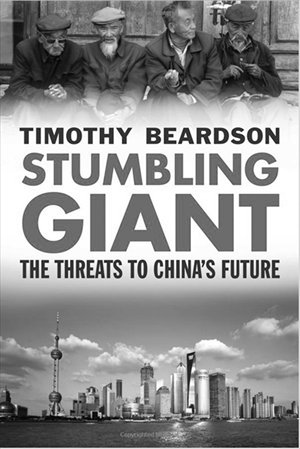
Tom Beardson's new book, Stumbling Giant: The Threats to China's Future, gives plenty of ammo to those who highlight China's weaknesses, and the considerable obstacles the country faces in the quest to become a fully developed country.
Beardson, a Hong Kong resident and executive, draws upon a formidable array of statistical data to demonstrate the problems China faces, from an aging population to alienated neighbors, a degraded environment, and rampant corruption.
Beardson doesn't deny national efforts to tackle these issues, and strives to put them in a global perspective, noting, for instance, that China's levels of perceived corruption put it only in the middling ranks, rather than at the bottom, of global charts. But the picture he paints is a bleak one, of a country where the problems incurred during the rise to its current status may ultimately cripple attempts to reach the top.
Many projections of China's future rely on the facile projection of current growth rates decades into the future, or on the blind swallowing of often flawed statistics.
Beardson emphasizes the unreliability of Chinese data, highlighting such anomalies as the national growth rate being significantly below the average of provincial growth rates, and drawing on central government statements about the problematic nature of many statistics.
A recent example was provided by the country's April trade statistics, which even China's foreign exchange authority has said are inaccurate as a result of false data provided by enterprises.
The book doesn't skimp on praising China for the country's many achievements, even if they aren't the focus of the book, but nor does it see them as justification for failures.
Beardson has a canny and fair eye for the problems of running a country of China's scale, and generally takes the Chinese government's stated goals at face value. But he also talks of the dangers posed by the spoiled and corrupt scions of the elite, and their role in cementing the massive wealth gap.
The weakest chapter is the historical one, where Beardson puts China's sense of national humiliation in the context of, as he sees it, its dominance by foreigners and outsiders over the past 1,200 years. While there's an interesting point in there, the sweeping statements and attempts to condense a hugely varied history into a few single points are not convincing. Fortunately, the author is much stronger on modern China, and especially on financial and technological issues.
The scope of the book is valuable, encompassing virtually every aspect of modern Chinese life. But it also makes the text heavy-going, not just because of the weight of footnotes, but because so much is crammed in that there's little space to give color or life to some of the descriptions of national problems.
A narrower focus and a lighter touch might make it more readable, but this is a very useful one-stop-shop for those looking for information.
Beardson's book is a valuable corrective to exaggerated fears of Chinese growth and power. It's also a sobering reminder of how far the country has to go before dreams of "national rejuvenation" can be achieved, and of the problems created in the wake of growth.
Publishers or authors of new works for review related to Asian affairs are invited to contact us at shumeng@globaltimes.com.cn.