HOME >> LIFE
Humayun's Tomb in New Delhi, India
Source:Xinhua Published: 2013-5-13 14:17:07
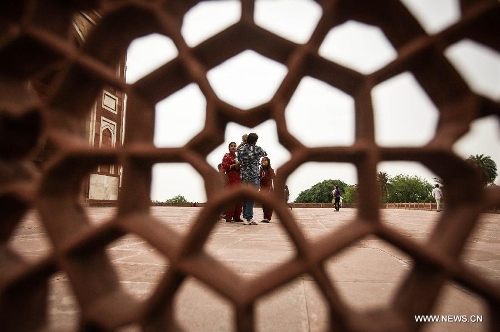
Tourists visit Humayun's Tomb in New Delhi, capital of India, May 12, 2013. Humayun's Tomb, located in east New Delhi, was built in 1569 to 1570 by Humayun's widow. As a precursor to the Taj Mahal, it stands on a platform of 12,000 square meters and reaches a height of 47 meters. The earliest example of the Persian influence in Indian architecture, the tomb itself is in the center of a large garden, surrounded by 12 hectares of gardens with pools joined by channels. The tomb brought Persian style to Delhi, but the two-tone combination of red sandstone and white marble is local, which shows the merging of different cultures. Humayun's Tomb was inscribed on the World Heritage List by the United Nations Educational, Scientific and Cultural Organization in 1993. (Xinhua/Zheng Huansong)
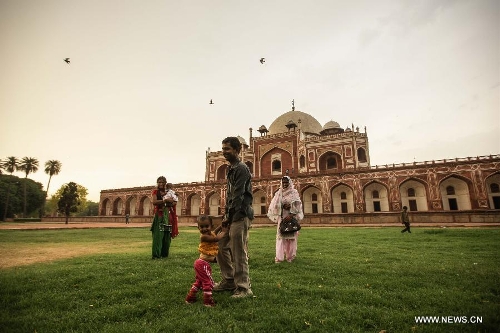
Tourists play on the lawn of Humayun's Tomb in New Delhi, capital of India, May 12, 2013. Humayun's Tomb, located in east New Delhi, was built in 1569 to 1570 by Humayun's widow. As a precursor to the Taj Mahal, it stands on a platform of 12,000 square meters and reaches a height of 47 meters. The earliest example of the Persian influence in Indian architecture, the tomb itself is in the center of a large garden, surrounded by 12 hectares of gardens with pools joined by channels. The tomb brought Persian style to Delhi, but the two-tone combination of red sandstone and white marble is local, which shows the merging of different cultures. Humayun's Tomb was inscribed on the World Heritage List by the United Nations Educational, Scientific and Cultural Organization in 1993. (Xinhua/Zheng Huansong)
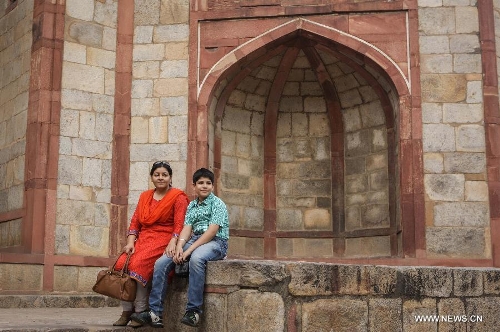
Tourists visit Humayun's Tomb in New Delhi, capital of India, May 12, 2013. Humayun's Tomb, located in east New Delhi, was built in 1569 to 1570 by Humayun's widow. As a precursor to the Taj Mahal, it stands on a platform of 12,000 square meters and reaches a height of 47 meters. The earliest example of the Persian influence in Indian architecture, the tomb itself is in the center of a large garden, surrounded by 12 hectares of gardens with pools joined by channels. The tomb brought Persian style to Delhi, but the two-tone combination of red sandstone and white marble is local, which shows the merging of different cultures. Humayun's Tomb was inscribed on the World Heritage List by the United Nations Educational, Scientific and Cultural Organization in 1993. (Xinhua/Zheng Huansong)
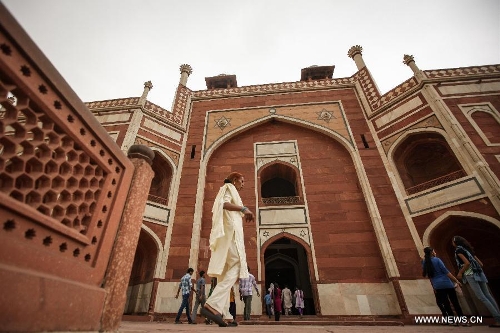
Tourists visit Humayun's Tomb in New Delhi, capital of India, May 12, 2013. Humayun's Tomb, located in east New Delhi, was built in 1569 to 1570 by Humayun's widow. As a precursor to the Taj Mahal, it stands on a platform of 12,000 square meters and reaches a height of 47 meters. The earliest example of the Persian influence in Indian architecture, the tomb itself is in the center of a large garden, surrounded by 12 hectares of gardens with pools joined by channels. The tomb brought Persian style to Delhi, but the two-tone combination of red sandstone and white marble is local, which shows the merging of different cultures. Humayun's Tomb was inscribed on the World Heritage List by the United Nations Educational, Scientific and Cultural Organization in 1993. (Xinhua/Zheng Huansong)
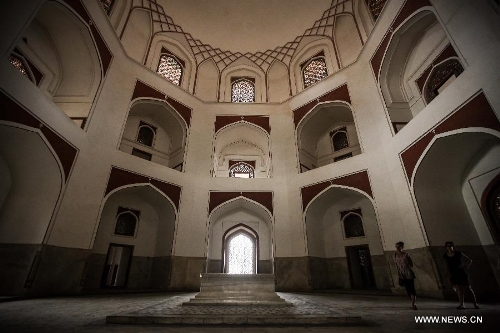
Tourists visit Humayun's Tomb in New Delhi, capital of India, May 12, 2013. Humayun's Tomb, located in east New Delhi, was built in 1569 to 1570 by Humayun's widow. As a precursor to the Taj Mahal, it stands on a platform of 12,000 square meters and reaches a height of 47 meters. The earliest example of the Persian influence in Indian architecture, the tomb itself is in the center of a large garden, surrounded by 12 hectares of gardens with pools joined by channels. The tomb brought Persian style to Delhi, but the two-tone combination of red sandstone and white marble is local, which shows the merging of different cultures. Humayun's Tomb was inscribed on the World Heritage List by the United Nations Educational, Scientific and Cultural Organization in 1993. (Xinhua/Zheng Huansong)
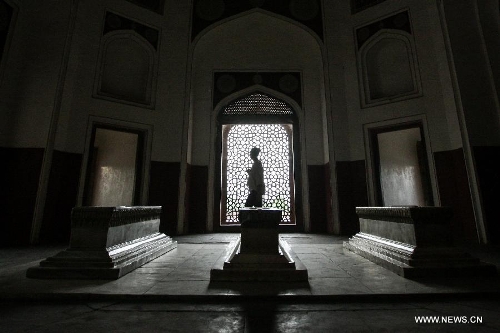
Tourists visit Humayun's Tomb in New Delhi, capital of India, May 12, 2013. Humayun's Tomb, located in east New Delhi, was built in 1569 to 1570 by Humayun's widow. As a precursor to the Taj Mahal, it stands on a platform of 12,000 square meters and reaches a height of 47 meters. The earliest example of the Persian influence in Indian architecture, the tomb itself is in the center of a large garden, surrounded by 12 hectares of gardens with pools joined by channels. The tomb brought Persian style to Delhi, but the two-tone combination of red sandstone and white marble is local, which shows the merging of different cultures. Humayun's Tomb was inscribed on the World Heritage List by the United Nations Educational, Scientific and Cultural Organization in 1993. (Xinhua/Zheng Huansong)
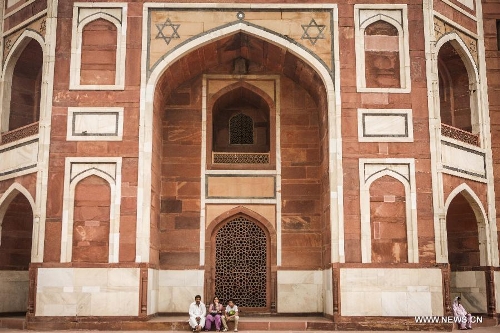
Tourists visit Humayun's Tomb in New Delhi, capital of India, May 12, 2013. Humayun's Tomb, located in east New Delhi, was built in 1569 to 1570 by Humayun's widow. As a precursor to the Taj Mahal, it stands on a platform of 12,000 square meters and reaches a height of 47 meters. The earliest example of the Persian influence in Indian architecture, the tomb itself is in the center of a large garden, surrounded by 12 hectares of gardens with pools joined by channels. The tomb brought Persian style to Delhi, but the two-tone combination of red sandstone and white marble is local, which shows the merging of different cultures. Humayun's Tomb was inscribed on the World Heritage List by the United Nations Educational, Scientific and Cultural Organization in 1993. (Xinhua/Zheng Huansong)
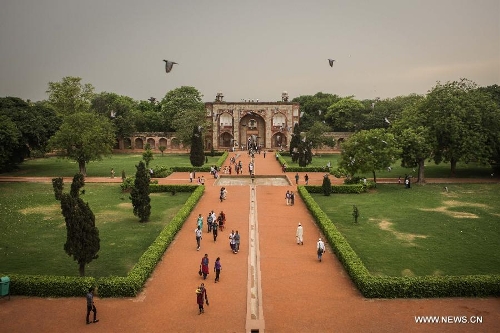
Tourists visit the gardens at Humayun's Tomb in New Delhi, capital of India, May 12, 2013. Humayun's Tomb, located in east New Delhi, was built in 1569 to 1570 by Humayun's widow. As a precursor to the Taj Mahal, it stands on a platform of 12,000 square meters and reaches a height of 47 meters. The earliest example of the Persian influence in Indian architecture, the tomb itself is in the center of a large garden, surrounded by 12 hectares of gardens with pools joined by channels. The tomb brought Persian style to Delhi, but the two-tone combination of red sandstone and white marble is local, which shows the merging of different cultures. Humayun's Tomb was inscribed on the World Heritage List by the United Nations Educational, Scientific and Cultural Organization in 1993. (Xinhua/Zheng Huansong)

A boy plays in the pool at Humayun's Tomb in New Delhi, capital of India, May 12, 2013. Humayun's Tomb, located in east New Delhi, was built in 1569 to 1570 by Humayun's widow. As a precursor to the Taj Mahal, it stands on a platform of 12,000 square meters and reaches a height of 47 meters. The earliest example of the Persian influence in Indian architecture, the tomb itself is in the center of a large garden, surrounded by 12 hectares of gardens with pools joined by channels. The tomb brought Persian style to Delhi, but the two-tone combination of red sandstone and white marble is local, which shows the merging of different cultures. Humayun's Tomb was inscribed on the World Heritage List by the United Nations Educational, Scientific and Cultural Organization in 1993. (Xinhua/Zheng Huansong)
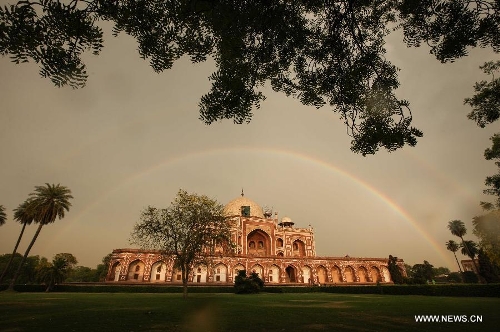
Two rainbows are seen above Humayun's Tomb in New Delhi, capital of India, May 12, 2013. Humayun's Tomb, located in east New Delhi, was built in 1569 to 1570 by Humayun's widow. As a precursor to the Taj Mahal, it stands on a platform of 12,000 square meters and reaches a height of 47 meters. The earliest example of the Persian influence in Indian architecture, the tomb itself is in the center of a large garden, surrounded by 12 hectares of gardens with pools joined by channels. The tomb brought Persian style to Delhi, but the two-tone combination of red sandstone and white marble is local, which shows the merging of different cultures. Humayun's Tomb was inscribed on the World Heritage List by the United Nations Educational, Scientific and Cultural Organization in 1993. (Xinhua/Zheng Huansong)
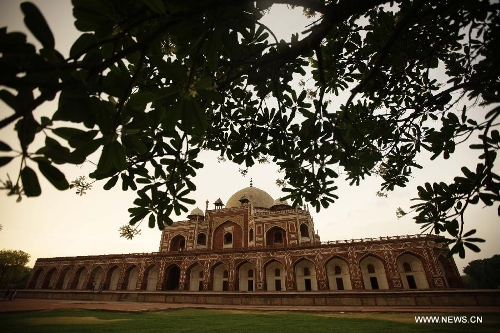
Photo taken on May 12, 2013 shows Humayun's Tomb at dusk in New Delhi, capital of India. Humayun's Tomb, located in east New Delhi, was built in 1569 to 1570 by Humayun's widow. As a precursor to the Taj Mahal, it stands on a platform of 12,000 square meters and reaches a height of 47 meters. The earliest example of the Persian influence in Indian architecture, the tomb itself is in the center of a large garden, surrounded by 12 hectares of gardens with pools joined by channels. The tomb brought Persian style to Delhi, but the two-tone combination of red sandstone and white marble is local, which shows the merging of different cultures. Humayun's Tomb was inscribed on the World Heritage List by the United Nations Educational, Scientific and Cultural Organization in 1993. (Xinhua/Zheng Huansong)
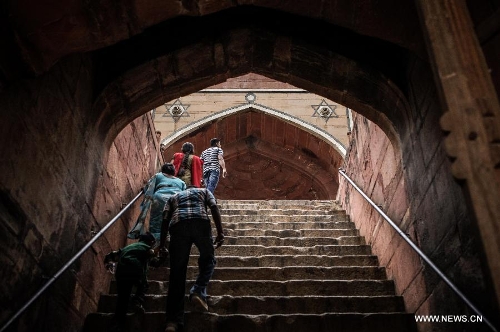
Tourists visit Humayun's Tomb in New Delhi, capital of India, May 12, 2013. Humayun's Tomb, located in east New Delhi, was built in 1569 to 1570 by Humayun's widow. As a precursor to the Taj Mahal, it stands on a platform of 12,000 square meters and reaches a height of 47 meters. The earliest example of the Persian influence in Indian architecture, the tomb itself is in the center of a large garden, surrounded by 12 hectares of gardens with pools joined by channels. The tomb brought Persian style to Delhi, but the two-tone combination of red sandstone and white marble is local, which shows the merging of different cultures. Humayun's Tomb was inscribed on the World Heritage List by the United Nations Educational, Scientific and Cultural Organization in 1993. (Xinhua/Zheng Huansong)
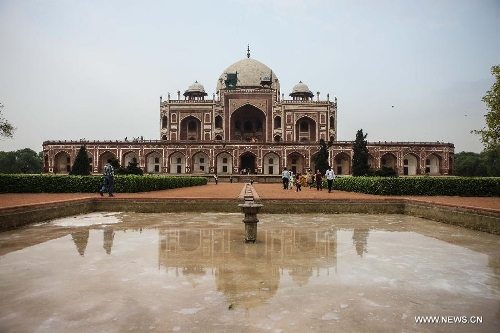
Tourists visit Humayun's Tomb in New Delhi, capital of India, May 12, 2013. Humayun's Tomb, located in east New Delhi, was built in 1569 to 1570 by Humayun's widow. As a precursor to the Taj Mahal, it stands on a platform of 12,000 square meters and reaches a height of 47 meters. The earliest example of the Persian influence in Indian architecture, the tomb itself is in the center of a large garden, surrounded by 12 hectares of gardens with pools joined by channels. The tomb brought Persian style to Delhi, but the two-tone combination of red sandstone and white marble is local, which shows the merging of different cultures. Humayun's Tomb was inscribed on the World Heritage List by the United Nations Educational, Scientific and Cultural Organization in 1993. (Xinhua/Zheng Huansong)
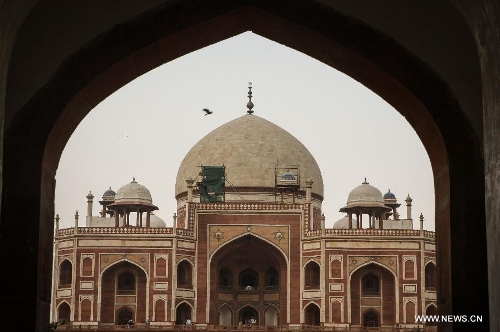
Photo taken on May 12, 2013 shows Humayun's Tomb in New Delhi, capital of India. Humayun's Tomb, located in east New Delhi, was built in 1569 to 1570 by Humayun's widow. As a precursor to the Taj Mahal, it stands on a platform of 12,000 square meters and reaches a height of 47 meters. The earliest example of the Persian influence in Indian architecture, the tomb itself is in the center of a large garden, surrounded by 12 hectares of gardens with pools joined by channels. The tomb brought Persian style to Delhi, but the two-tone combination of red sandstone and white marble is local, which shows the merging of different cultures. Humayun's Tomb was inscribed on the World Heritage List by the United Nations Educational, Scientific and Cultural Organization in 1993. (Xinhua/Zheng Huansong)
Posted in: Gallery