Cab drivers' blues
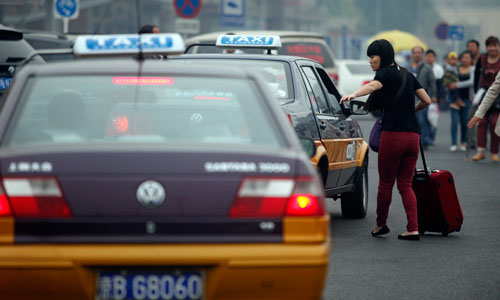
For Beijing's taxi drivers, new moves to boost their income can't come soon enough.
One driver, surnamed Zhao, said that every month he has to pay a taxi company contract fee of more than 5,000 yuan, averaging 200 yuan per day. It has also become harder to make money as more people are taking the subway these days.
Zhao has been driving a taxi for more than 10 years, working 14 hours a day, six days a week. Saturday is the one day he gets to relax and spend time with his family.
Despite the long hours, his monthly income is less than 5,000 yuan and it is hard to make ends meet sometimes, he told the Global Times Wednesday.
"It's less stressful for me than drivers on a double shift (in which two people share one car per month). They have to pay an average daily contract fee of more than 270 yuan to the company," he said, adding that to earn more money, cab firms seldom offer single shift contracts at present.
Low pay and long working hours have cut the number of people who want to be cab drivers.
Data from the Beijing Municipal Commission of Development and Reform (BMCDR) on May 7 indicated that the number of people applying to become Beijing taxi drivers has dropped by more than 60 percent from 2007 to some 6,000 in 2011.
Fee increase
In order to improve the lot of taxi drivers, the BMCDR is considering raising taxi fares. It issued a draft of the plans on May 7, with a public hearing to be held on May 23.
The standard fee for the first three kilometers is set to increase from 10 to 13 yuan, and there are two suggestions for the fee per kilometer after that: One is to raise it from 2 yuan to 2.3 yuan and the other one is to raise it from 2 to 2.6 yuan.
A driver is expected to earn 0.41 yuan more per kilometer according to the first suggestion and 0.64 yuan more with the second one.
The BMCDR has ordered that taxi firms must not try to siphon the extra revenue for themselves.
The plans have been supported by some, but others have expressed concerns.
The taxi fare has not changed since 2006 but the price of fuel has surged in recent years, taxi driver Zhao noted, adding that the government's fuel subsidies are not enough.
For instance, the retail price of oil products in Beijing averaged around 4 yuan per liter in May 2006, while the current price reached to more than 7 yuan per liter.
"But I am worried that the added income will not go to the drivers, and that the contract fee may increase along with other fees like those for vehicle maintenance," said Zhao.
Taxi firms including Beijing Yinjian Investment Co and Beijing Beiqi Kowloon Taxi Co refused to comment when contacted by the Global Times.
Zhao also said he was concerned that the price hike will cut demand.
Price rise unpopular
Xiao Ning, a 27-year-old white-collar worker in Beijing's CBD, told the Global Times Thursday that if the price hike goes ahead, she will take public transport instead of taxis.
Xiao lives in Wangjing area, about 13 kilometers away from her office.
"During the rush hour in the morning, the subway and buses are crowded. At that time, I am used to taking a cab, costing me about 33 yuan. But with the price hike, I will have to pay more. I think I'd better get up a little earlier to avoid the peak hour and take the bus," she said.
Many other Beijing residents feel the same way. According to an ongoing survey by news portal sina.com, as of Monday, 85.1 percent of 3,091 participants did not support the policy.
A report by Beijing-based Horizon Research Consultancy released on May 7 predicted that 30.5 percent of Beijing residents will be less likely to take a taxi after the price rise.
"The price rise is a false measure. It will not lighten taxi drivers' burden and will make consumers more unsatisfied with the whole taxi industry," Sima Nan, an influential independent scholar, said on his Sina Weibo Wednesday.
The essential problems are that taxi firms do not want to make concessions over the high contract fees, while the authorities just support the firms and protect their benefits, he remarked.
Industry reforms needed
Raising the fare price is just a temporary compensatory measure, Zhang Lei, an economic analyst with the Beijing-based Minsheng Securities, told the Global Times Wednesday. Contract fees and a closed operating model are the real causes of drivers' low income in Beijing, Zhang said.
In 1996, the taxi industry authority classified the contract fee into four standards according to different vehicle types, at 3,000 yuan, 4,000 yuan, 4,500 yuan and 6,000 yuan, said Wang Jun, a professor at China University of Political Science and Law, who has studied Beijing's taxi industry for three years.
Firms are allowed to set their own contract fees within a 15 percent range of the official standards, but this is often carried out under the table and puts drivers in a disadvantaged position, Wang told the Global Times Wednesday.
The standards have remained unchanged since then, but it is hard for taxi drivers currently to earn as much as they did in the 1990s, due to competition from cheaper and more developed public transport, as well as the increasing use of private cars, he said.
Data from the BMCDR indicated that for taxis on single shifts, the monthly mileage fell by 520 kilometers in 2012 compared to 2008, with the number of rides decreasing by about 50.
The franchise mechanism also needs to be changed and the authorities should encourage more individuals to enter the taxi business, said Wang.
In the early 1990s, when Beijing's local government allowed individuals to get a license to operate a taxi, more than 1,000 people applied, he said, as this enabled them to avoid paying contract fees.
But this stopped in 1994, as the government was concerned that too many self-employed people in the sector might be hard to manage, Wang noted.
A package of reforms will be seen in the sector and raising the taxi fare is just one of them, the Beijing News reported Thursday, citing Li Sufang, head of the price-setting department at the BMCDR.
Beijing's government is mulling various policies related to the supply of taxis and management of taxi companies and the franchise mechanism, in order to improve the industry's service, according to a statement from the Beijing Municipal Commission of Transport in April.
The self-employed business model, with drivers managed directly by the government, could help free the drivers from companies "oppression and exploitation," Sima noted.
Liang Jialing contributed to the story