NBS data indicates slow recovery: analysts
Editor's Note:
A series of indicators for China's economy for April were announced Monday by the National Bureau of Statistics (NBS), signaling moderate recovery in the economy after disappointing first-quarter growth data. But the indicators do not point to strong growth momentum, and some economists have expressed concern over the sustainability of economic growth, write GT staff reporters Li Qiaoyi and Song Shengxia.
The Monday announcement - which came after unexpectedly strong growth in April exports and in new yuan-denominated lending - indicated a lukewarm recovery of the Chinese economy, which economists say makes it unlikely there will be any shift in the country's current fiscal and monetary policies.
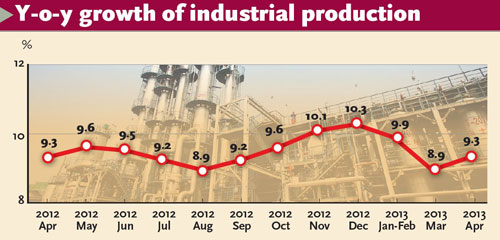
IP growth up only slightly
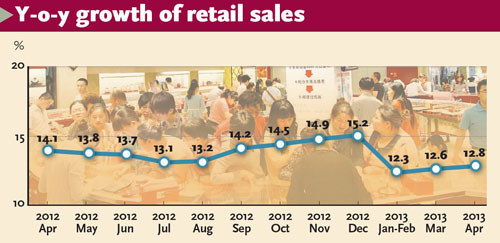
Retail sales improve
An improvement was seen in retail sales during last month, with the NBS data revealing a rebound in growth in both nominal terms and real terms.
Lu Ting, China economist at Bank of America Merrill Lynch in Hong Kong, said in a note sent to the Global Times Monday that the higher growth was led by surging sales in gold bullion and jewelry, as many Chinese households joined a buying spree after a slump in gold prices during the month.
Sales of gold and silver bullion and jewelry saw a surge of 72.2 percent year-on-year in April, compared to a rise of 26.3 percent in March, according to the bureau.
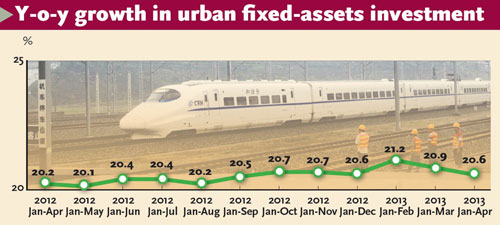
FAI figures disappointing
During the first four months, the country's urban fixed-assets investment (FAI) growth slowed to 20.6 percent from 20.9 percent during the first three months, according to the bureau.
Private urban FAI, which accounted for 63.5 percent of the total during the first four months, rose by 23.9 percent during the period, down 0.2 points from the reading for the first three months.
The FAI growth numbers are quite weak, Zhang Zhiwei, chief China economist at Nomura Holdings Inc in Hong Kong, said in a note sent to the Global Times Monday.
No big changes expected
Monday's economic indicators point to a lukewarm recovery in the economy, Tang Jianwei, an economist with Bank of Communications in Shanghai, told the Global Times Monday.
New yuan loans in April were above expectations, which Tang said could prop up growth later in the year, but for now the government is likely to stick with the current prudent monetary policy rather than introducing any policy shift.
Standard Chartered Bank's Shen also said a policy shift was unlikely. The disappointing FAI growth figures in particular are a reflection that the country's new leadership is keen on rebalancing the economy, which may put the growth readings under threat but can help avoid big structural risks, Shen noted.
China's economy has been losing growth momentum, and the government should carry out deep structural reforms to maintain the sustainable strength of the economy over the longer term, Tang said.
To address challenges confronting the economy, the new leadership has maintained a prudent policy stance while announcing a series of moves to loosen government controls so as to inject more vitality into the economy amid global uncertainties.
Lu Ting also said that in April alone, a sharper drop was seen in overall FAI growth, to 20.1 percent from March's 20.7 percent.
Related story: Property market still recovering, despite renewed curbing policies