Pakistan to fine tune anti-terror strategy
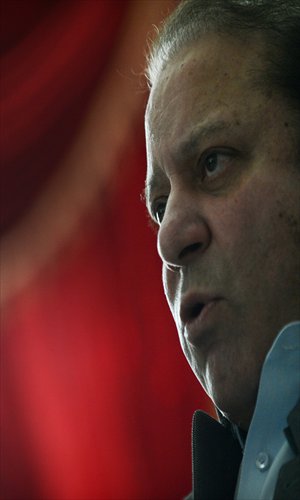
The future of Pakistan's strategy for the war against terrorism and its relationship with the US are in focus after former Pakistani leader Nawaz Sharif returned to power with his conservative Pakistan Muslim League-Nawaz (PML-N)'s overwhelming victory in weekend parliamentary elections.
Analysts said that while Islamabad will continue fighting terrorism and maintain its alliance with Washington, at the same time the new Pakistani leadership is likely to seek more non-military solutions to the issue and place more emphasis on the protection of its core national interests when conducting joint anti-terror operations with other countries.
Initial results declared by Sunday evening showed that Sharif's PML-N had captured 94 of the 272 contested National Assembly seats and it was likely to be able to make up the required majority of 137 with support from independents and small parties.
The polls marked the first time one elected civilian government was to replace another after a full term in office.
China on Monday congratulated Pakistan on its smooth general election, pledging continued firm support for the country.
"China is glad to see that Pakistan's general election has been smoothly held. China welcomes and congratulates this," Chinese Foreign Ministry spokesman Hong Lei told reporters. "We are convinced that with joint efforts, the China-Pakistan strategic cooperative partnership will be lifted to a new level," he added.
During his election campaign earlier this month, Sharif said Pakistan should reconsider its support for the US war on Islamist militancy as the military is not the best way to deal with the insurgency, according to Reuters.
The PML-N has also been criticized for its "soft" policies regarding militant groups in its stronghold of Punjab province.
But observers believe that Sharif is actually taking a more pragmatic approach regarding Islamist militancy and Pakistan's relationship with the US, which could be seen by the fact that he was less vocal against US drone strikes compared to cricket star Pakistan Tehreek-e-Insaf party leader Imran Khan.
"As he had promised to his supporters in the campaign, Sharif knows that military means alone cannot deal with the threat of Taliban. He will also try to negotiate more and seek tribal reconciliation and better governance," Fu Xiaoqiang, a professor on South Asian affairs at the China Institutes of Contemporary International Relations, told the Global Times.
Regarding the relationship with the US, Sharif will keep some distance between Islamabad and Washington, carefully gauging the domestic response while trying not to let the bilateral relationship deteriorate, while also attempting to influence US assistance for the war on terror, according to Fu, who also noted that the US and Pakistan have been cooperating for over 10 years, and breaking such an alliance would be a result that neither side could afford.
"For Islamabad, Washington's aid remains very important now considering the grave economic and security situations at home," Fu said.
"What is most important is that we must never allow our soil to be used by anyone to create problems with any country in this world," Sharif was quoted as telling the Sunday Telegraph as it emerged he had won Saturday's election.
US President Barack Obama also said Sunday that Washington would continue to work with the new Pakistani government. "My administration looks forward to continuing our cooperation with the Pakistani government that emerges from this election as equal partners in supporting a more stable, secure, and prosperous future for the people of Pakistan," Obama said in a statement.
Wang Dehua, head of the South and Central Asian Studies Institute at the Shanghai Institute for International Strategic Studies told the Global Times that under Sharif, the relationship between Pakistan and India might also improve.
"In 1999, Sharif managed to invite then Indian prime minister Atal Behari Vajpayee for a historic visit to Pakistan," Wang noted.
India's Prime Minister Manmohan Singh wrote on his official Twitter page Monday that he hoped to chart "a new course for the relationship" between the nuclear-armed neighbors. And Sharif said Monday that he would be "very happy" to invite India's Singh to his swearing-in ceremony.
Aside from foreign policies, Sharif will also have to face major domestic challenges including improving economic development and energy security.
"Compared to his predecessors, the advantage for Sharif is that he can create a stronger government as he does not have to form a coalition with major opposition parties," Wang said.