Artistic evolution
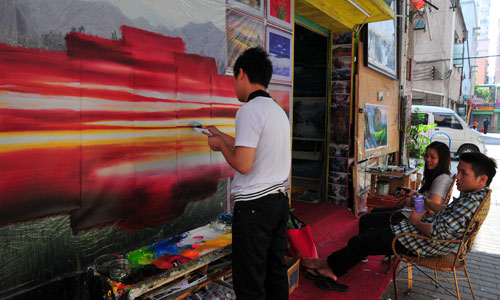
Anyone who traveled to Dafen Village in Shenzhen of Guangdong Province 20 years or so ago may find it hard to believe that the poor and unknown 4-square-kilometer place has become a center of art production, churning out millions of reproduced oil paintings every year.
Dafen Oil Painting Village was created in the 1990s, drawing people from all walks of life - farmers, workers, students or hair dressers - to paint Da Vinci, Van Gogh, Monet or any other master artist you can think of.
Dafen exports its products all over the world now and has made a fortune for many people who would have never left their farmland if not for this industry. By 2010, the yearly transaction figure reached 3.5 billion yuan ($570 million), according to chinanews.com.
However, 20 years since its start, Dafen Village is undergoing a kind of evolutionary transformation. Among all the challenges, the issue of copyright is on top of the list.
Recently, the Art Industry Association of Dafen Oil Painting Village (AIAD) and the village's general management office together with the Shenzhen City Bureau of Copyright have announced that a new online copyright recording system will be presented during China Shenzhen International Cultural Industries Fair (May 17-20).
Adapting to the changes
The modern-day story of Dafen starts in 1989 when Hong Kong businessman Huang Jiang arrived in Shenzhen to open commercial painting factories. Accidentally he found Dafen Village and established his business there. Since then, Dafen became a small society for art and started to develop its market.
At most companies in the Village, the production process is like an assembly line in which each person paints only a small part of a painting. There are also teachers to train the painting techniques.
The results were satisfactory enough for Dafen's market to rapidly expand until 2008 when the global financial crisis hit. In the relatively choppy waters since then, competitive firms have found it necessary to differentiate themselves from each other.
Artist Jiang Qingbei has witnessed the changes over the years. He came to Dafen Village 10 years ago. At the time, it had already developed very well into a place for reproductions.
Jiang felt that in such a big market, there should also be room for an artist like him to do his own work. Things turned out fine with Jiang's first exhibition attracting much attention and he has been in Dafen ever since.
"Things changed. It used to be easy to make a living by just copying the others but not anymore… Even reproductions need original elements to grab the consumers… The requirements for art workers increased," said Jiang.
He also explained that many artists who have solid skills usually have flexible cooperative relationships with businesses. Since the economic crisis in 2008 and orders from abroad dropped off, the artists also began to work on their own.
Luan Liyin, director of AIAD, told the Global Times that with the development of Dafen Village, over half of the Village's big companies have created research and development departments to work on product design.
"A customer who bought a painting here would find there is another one hanging there when he comes back a few days later. People now want to have their one-and-only artwork. Originality is essential," said Luan.
As originality takes a front seat, the issue of copyrights has become increasingly important.
Online copyright system
Jiang explained that the "originality" does not necessarily mean a totally new painting. It can also be seen as a design of an art product from every aspect in the production process including the method a painting was produced and the original elements added in a copied artwork.
In the past, anyone who wanted to apply for copyright protection needed to submit photos and descriptions of the work to the regional or state copyright bureau. After a few days to accept the submission, it would take another month for approval.
The new system that will be shown this Friday is called TSA (Time Stamp Authority) and is intended to shorten the process. Applicants register online with the Shenzhen City Bureau of Copyright and get an identity number for each creative idea from first sketch to the finished work.
The system will make it convenient for people who want to borrow the concept of an artwork to develop spinoffs.
"In this case, if we want to attend any event in a few days time, the application will provide a record on the system in order to protect our copyright. It saves a lot of time," said Luan.
He added that another project in development is a barcode system with product information provided by the city's copyright bureau. Information such as who made the piece, when it was made and how many of the items have been sold and to which countries will all been included.
Through a trial program in late April, several companies have used the system and over 10 artworks have successfully obtained an "e-certificate."
Possibilities for the future
China's art community usually has a prejudice against painters from Dafen, since the "Dafen" tag is often associated with endless reproductions. But in spite of that stigma, the trends of Dafen correspond to the Chinese art market as a whole. Unlike many artists who can paint whatever they want, artists from Dafen think more about what the market will accept.
"Everyone who comes here has to face the examination of this market and adapt themselves to speaking a market language within their specialties. Many people come and go because they can't survive here. But the market has often proven that paintings favored by the market are mostly of the highest quality," said Jiang.
Although the percentage of artists who only work on original paintings is still low compared to reproduction painters, Dafen Village is moving and contributing to art development in China.
In 2010, one of Dafen painter Ma Yingliang paintings sold for 1.05 million yuan ($170,000). Prices over 100,000 yuan are common for some artists there.
On the other hand, as the business grows, space remains limited, and rents have increased over the years, making life tough for many shops and artists. Future transformation seems inevitable.
Luan said the local government plans to expand the area to almost three times its current size. Beyond a boost in real estate, Luan is thinking about developing the place into a more commercial area where people can spend some leisure time.
"Many people come to buy artwork and find it hard to find a good restaurant or café. We just don't have such places yet," said Luan.
Many art zones in China are just places for artists to work together. The commercialization of such art zones is often seen as a negative trend. But Dafen Village was a commercial center to begin with. So, according to its business model, the plan sounds like more natural evolution.