Out of history and into comfort
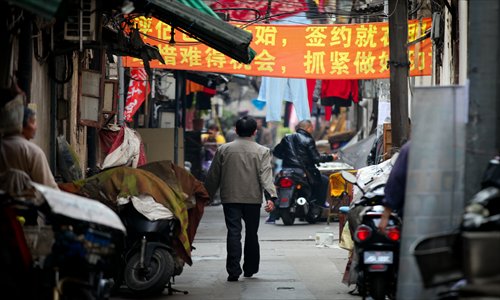
Cheng Zhonghai is having trouble sleeping at night. "I've been waking up at three o'clock in the morning for almost a week. I know I am going to miss living here but I'm really excited at the idea of moving." The neatly-attired 61-year-old is one of the 10,851 registered residents who lived at the East Siwenli on Xinzha Road in Jing'an district, one of the largest longtang (lane) neighborhoods in Shanghai. The century-old longtang, which spreads over 40,000 square meters, will soon be torn down to make way for a commercial development backed by the government. The compact brick-sided laneways will be replaced by towering office blocks and malls.
More than 80 percent of the residents of East Siwenli have moved out - to Pudong's Sanlin and Hangtou towns, to Gucun in Baoshan district, and to Taopu in Putuo district. The Chinese character "kong" (vacant) has been painted in red on the locked wooden doors and peeling brick walls of most of the houses there. Peering in through the grubby windows, all that remains inside the abandoned homes are scraps of newspaper and bits of furniture.
Cheng was among the last in his row to move. With only a handful of neighbors remaining, he has grown accustomed to greeting his old friends in the narrow longtang not with a cheerful "Hello" but asking, "When are you moving out?" The local demolition and relocation office has urged all the households that have signed contracts to move out by next week.
Middle class
East Siwenli was built in 1914 over a vast, weed-filled cemetery. A British Jewish businesswoman bought the cemetery from its Chinese owner and built 39 rows, or 706 units of shikumen (traditional Shanghai-style houses with stone gates) there, divided into two blocks by Datian Road.
The eastern block, with 21 rows and 388 units, was named East Siwenli. West Siwenli with 18 rows and 318 units was built in 1918. Together east and west formed the largest longtang neighborhood in Shanghai.
The buildings were designed as the new-style shikumen houses, a combination of traditional Chinese architecture and Western terraced homes. Each row in the longtang consisted of 18 to 24 identical two or three-story shikumen. Each house comprised a courtyard, living room and kitchen on the ground floor, and bedrooms on the second. They were designed initially for middle- and upper middle-class families.
The development was not so popular in its first few years - not many people wanted to live over a cemetery and Xinzha Road was far from the city center at that time. The first major influx of residents happened after 1937 when the War of Resistance against Japanese Aggression (1937-45) forced many residents from Zhabei, Yangpu and Hongkou districts to move into the neighborhood, which was in the International Settlement and then safe from Japanese soldiers. The Cultural Revolution (1966-76) and the return of the zhiqing (educated youth) saw another population boom for these homes. Many were subdivided and accommodated four to five times the number originally intended.
Overpopulation and time bred problems. "There is no sunshine, and it's dark and wet inside. The walls are not soundproof and we have to whisper if we want to talk about private matters. Rats have become common as well," Cheng said.
West Siwenli was demolished in the early 1990s, and the 22,875-square-meter area was later turned into a residential and commercial development.
A new home
On Monday, Cheng received the keys to his new apartment at Gucun, Baoshan district. The apartment is in a new neighborhood which was built as affordable housing, about 20 minutes' walk from the nearest metro station Liuhang which is 15 stops from the city center.
The 76-square-meter apartment is part of the compensation he received for the relocation. Another apartment, about 97 square meters in size and close by this one, along with 950,000 yuan ($154,501) in cash will be handed over after he moves out of East Siwenli. The two apartments and the money are worth altogether 2.65 million yuan.
Cheng's son drove him and his wife there in his brand-new Passat, bought just a week ago and still to have a license plate attached. "I'm so happy. A year ago we couldn't afford to buy an apartment even if we used all our savings and sold our house, and now we have an apartment, our son's got one too and a car."
Cheng said he was the first to sign the relocation agreement. "I needed the apartments. How can my son get married without a proper apartment? He's 32 years old and good-looking, but can't find a girlfriend. Girls want to know if he has a car and an apartment. I was under huge pressure."
On April 2, when the 2,194th household of the 2,580 households in East Siwenli signed the contract agreeing to move, the entire neighborhood suddenly erupted with celebrations and fireworks. With that contract signed, 85 percent of the households had then agreed to move - 85 percent is the number needed by law for a relocation project to go ahead.
Cheng drew No.78 in the relocation draw - he was the 78th person to select the apartments he wanted from those being offered to the East Siwenli residents.
"I was kind of lucky to be No.78. I chose the eighth floor because it's not too high or too low," he said. "I will get used to the new life."
A vanishing address
One Sunday afternoon, at the suggestion of his nephew, Cheng carried an old chair outside his front door of his former home. Standing on the chair, he unscrewed the green address number plates from the old peeling black wooden gate.
"This is for me to remember this place. No.177, Lane 568 Xinzha Road. This address will not exist in the future." As well as the numbers, Cheng, who describes himself as a nostalgic man, is also going to take his 20-year-old bicycle and hundreds of books to his new apartment. "I don't want to leave anything behind - that's why I haven't moved out yet."
When Cheng first arrived here some 30 years ago, his son was an infant. After he grew into adulthood, Cheng added an extension to the house to make a bedroom for his wife and him.
Even for Cheng who is eager to move, the longtang community spirit will be really missed. His neighbors were also his friends, and it was hard not to bump into someone you knew on the way to work.
Cheng's most cherished memory is of summer times when each home carried deckchairs into the longtang and had suppers outside. "The food could be smelled from the gate and you could see what the Zhang's, the Li's and the Mao's were eating. And there were chats. They were great times."
Not every one is as happy about relocation scheme as the Cheng family. The Liu's are among the 200 or so households that have refused to accept the compensation plan and move.
Mrs Liu said, "It's not that we don't want to move out, but they didn't include all the area that should be included in the calculations for compensation. Our courtyard and the attic space should be counted as well."
Liu said that there were six people under the hukou (household registration), including her brother and sisters and two children. "We're six families, and the compensation offer is only enough to buy two apartments. It doesn't solve our problems."
All of the Liu family actually moved out of the shikumen home years ago and rented it to migrant workers for 1,780 yuan a month. They now rent apartments near the Longhua Temple in Xuhui district.
"We haven't talked to the demolition and relocation office. We don't want to approach them first in case they think that we're feeling desperate."
At the demolition and relocation office, a three-story building located at the southeastern corner of East Siwenli, it is immediately obvious that something big is going on.
Huge posters of the relocation plans, compensation schemes, the number and names of residents who have signed the contracts alongside floor plans of the new apartments fill almost every inch of the walls. This is where residents can find out how the massive relocation is progressing.
Everything is printed out clearly in large type to ensure that older residents can read the official announcements, but modern electronics have also found their way into this century-old neighborhood. In the hall, a large screen shows the current percentage of people who have signed contracts (88.64 percent by May 14). Residents can check the numbers and floor plans of the available apartments on touch screens and see the total sum the government is spending on the project.
Lu is an official there and said that the most difficult part of the work was convincing households with complicated hukou or family arrangements. "These families are the most reluctant to move. They are the ones still here."
Most difficult
For Professor Zhang Linwei of the Department of Architecture at Tongji University, life in the cramped shikumen homes was a critical element in forming the Shanghainese character that sets them apart from people in the rest of China. "Back in the longtang days, people had to share the same house, kitchen, toilet and even water and electricity meters with their neighbors. Living like this they had to be practical, shrewd and even a bit worldly to keep their interests intact and avoid disputes. This is also why some attribute pettiness to the Shanghainese character," he said. Before 1949, more than 70 percent of all residential areas in Shanghai were shikumen.
The small subdivided houses also led to the Shanghainese attention to detail and the ability to make the best out of limited spaces and resources. "Many Shanghainese houses, although small in size, are exquisite and full of the spirit of life," Zhang said.
"Man builds architecture and architecture builds the man. The demolition and relocation of traditional shikumen will destroy the root of the Shanghainese character, but this is inevitable in a modern society. Commercially speaking, it's more efficient if commercial areas, not homes, are built in a city center."