Moments worth expressing
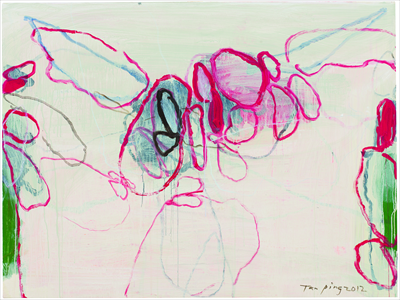
Last December, Tan Ping, vice-president of China Central Academy of Fine Arts, became the first artist to hold an abstract art exhibition at the main lobby of the National Art Museum of China (NAMOC). There, his famous print +40m, which took him six hours to carve, stunned many museum visitors.
For people who are not familiar with abstract art, +40m is just a 40-meter-long line on a huge painted board. But for Tan, the process was carefully prepared with detailed consideration of the materials and time used: in his work, every minute is counted.
"It's more than just a feeling of those moments. If there is more time left, the line would be shaped differently," Tan said. Before the exhibition, he went to NAMOC many times to see the space and prepare for his work.
This month, another group of Tan's works are exhibited at Meilidao Gallery in Beijing 22 International Art Plaza. Different from the exhibition at NAMOC, this time, Tan's focus is entirely on his "inner space."
Finding a path
Tan Ping developed his interest in abstract expressionism following the "85 movement" in mid-1980s. The way Tan and other artists were trained emphasizes the observation of a specific object.
Tan found that creating art based on a specific object made him feel constrained. On the track of breaking away from restrictions, he fell in love with abstract expressionism.
In 1989, Tan traveled to Germany to continue his studies: there his interest in abstract art grew. Tan said it was like coming home because abstract art was almost everywhere in Germany, especially in its industrial designs.
His understanding of abstract art has also broadened. Abstract art can be a representation of a microscopic part of a common object or a blurred image resulting from an artist painting with a specific item in mind. "The basis is that viewers would not identify the object immediately but develop very different understandings and feelings when seeing abstract art," said Tan.
Process over result
Over the years, styles or schools became less important to Tan, who believes that everything comes down to the value of self and the exploration of new possibilities in the process of expression.
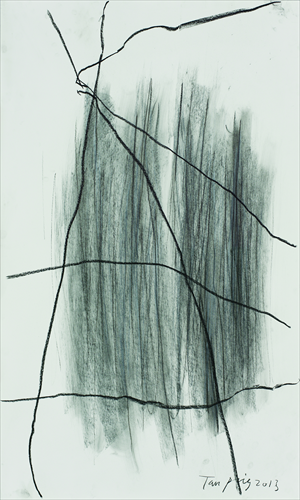
Tan usually sets up a certain time period like two or three minutes to work. He told the Global Times that painting for a long time would automatically make the painter "think" too much and as long as one starts to think, he would use a habitual way to achieve a result.
Within a self-allotted window of two minutes, the fast painting speed limits the time for thinking and allows the expression of emotion to come directly onto the canvas. "People may doubt that painting without thinking would be like a fool painting. But I had 40 years of art training, which means every time I draw, it includes the result of my past education and experience," said Tan, who describes his work now as "not-west, not-east," combining all his past experiences.
Tan explained that it is a general trend that many artists see the process and working method as more important than the result. Creating art needs new things and new feelings. Unless someone has unique talent, the same repetitive ways could hardly create a new world.
"Classical paintings were more about comparing the results of artists' works. Contemporary art, on the other hand, emphasizes the difference between individuals," said Tan.
Tan's way of working contains accidental conditions, suggesting that not every time could come out with a satisfying result. As he said, within 100 moments, there might be just two moments worth expressing. Instead of creating a new work, Tan often just continues to paint on the same canvas to create new possibilities for the work, adding layers to the work.
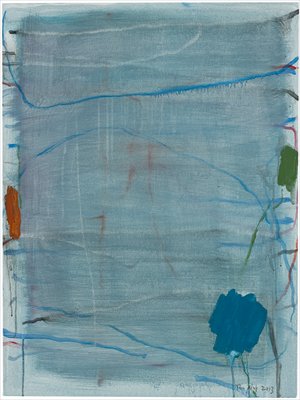
In 2009, one of Tan Ping's Cell series sold for over 504,000 yuan ($82,000) through Guangzhou Huayi International Auctions. In 2010, a Red series painting went for 392,000 yuan at International Co. of China.
Tan's success on the market is seen as the public's improved understanding of art and the pluralist cultural environment encouraging individuality.
In fact, there have already been several exhibitions of abstract art in different cities around the country this year. Li Lei had his exhibition in Shanghai during March and April while the exhibition of Shaanxi painter Liu Jiutong's Eastern Abstractionism just began a week ago at NAMOC.
Tan sees the increased number of exhibitions of abstract art as the result of two general trends. One is that people have seen a lot of pop art or realistic style and are looking for something fresh. The other trend is that as the understanding of art grows, more people find abstract art attractive and interesting.
"The works that ended up being collected are good art, not just average. There are people who understand it. The public's perception has changed to become more rational now," said Tan.
Most Chinese artists who paint abstract art have been through a tough exploration process of different styles or forms of art, often beginning with realism and gradually turning toward abstract styles. The act of "going inside" to seek inspiration requires an artist to be grounded in his own philosophy.
Such a way of working can be lonely and challenging, especially when so many artists gain their first experiences working on group projects or in different media forms. However, Tan finds painting abstract art entertaining, full of freedom and a sense of the unknown.
A professor at China Central Academy of Fine Arts, Yi Ying, put it this way: "In such a boom of commercialism, Tan is still so determined about his art ideal, like his works - extremely pure, but [they have] waves underneath."