One man’s fight to preserve evidence of Japanese wartime aggression
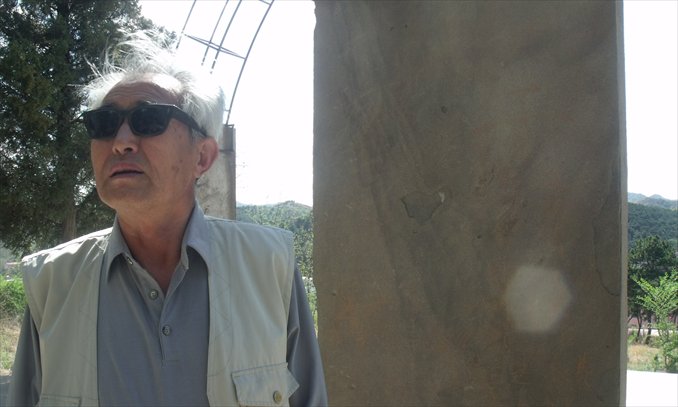
Climbing up concrete steps past modest bungalows scattered along the pathway, up to a barren hillside covered with weeds, on a cramped clearing where a shabby unmarked monument tainted by scrawls stands, a white-haired man shakes his head and sighs, "No one even cares about this place."
Located in Chengde, Hebei Province and about 230 kilometers northeast of Beijing, this is a mass grave where the remains of at least 36,000 people killed by invading Japanese troops during their occupation from 1933 to 1945 are kept.
Peng Mingsheng, a 75-year-old retiree in Chengde, has devoted almost half his life to researching the mass grave in the city, which used to be annexed as part of the Manchurian puppet state during the Japanese occupation.
Nearly 30 years have passed since he began his research. Although he has been calling on local authorities to set up a cemetery to better protect the site and commemorate the people killed for defying or fighting Japanese rule, the mass grave is still a barren wilderness, with a growing number of private buildings encroaching on the site.
"Japanese right-wing politicians have still been openly denying Japanese wartime atrocities recently. We must keep the evidence of their crimes," he said.
Sense of obligation
As a senior policy advisor at the Chengde Party History Research Center, Peng was assigned the task of studying the mass grave in 1984. Before that, Peng had never been involved in history-related work, but his commitment to it has continued ever since.
"At first, I didn't have much of an impression of the mass grave," Peng said. "But after I began my research by visiting families of the deceased victims, I feel a strong obligation to ensure that the historical facts of the mass grave are sorted out clearly. The people I visited, mostly aged 60 to 70, wept out their grief to me, and I got to know how tragically they suffered from the war."
During the research, Peng traveled across different provinces to visit the survivors, families of the victims and those who served the puppet regime, as well as to scour historical archives in libraries and even the State Archives Administration, where he was given access to confidential files.
Peng organized all the materials and wrote the book Zui Zheng (Evidence of Crimes) published in 1996, recording the cruelty of the massacres in China. Japanese soldiers frequently beheaded Chinese people who were carried in dozens of vehicles one by one for hours on end. When Japan surrendered in 1945, people found bones all over the area.
After retiring in 1997, Peng still devoted himself to raising awareness of the existence of the mass grave and its protection by giving speeches in schools, companies and government agencies. He has received some 70 Japanese people over the past 20 years who visited the site after they learned about Peng's investigation.
"Most of them came with a suspicious attitude," he said. "But after they found bones and listened to my explanations, they came to believe the crimes Japanese committed here and mourned for the victims at the site."
Peng had Japanese history textbooks brought by his Japanese friends translated at his own expense and wrote articles refuting what was said in the textbooks. Even today, Peng collects materials from newspapers and other publications about Japan's hostility to China.
"I don't care about other stuff, just news about Japan," he said. "Chinese people were tortured so much, and yet Japan denied the invasion. We have to refute them with firm facts."
Spreading the word
Concerned about children's lack of awareness of the mass grave and the anti-Japanese war, Peng began writing a book in 2004 about massacres nationwide, with each entry being briefly outlined.
Peng said that many history books are too big, and not suitable for adolescents who don't have much time to learn history.
After spending almost three years writing the book despite suffering disabilities in his fingers, Peng was still unable to get it published as the publisher in Beijing told him the content of the book may cause potential harm to the current Sino-Japanese relations, and market prospects for the book looked bleak.
While writing the book, which describes 1,062 massacres based on searches through a wide range of historical materials, Peng was surprised to find that as a single burial site, the mass grave in Chengde had the biggest number of victims killed by the Japanese in China.
This made him feel more obligated to protect the mass grave. He has petitioned the local government several times about setting up a cemetery on the site in recent years, but has not been met with a satisfactory reply.
Apart from the unmarked monument erected in 1963, two other monuments were set up by local and provincial authorities in 2010 and 2011. The first marks the location where the most bones were buried but stands at the wrong spot, and the second is barely noticeable on the side of the path.
"Just setting up monuments is not enough," Peng said. "Specific protection measures should be taken. Now, the site is just like an ordinary wilderness. People can't even find it if they are not familiar with the site."
However, Peng's efforts did have some positive responses. One woman from Tangshan, about 190 kilometers from Chengde, visited Peng in 2011 in a bid to find her deceased grandfather.
Fortunately, the martyr was among some 200 buried in the mass grave whose names were recorded in historical materials.
Lifelong responsibility
The local authorities' reluctance to give importance to protecting the mass grave, along with his unpublished book, hasn't discouraged Peng, even though he feels a little anxious.
"I don't feel disappointed," Peng chuckled. "I do my best and the decision is up to the government."
Cui Fengxiu, Peng's 80-year-old wife, feels empathy for her husband, but she discouraged Peng from going out to give speeches as he's getting older and suffering from severe hearing loss.
"He would definitely like to attend these activities," Cui said. "He's that kind of person: warm-hearted, takes things seriously and conscientious about everything he does."
But Peng feels so deeply obligated because he's the one who is most familiar with the issue, and along with his coworkers, is the only one sticking with the investigation.
"So many people died fighting the Japanese in the war and they left us better off," Peng said. "We should not forget them. For me, apart from reinforcing the message of the mass grave, my hands are tied. I just fulfill my responsibility."