Lap dog of luxury
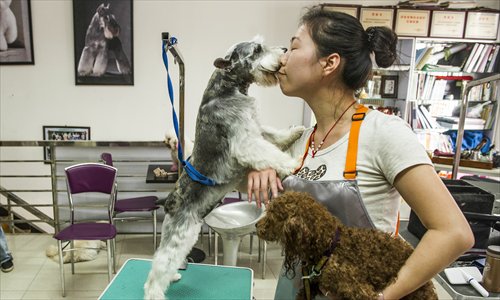
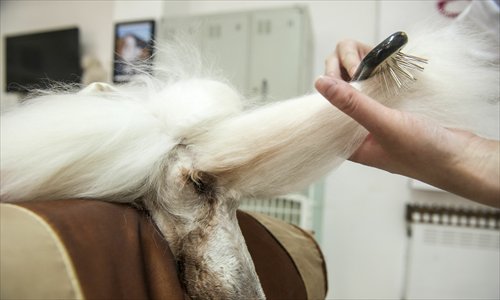
Inside the entrance to Ruowen Pet Salon, a female stylist stands at her workstation, braiding a long, white cloud of cotton candy fur. It belongs to a grown poodle, whose tender hind calves have been shaved to accentuate two bouffant haunches. Braiding a poodle's fur is a slow process, but the dog seems determined to persevere as it stares down a strand of loose fur dangling from its nose. Beneath the worktable, a store-owned Pomeranian named Liangliang wanders about the shop floor. He has been cropped and sprayed to look like a raccoon, a treatment that can cost creative dog owners 8,000 yuan ($1,302). When Liangliang frolics with a dog waiting to be picked up by its owner, he unwittingly repels his new playmate by letting it sniff the purple flower decoration painted on his back.
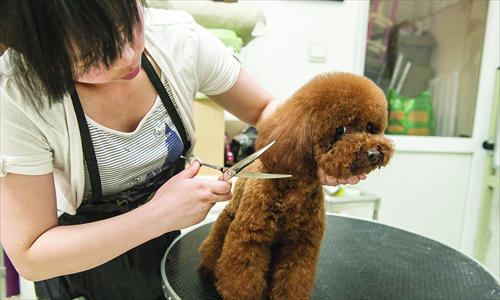
Founded a decade ago, Ruowen Pet Salon became widely known thanks to a rash of media coverage in 2010 for its unique take on pet grooming: spray-painting dogs to look like other animals. Their creations run the gamut from pandas to turtles. Since the relocation of Ruowen from Chaowai SOHO to Joy City, Chaoyang district, in late 2012, tastes have shifted from wildlife look-alikes to smaller breeds of dog that can be dressed up in dog-sized outfits. According to salons, the miniature, cocoa-colored breed of dog known as the teddy bear is currently taking Beijing dog lovers by storm. A typical teddy costs about 3,000 yuan. Raccoon-ified Liangliang has become passe.
New trends in Beijing dog fashions show just how far dog owners will go to indulge their four-legged companions. But knowing what is best for a pampered dog in Beijing can incite ferocious debate among owners and experts.
Hair of the dog
Sun Ruowen, 48, owner of Ruowen Pet Salon, gave Metropolitan a tour of her business while inspecting the work of several stylists stationed at different worktables. The salon continues to offer dog makeovers, which entail either their signature animal-design decoration, or beauty treatments such as hair braiding or dying fur bubble gum hues like pink or purple.
"The dyes we use might not be completely natural. They certainly contain complex chemicals," she says. "But the standard of quality we use is the same as with human cosmetics. They are totally harmless to pets in my view."
Sun says she often tries to dissuade her clients from wasting money on shaving or trimming dogs' fur, encouraging them instead to experiment with their dog's existing fur for a more attractive look. The walls surrounding Sun's office are hung with framed photos of Ruowen's proudest creation, a 1-year-old poodle named Gui Bin.
"She is a queen around here, though you won't see her often. She only walks around from time to time," Sun says.
Meanwhile, outside the dog salon iPet in SOHO Shangdu, packs of passersby frequently gather to peer through the window and catch a glimpse of stylists aiming industrial-sized blow dryers at windswept teddies.
Cheng Yue, 31, technology supervisor at iPet, sees royal behavior more from their human clients than any princely poodles. She remembers one male customer asking for a haircut on a dog as though it were his own.
"He gestured to his own hair, brushing it with his palm and saying he wanted his dog's cut to look natural, and insisted that we make take a casual approach to trimming it into style. Since when does a dog's hair ever look unnatural?" she says. (Perhaps she isn't familiar with Ruowen's work.)
Canine couture
Doting dog-owner Dai Tingting, 23, regularly conducts glamorous photoshoots for her beloved Kiwi, a 10-month-old Pomeranian, and posts them to Weibo. Kiwi appears in several shots with her abdomen and legs closely shorn, while her face, tail and feet sport voluminous bursts of soft, snow-white fur.
In the dog's short lifespan, she's already spent 100 yuan on clothing for him. But in the realm of extravagant dog divas, Kiwi sits on the more conservative side.
As dog owners move away from wild fur-ball creations and toward dog outfits, iPet kept up with the trends with their boutique that sells tiny hats, paw-sized shoes and T-shirts that read "I (heart) my dog." Dog accessories such as jewel-studded collars and decorative bows range in price from 300 to 2,000 yuan. Japanese brands are cheaper, around 300 to 400 yuan per item. Italian brands can reach up to 2,000 yuan per piece. Clothing is similarly priced depending on the brand.
Though she has not yet spent quite that much on Kiwi yet, Dai, a dog owner since the age of 8, takes the approval of online users toward her snapshots of Kiwi as a personal compliment.
"I think it shows I am a responsible and kind individual when people notice and comment on the effort I put into my pet," she says.
Vetting salons
Mary Peng, 40, cofounder and CEO of the International Center for Veterinary Services Beijing (ICVS) located on Futongxi Dajie, Chaoyang district, says she has no doubts about the love Beijing dog owners have for their pets.
"There's no difference between the way a Beijing owner relates to their dog and the way someone from another culture sees a pet," Peng says.
Yet as a specialist in animal health, she can't help but raise a few concerns about the dog grooming industry.
While Sun and Cheng both say the products their salons used to treat the dogs are the same as might be used to clean and color human hair, Peng differs in opinion to them about the use of human cosmetics on dogs. She says she believes most cosmetics designed for humans can put pets at risk.
"It should be common sense to make sure these products are appropriate for animals," she says. "I've seen many animals carried into our center that were seriously ill after having the wrong dyes used on their fur."
The adverse effects of using complex agents to beautify dogs have been recorded to include respiratory problems, vomiting and diarrhea. Peng adds that the difference in skin pigmentation and follicles between humans and dogs is what accounts for the symptoms in most cases.
"There was a regular black and white Siamese cat I remember once who came with all the worst side effects. Its body just couldn't handle the level of toxicity in the dyes that were applied to it," she says. "The same goes for those teensy weensy teddy dogs that are becoming more popular now."
Yet, owners who take the job of removing a dog's coat into their own hands are not always aware of the harm they are unintentionally inflicting. Peng says ICVS has received several cases of dogs in the past who have shown adverse reactions to their owner's self-styled treatments.
"In a dog's genital region, we've often found abrasions as a result of clumsy sheering, or in places where you really should try to avoid contact with an electric razor," Peng says.
Among the most shocking health problems dogs suffer after cosmetic treatment are claw infections following false nail fittings at dog salons, according to Peng.
But avoiding pet grooming altogether may not be the answer, either. Peng encourages shaving dogs to ensure they don't overheat in the rising temperatures of Beijing's sweltering summer season.
"The harm done to dogs that have their fur shorn in salons really depends on the breed. Dogs like Schnauzers are prone to grow fur that is matted and likely to tangle in humidity. This is bad for a dog, as it can cause abrasions and rawness if fur is left knotted for too long," she says.
The best advice, then, may be to consult a vet on your specific breed of dog before heading to the salon or picking up the scissors.
Lin Liang and Zhu Yuanyuan contributed to this article