Time to spend
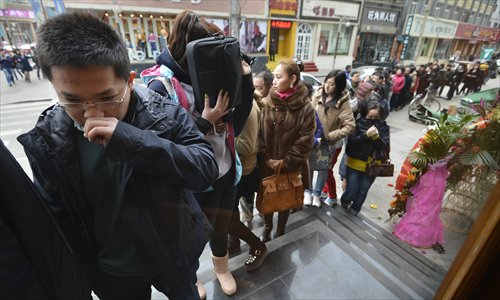
Wearing a floral brocade cardigan and toting a Huawei smartphone, Guo Qian, 22, gushes over her latest purchases on Taobao, China's largest e-commerce platform.
As an administrative worker, Guo makes only 3,000 yuan ($487.80) a month and spends most of it.
Not only does she spend nearly all of her own money, Guo also fritters away most of her father's 1,000 yuan monthly pension on trinkets and clothes on Taobao. "Sometimes I feel guilty using his money, so I buy him some clothes."
Guo, a Zhengzhou native, already owns an apartment - her parents helped finance the purchase last year - and is on the upward climb to join China's burgeoning middle class.
As Beijing tries to engineer a crucial macroeconomic shift - toward more consumption and less investment, the crucial "rebalancing" China's new leadership is committed to, and the rest of the world is counting on - it is young consumers like Guo who may hold the key to the transition.
Raised in an era of unprecedented prosperity, Guo, like many other members of what is known as the post-80s generation (anyone born after 1980), has a very different answer from her parents when it comes to a central economic question: whether to spend the money she has, or save it?
"I don't save at all," she told Reuters. "Why should I?"
Her "spend it if you've got it" attitude, some economists argue, may help unlock the surge in consumption that China urgently needs to rebalance its economy over the next decade, ending an era of lopsided, investment-driven growth.
Go west, young man
Today, cities along China's eastern seaboard account for about 35 percent of China's annual 18 trillion yuan retail spending. This reflects the extent to which cities such as Shanghai and Guangdong have prospered compared to the rest of the country since China's economic opening 30 years ago.
But surging income growth in China's interior - as companies shift manufacturing capacity away from the east, in search of less expensive labor and new markets - is shifting the economic balance of power in China.
"(There) will still be growth along the (east) coast. But it's in the first band of inland provinces - Jiangxi, Henan, Anhui - where you will see more significant growth in the consuming class," said Jeff Walters, Beijing-based managing director at the Boston Consulting Group (BCG).
"If you look at the coming years, you have a lot of consumers whose incomes are rising, and they are just about to cross the threshold into those levels of income where households are going to become more comfortable spending more."
The emerging comfort zone has important macroeconomic implications. Today, China's household savings rate is around 28 percent, among the highest in the world.
But continued strong wage growth is prompting Chinese households to loosen the reins on spending. In urban areas, average total income per capita has grown nearly 30 percent since the end of 2010, while disposable income per capita has also risen about 30 percent.
Where the growth is
The newly emerging economic landscape is most visible in Henan, the country's third-most populous province, where bucolic pastures have long since given way to crowded cities and construction cranes.
According to a report by the Economist Intelligence Unit (EIU), the province is now home to three of the fastest growing cities in China - Zhengzhou, Jiaozuo and Xinxiang.
The labor market has been steadily tightening, in part because China's aging population is reducing the number of working-age employees. In 2012, the number actually fell for the first time since China opened its economy more than 30 years ago.
In response, companies, both foreign and domestic, have been moving a massive amount of manufacturing capacity from the east to western and interior cities like Zhengzhou, taking advantage of lower labor costs and government tax incentives.
"Provinces like Henan have a big population base, and on top of that, the people are becoming richer and richer at a faster pace," said Louise Liu, deputy director of the EIU's Access China unit.
Chongqing, Hunan, Hebei and Anhui will also experience a boom in urban middle class and affluent households, according to a recent study by BCG.
Not only are these regions now growing more briskly than cities in the east, the behavior of consumers, market researchers say, is changing across provinces in China's heartland for concrete economic reasons.
Disposable incomes tend to be higher in places such as Zhengzhou and Chongqing, even if wages are slightly lower than they are in Beijing and Shanghai. A big part of the reason is that for all the talk of a real estate bubble in China, apartments are much more affordable in smaller cities throughout China's interior.
Guo already has her apartment, and she plans to buy another one with her boyfriend in two years.
"Lower housing and other costs in smaller cities mean households have more left over after basic living expenses to spend on discretionary items," said BCG's Walters. "This is a key reason why the lower-tier consumer who just crossed the middle class threshold tends to be more secure and willing to spend than their higher-tier city counterparts."
Savings less important
Economists who believe China's rebalancing is underway say population trends and income growth are only part of what will trigger a sustained increase in consumption's share of the overall economy.
Rising disposable incomes coincide with a change in psychology among younger consumers, a shift that means when it comes to money and spending they are decidedly different from their parents.
"We don't have that mindset to save all our money and worry about what will happen in the future," said Han Lingxiao, a law student in Jiaozuo, 90 kilometers from Zhengzhou. "We are more focused on how to improve our lives now."
Han moved from a poor farming county near Jiaozuo to study law at a city university. She says her younger brother who is only 12 will also follow in her footsteps and move to the city.
For younger consumers like Han, three decades of steady economic growth means that "perpetual optimism is the driver," said Ling Hai, China general manager for Mastercard. "They will not save as their parents have, and they will start to use tomorrow's money."
To be sure, a major economic shock of the sort that derailed the US economy in 2008-09 could similarly undercut China's. But absent that, many economists and market researchers now believe the shift in attitudes toward consumption will prove to be durable, even if the economy slows.