China's expanding house presses rest of global village
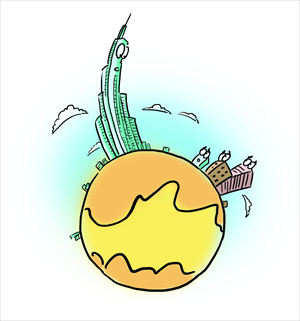
It's true that we cannot predict the future. Yet when we know how much snow has fallen on the Himalaya Mountains, we can predict flood levels six months later as the snow creates the floods. Similarly, a lot of snow has fallen on the global order, and we can see some of the flood of challenges to come.
One prediction in my new book, The Great Convergence: Asia, the West, and the Logic of One World, is that China will face an increasing series of global challenges.
Why do I say this? As former UN secretary-general Kofi Annan has said, we live in a small global village. And this village is shrinking day by day, but in the middle of this shrinking global village is one house that is expanding. That house is China, which has had the fastest growing economy for the past few decades.
Therefore, we should not be surprised if the remaining 5.7 billion inhabitants of our planet feel increasingly squeezed in the ever-shrinking global village by the ever-expanding house of China. Many will thus resent the rapid growth of China.
One critical challenge that China's leaders and people will face in the coming decades is how to manage the sentiments of these 5.7 billion people toward China.
I remain confident and optimistic that China can win over their hearts and minds. However, to do so, China's policy-makers must develop a deep understanding of the current global order and find new ways of managing it.
This is what The Great Convergence tries to do: provide a good understanding of the new world order that is being created.
Fortunately, there is a lot of good news in the world that we can celebrate. Wars, especially inter-state wars, have become a sunset industry. The number of people dying in inter-state wars is the lowest it has ever been since statistics began to be kept.
And we are well on the road to eliminating global poverty. In 2000, the UN established many Millennium Development Goals (MDGs) to be met by 2015. Many MDGs will not be realized but we will succeed in meeting the MDG of halving global poverty by 2015.
Along with this is an explosion in the middle class population. In all of Asia today we have about 500 million people enjoying middle class living standards. By 2020, this number will explode to 1.75 billion, an increase of 3.5 times in seven years. 670 million of this new middle class will be Chinese.
It is vital to emphasize that China has contributed significantly to all these positive developments and China should therefore join the world in celebrating them.
There are other challenges that may require greater effort. As we move inexorably toward becoming a global village, we also have no choice but to strengthen global village councils.
The Chinese people understand this well. They have lived in villages for thousands of years. They know well that the absence of strong village councils and strong village laws only leads to chaos.
The Chinese word for chaos is luan. To avoid luan globally, China should work actively to strengthen global village councils.
One dirty little secret is that it has been Western policy to keep all global village councils, including the UN family of institutions, as weak as possible. The West, especially the US, did this because it believed that the UN and other multilateral organizations would only constrain Western power.
One big strategic decision that China will have to make in the 21st century is whether it should join the West in weakening global village councils or formulate an independent policy of strengthening them instead.
As China is now the biggest exporting country in the world and also has to import natural resources from all over the world, it has a greater vested interest than any other country in sustaining and strengthening the current rules-based order.
This is why the time has come for China to consider the possibility of providing greater global leadership.
China can also provide leadership in seeding new ideas to make the world a better place. For example, Pan Jiahua of the Chinese Academy of Social Sciences has proposed that China develop an "ecological civilization." This is an excellent idea. If China can become one of the most environmentally responsible nations on planet Earth, it would help to develop more positive global attitudes toward China's reemergence.
The author is dean of Lee Kuan Yew School of Public Policy at the National University of Singapore.opinion@globaltimes.com.cn