Booking a place with fame
Two Hollywood blockbusters The Hobbit and Cloud Atlas drew big crowds when they screened in Chinese cinemas this year. And they also drew crowds into bookstores in China as the films sparked renewed interest in the original books.
Chinese readers can appreciate these books because of the work of Wu Gang who translated The Hobbit and Yang Chunlei who made David Mitchell's Cloud Atlas accessible to a home audience. The people who translate books, for the most part, remain unknown and retiring although some, because of the popularity of the works they bring into Chinese homes, achieve passing fame. But all these literary translators are united by their enthusiasm for their difficult and often poorly-paid work.
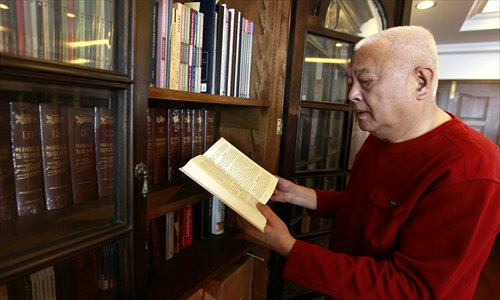
Last year Zheng Kelu, a 74-year-old retired professor, achieved a little fame when he won the Fu Lei Translation and Publishing Award for his translation of Simone de Beauvoir's classic French feminist tract, The Second Sex. The award was named after the Chinese translator and art critic Fu Lei (1908-66) who was best known for his translations of books by Voltaire, Balzac and Romain Rolland.
Huge undertaking
Translating a major literary work is a huge undertaking - the translator must take into account the style the original work is written in and the references and idioms the work contains.
When it came to translating The Hobbit, 43-year-old Wu Gang, now an associate professor at the Shanghai International Studies University (SISU), spent ages selecting the right words to bring The Hobbit alive for Chinese readers. He has been working on literary translations for 20 years.
The Hobbit by J. R. R. Tolkien was first published in 1937. It was nominated for a Carnegie medal and won a New York Herald Tribune prize for best juvenile fiction. It remains one of the most popular classic children's books and its popularity has been revived with the release of the first film in a trilogy being made by Peter Jackson. Wu's translation was approved by the Tolkien estate.
"Readers expect complicated language in The Hobbit because it's regarded as a prequel for The Lord of the Rings. However, the language was actually quite simple because the writer created the story for his little boy. The big challenge was how to deliver the humor and liveliness the writer expressed between the lines," Wu said.
After he was given a deadline in 2012, Wu spent five months working on the book. Every day he forced himself to complete 3,000 words. He believes that translations are not just about the correct words but they also have to convey the feelings and thoughts behind the words. "I tried my best to shape every character in the story with distinctive features, to make the story more vivid and interesting for children." Wu read his Chinese translation to his first-grade twin sons to see how they reacted to the story.
In contrast to The Hobbit, The Second Sex involves philosophy, biology, anthropology, psychology, medicine, sociology, history and literary criticism. Translator Zheng Kelu said that the process of translating this book gave him a great opportunity to broaden his horizons and learn about new fields. "I did my best to check background information and undertook related research to ensure I delivered an accurate translation."
Unlike the former translations which were based on the English translation (which itself has been criticized for inaccuracy), Zheng translated his version from the original French edition to avoid any of these problems.
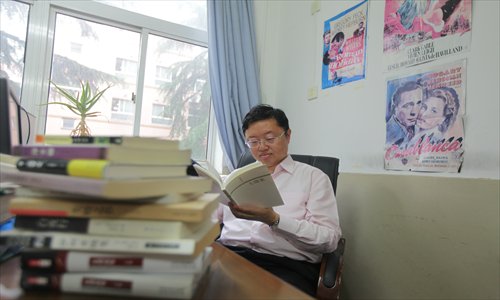
Translating books of this stature is not just a huge mental effort - it is also physically demanding. When working on a translation, Yang Chunlei begins by reading the book, relaxing on a sofa and when he is actually writing the translation he sits or stands at a desk.
Yang is also an associate professor at SISU and is mostly involved with linguistics. He spent most of his time outside of teaching translating Cloud Atlas. "I spent about three hours every day working on it and I had to give up some of my linguistics work."
Yang had never worked on a book as long or as complex as Cloud Atlas before. The award-winning and acclaimed novel was shortlisted for the Booker Prize. There are twice as many words in Cloud Atlas as in the similarly-constructed Gabriel García Márquez's novel One Hundred Years of Solitude, and many archaic words and expressions.
In his translation Yang had to shift between formal and colloquial expressions, using four-character Chinese idioms and dialect. "When I translate English poetry I also have to consider the historical and cultural background of the verse."
Yang also checked through other books and research material to translate the many created words the author invented using elements of Latin, French, German, Italian and Japanese. He also researched music, geology, navigation and botany.
Quality the key
Before these translators became known for their work, they spent years quietly working away unnoticed. Although they like the thought that readers can now enjoy these famous works, they do not expect any personal glory. They are not driven by market forces and bestsellers, but prefer to work on books of quality - not just Chinese translations of the most popular books available. "Whether it's a bestseller or not is not my business - that's solely the business of the publisher. I only want to translate good literature," said Zheng.
After graduating from Peking University in 1962, Zheng translated French literary works for more than 30 years. After he completed the first Chinese translation of Balzac's L'Élixir de Longue Vie, he didn't stop. His translations include The Count of Monte Cristo, La Dame aux Camélias, Les Misérables and The Second Sex.
Although Zheng loves the romantic aspects of French literature with handsome heroes and elegant ladies, he chooses his work with care. "I don't just translate anything a publisher offers. It's only quality and classic works that make me enthusiastic."
When a publisher asked him to translate an early work by Marguerite Duras, he turned down the offer because he believes L'Amant (The Lover) was the only book by that French writer worth translating.
He also refuses to translate modern bestsellers. "I won't live a long time. For me only books that will live for a long time are worth my efforts."
After he retired from the Shanghai Normal University in 2009 when he was 70, Zheng insisted on continuing to go to the office every day to translate. He spent all day there, sometimes staying until late at night - a habit that was curbed later that year when he had to undergo heart surgery.
"Since then I have restricted myself to less than three hours a day translating," the snowy-haired confidently-voiced Zheng told the Global Times. Unlike many traditional Chinese elderly men, he will not be keeping a bird in a cage or looking after a pet in retirement. His aim is to spend all of his life translating and reading. "I won't stop translating until the day I cannot read a word."
Zheng hopes he will leave the readers one or two books that turn out to be classic Chinese versions, as Fu Lei did. He is still keeping up with new words and expressions - "It's important to use the sort of language that modern readers are familiar with."
New approaches
Wu Gang started translating as a career after he graduated from SISU in 1993. It's also his hope to translate two or three major works that will become literary cornerstones even though they might have been previously translated.
Wu believes it's important to have a new translation of major works every 30 or 40 years because society changes along with language, culture and perceptions. "A new translation keeps pace with the changes and is a mark of the time. A translator represents the people of his or her time when he or she is doing the translation. As people have different understandings of books, a new translation can also offer a new approach."
But, he added, it was important that the new translation was always an improvement on the earlier works.
A good translator has to read a large number of books to constantly expand his or her language and knowledge. Wu reads nearly 150 books each year and takes notes on every book he reads. Although his favorite books are detective novels, classics and poetry are also found on his reading list. "Sometimes I translate in my mind as I read a book for the first time and sometimes I read parts of a book over and over again to reveal the deeper meanings."
Being able to accept suggestions is also a good quality for a translator to develop. One time when a cousin mentioned to Wu that every character in one of his translations seemed identical, he was taken aback. Now he tries to ensure that every character has distinct features and styles.
He also reads the final draft of his translations within two or three days of completing the work. "It's an essential process to ensure your book is at its best and is homogenous. A translator's skill sharpens during the translating if he's determined to create a better version. He can always learn something in the process."
Passion not pay
However, the passion and effort they put into their work and the fact that they are dealing with major literary figures are not matched by the pay they receive. Publishers pay translators between 60 yuan ($9.76) and 70 yuan per 1,000 words. Unlike their predecessors who became famous and made a lot of money translating major works, professional literary translators these days struggle to make a living.
Zheng said that at one time translators didn't need to worry about their earnings. "The translator Ye Shuifu could afford a Beijing courtyard residence in the 1940s with the payment he received for one book. I earned 7 yuan per 1,000 words after the Cultural Revolution (1966-76), when the average monthly salary was 50 yuan to 60 yuan. By translating a 60,000-word novel, I could then earn as much as an average salary for half a year. But today this barely equals the average one month pay for an ordinary office worker."
Because of this, few foreign language graduates choose a career translating literature and much of the work done today is of poor quality. "I found one translator who muddled Monday and Thursday - how stupid is that?"
Zheng said even fewer modern translators bother to spend time writing forwards for the books they translate although these are an important guide to readers and offer extra information about the book and its subject matter. However, he does believe that the few dedicated translators remaining will continue their work bringing great foreign works of literature to the Chinese.
Wu teaches at the Graduate Institute of Interpretation and Translation at SISU and said few of his students translate literary works as a full-time job because of the low rates of pay. "A very small number of graduates who are fond of literature spend a little time translating literature after work but it's hard to insist that they do this. Most graduates work on commercial translations."
Even so, Wu still believes that the art of translating literature will survive. "It is human nature to seek comfort from literature. Translators also find a satisfaction in this that other translations can never bring. In the process they feel they are also creating something great."
Wu said in an era when people are reading less and even less real literature, translators deserved praise and support. He admits that it is hard for publishers to pay more when the industry is in a crisis battling online books.
Yang hopes the pay will increase some time. "Nowadays most translators are translating in their spare time just out of love. More pay would allow translators to spend more time and create better work. I hope an effective system can be set up to protect the industry."