Charity should be a choice
Whenever a natural disaster strikes, there are always warmhearted people eager to donate money, clothes, food and even blood to help the needy.
However, the recent case of a fundraiser at a school in Shanghai, which allegedly involved pupils being forced to donate money for earthquake-affected victims, illustrates how important it is to go about fostering such sentiments in the correct manner.
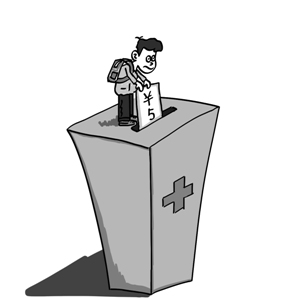
Students at Shanghai Zhoupu Town Elementary School in Pudong New Area recently complained that some teachers pressured them to donate at least 5 yuan ($0.81) each to aid the victims of the Ya'an earthquake as part of the school's fundraising campaign with the Red Cross Society of China (RCSC).
The pupils said some teachers would scold those who refused to donate money or gave less than 5 yuan. In one extreme case, a female teacher with more than 20 years of experience removed a 10-year-old girl from her post as class leader after the girl openly announced that she wouldn't donate a penny to the RCSC, a charity organization whose reputation has been tarnished by a chain of scandals in recent years.
When contacted by local media, Principal Gu of Zhoupu Town Elementary School confirmed the aforementioned case, though denied the school compelled any students to donate money. He also noted that 97 percent of the school's some 1,460 students have shown "their kindness" and thus raised more than 10,000 yuan via the RCSC for the quake-hit area. Although the principal finally admitted the teacher who stripped the outspoken girl of her post as class leader had made a "serious mistake," the school's officials haven't decided whether the teacher will be punished.
Gu's self-contradictory statements to the media cast doubt on the school's motives. In this particular case, I'd suggest the teacher apologize to the student for her condescending attitude and abuse of power. Everyone in today's world is entitled to choose what they want to believe in and shouldn't be punished for making such a choice.
At the same time, it should be recognized that compelling students to donate in this way will have long-term negative effects, as it sets a bad example in terms of respecting individual rights; while it may also deter them from willingly donating to charity later on in life. If even teachers, who are supposed to stand as role models, violate the principles of honesty and integrity, how can we expect our youth to develop good qualities such as kindness, honesty and righteousness?