Air wrangle
At a recent aviation industry forum in Beijing, officials from China Southern Airlines Company Ltd and China National Aviation Holding Company answered questions about a possible cooperation between the two firms.
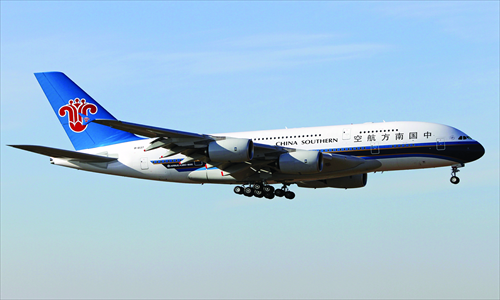
Guangzhou-based China Southern hit the headlines in 2011 when it became the first Chinese airline to acquire an Airbus A380, the world's largest jumbo jet, with more than 500 seats. Now, the company has five A380s, and it is the only Chinese airline operating the giant plane.
However, results for the company have been disappointing recently. China Southern saw its net profits fall by 82 percent year-on-year in the first quarter to 57 million yuan ($7.29 million), and it is seeking ways to turn its fortunes around.
Cooperation or not?
Zhang Zifang, Party chief of China Southern Airlines, and Wang Yinxiang, Party chief of the China National Aviation Holding Company, both said at the China Civil Aviation Development Forum Thursday that negotiations between the two sides were continuing.
China National Aviation Holding Company is the parent company of Air China, the national flag carrier.
"The cooperation is under the guidelines of the Civil Aviation Administration of China (CAAC), and the final goal is to reach a win-win situation," Wang said.
There was much interest in their statement, as earlier rumors had said that the two companies' negotiations started in 2012 but had stalled due to various issues.
The best way to make a profit with the A380 is to use it on long-distance routes, such as between Beijing and European destinations. But China Southern has so far been unable to realize this ambition.
In the middle of 2012, there were rumors that China Southern hoped to cooperate on routes between Beijing and Paris with Air China, but there has been no news since then. In October last year, China Southern started using two A380s on the route between Guangzhou and Los Angeles in the US.
"Getting international routes from Beijing could be the way for China Southern to ease its problems," Lin Zhijie, an independent market watcher, told the Global Times Monday.
China Southern's ambitions
Purchasing five A380s was seen as an important step for China Southern in boosting its global presence.
The company started its internationalization plan in 2006. In 2011, it launched international routes to Auckland, Amsterdam and Vancouver, followed by routes from Guangzhou to London, and more frequent flights between Guangzhou and Vancouver in 2012.
However, flights from Guangzhou face challenges from rivals such as Singapore Airlines, Cathay Pacific and Emirates in terms of ticket prices and schedule. In response, China Southern cut prices to boost sales, but profits fell as a result.
China Southern hoped to use the A380 on flights from Beijing, but found that it could not break the monopolization of international routes from the Chinese capital by Air China.
The company even started using the jumbo on flights from Beijing to Guangzhou, Beijing to Hong Kong and Beijing to Shanghai.
There have been rumors that China Southern tried to lobby the National Development and Reform Commission and the CAAC to get more access to flights from Beijing. Meanwhile, the planned opening of a new airport in the capital in 2018 may offer a chance for the company to expand in the Beijing market.
"Those who win the Beijing market will dominate the Chinese aviation market," Su Baoling, a researcher from CITIC Securities, told the Global Times Tuesday.
Advantage Air China
For a long time, the three main State-owned airlines - Air China, China Southern and China Eastern - have had their own territories. Air China, the one with the most international routes, has dominated flights from Beijing for more than 10 years, long-distance routes in particular.
According to the Air China website, by the end of 2012, it had opened 72 international routes with 45 cities. With the help of alliances with other airlines, they now offer services to 1,329 destinations in 194 countries and regions.
China Southern had planned to build on its routes from Guangzhou and Beijing, but with only moderate success so far.
Instead the company is still focusing on flights from Guangzhou, with international routes mainly to Europe and Australia.
But Beijing has more business clients than Guangzhou, and traffic from Guangzhou cannot fully utilize the A380's capacity, Lin said.
There is also less competition in Beijing than in Guangzhou, Lin noted, but in terms of flights from the capital Air China has advantages in scheduling and customer numbers.
If the two companies can succeed in forming their cooperation, the route between Beijing and Paris will yield significant profits, Su said.
Insiders said that the CAAC is wary of allowing other carriers to get access to the same international routes as Air China, as the CAAC is believed to have close relations with Air China.
Lower profile
According to the company's financial reports, income from international flights accounted for 13.1 percent of the total for China Southern in 2010, and the figure rose to 17.9 percent in 2012.
However, the ratio is still well below the level of about 30 percent for China Eastern and 40 percent for Air China.
In March this year, Tan Wan'geng, general manager of China Southern, said that negotiations over their cooperation with Air China on the A380 are still proceeding.
However, analysts said that cooperation will be hard as China Southern belongs to the SkyTeam alliance and Air China is part of Star Alliance.
One method would be for Air China to rent the A380s and let China Southern provide the staff, but the question then would be how to divide up the benefits, whether with revenue-sharing or profit-sharing.
Shi Boli, who is the head of the traffic department of the CAAC, was quoted by the Tianjin-based Innovative Finance Observation newspaper Sunday as saying that the aim is to make the three giants team up against outside competition.
On May 31, China Southern will receive its first 787, a new long-distance twin-aisle plane from Boeing.
Compared to the high-profile arrival of the A380 two years ago, the company has been more low-key with the 787, and has given relatively little information to the media about its new plane.
"It is a sensitive time, and keeping a low profile is not a bad thing," Lin said.