Jury duty: trial and error
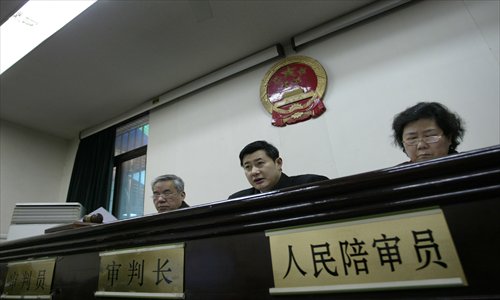
Eight years ago, Liu Yuexin, now 55, decided to apply for a part time juror position in the Xicheng district of Beijing.
Having worked as a mediator with a grass-roots organization, he wanted to further explore his passion for the law. Now, he is on his second five-year term as a juror and has been involved in cases involving criminal, commercial and civil laws.
"My passion for being a juror and assisting judges to make the right decision has never wavered during the past eight years," Liu Yuexin, who participates in more than 100 trials a year, told the Global Times. "It's a meaningful and honorable job."
However, it is not an easy job, Liu Yuexin said, noting that he often gets confused when it comes to complicated cases involving obscure fields of law.
"I'm a veteran juror and majored in law at college, but I still feel that I'm incapable of offering help to the judges in some cases," he said, adding that he was recently confused by a complex bribery case. "I think this might happen more often among other jurors."
According to statistics cited in a Yunnan Information Daily story, more than 70 percent of jurors in Yunnan Province "occasionally speak" or "do not speak" during a trial, and the most common thing jurors utter in court is "I agree with the judge."
This raises the question of whether these "people's jurors" are really representing the public in the judicial process or are a mere formality.
A democratic role
Mo Jihong, a researcher with the Institute of Law at the Chinese Academy of Social Sciences, told the Global Times that China launched the jury system to ensure democracy in the judicial process.
The National People's Congress appoints jurors based on applications approved by local courts and administrative departments. Successful candidates need to be over 23 years old, hold at least a vocational college diploma and have no criminal history, according to regulations.
"The jurors represent the public in supervising the course of a trial, and they have the same power as the judge when ruling on cases," Mo said.
When serious conflicts happen on the collegial panel, the case will be handed to the judicial committee to make a final decision.
Liu Yuexin said that jurors are in place to provide human interest and insight in civil cases and to correct judges' biased mindsets, which are the result of dealing with similar cases over many years.
Lip service
Experts say that despite the fact that jurors do offer good suggestions in some cases, most do not effectively supervise the judicial process.
Mo said jurors always seem out of place and are unable to utter a word, especially in criminal and commercial courts, because they are not required to pass judicial examinations and thus lack knowledge in law.
"If the jurors cannot challenge the judges and actively offer their perspective on a ruling, they become useless and are a mere formality," he added.
Zheng Xu, an associate professor in criminal procedure law with the China University of Political Science and Law, agreed with Mo, adding that most jurors like to say that they agree with the judge because they aren't confident enough to disagree.
"When a juror's view conflicts with a judge's, the juror tends to follow the authority of the judge and blame himself for not knowing much about the law or the case," Zheng told the Global Times, noting that some jurors even try to curry favor with judges.
A veteran judge surnamed Liu, based in a commercial court in Beijing, echoed Zheng and Mo, adding that in particular, the jargon-laden security and insurance laws are weak spots for most jurors. "There has never been one instance when a juror's advice has overturned my original ruling during the 20 years that I have been acting as a judge," he said.
Liu Yuexin, however, defended his fellow jurors saying that it is unfair to say they are of little use just because they are quiet in court.
"Jurors make most of their contributions out of the court," he said. "We make efforts in reading the case-related documents and confirming facts in the case, and we communicate with the judge before and after the trial."
Liu Yuexin said he used to offer advice that fundamentally changed a ruling, but refused to share details of the cases citing court regulations.
Root of the problem
The lack of training in both law and court etiquette is one of the top reasons why many jurors fail to perform their duties, experts say.
Judge Liu said that once a juror became emotional during a trial of a dispute between a bank and its client, and in court, openly accused the bank of exploiting customers via unreasonable terms.
"The lack of training led to this unprofessional act, which impeded the trial process and was absolutely unacceptable," he said, adding that he immediately stopped the juror from behaving inappropriately.
However, the courts are not able to freely select high-quality jurors, Judge Liu said, because jurors are a "scarce resource."
"A court hears tens of thousands of cases a year, there are just not that many jurors available," he said.
Mo echoed Judge Liu, adding that jurors receive little compensation for attending a trial, usually less than 100 yuan ($16.30) per case, which often barely pays for the necessary taxi fees. This makes it hard for jurors to maintain interest in the long term, he said.
The fundamental problem in terms of the practicality of the jury system is that the people who select jurors are confused about the purpose of having jurors, Judge Liu said.
"If we want to hire a diverse group of jurors to represent the public, we should limit their power in deciding on the final ruling; if we want the jurors to have real power in the ruling, we have to hire law professionals to act as jurors, but they won't represent the public," Judge Liu said. "We tried to have both and we failed."
Zheng said that China should learn from the US and adopt a randomly chosen group of jurors, whose duty is to decide on the facts of a case, and leave the law-related questions such as sentencing to the judges.
"The jurors must come to the court for their jury duties, and not feel pressured by other jurors" Zheng said. "But this requires a big change in procedural laws in China, which is extremely difficult to achieve."