Medicine or ideology?
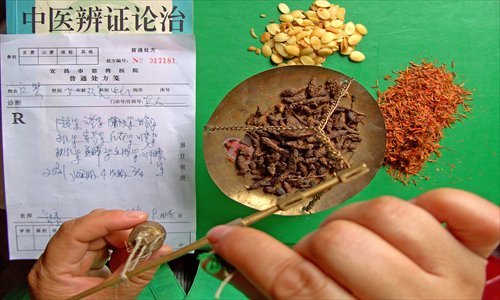
Tongrentang (TRT), a Beijing-based traditional Chinese medicine (TCM) giant, announced Wednesday that its medicines are in line with national standards and are safe for patients, after Hong Kong authorities said the mercury levels within their cinnabar products were five times over the local limit.
While cinnabar has been used in TCM for about 2,000 years and believed to be effective in treating lots of disorders, it is illegal to use it in medicine in countries such as the US and Japan.
The incident has highlighted problems assessing the safety of TCM, and renewed debate on whether Western scientific methods of analysis can be applied to TCM.
"Our medicine can also be prescribed according to TCM theory and the national standards of medicine production and sales. The medicine is safe and effective if people follow doctors' suggestions and the instructions on our packaging," read an announcement on the TRT website.
Cinnabar is considered useful for remaining calm, improving eyesight and detoxification, according to the Chinese Pharmacopeia Commission's 2010 pharmacopeia handbook, read an announcement on the TRT website.
However, the handbook also says it's poisonous when taken improperly or in excessive amounts.
According to a medicine evaluation expert who requested anonymity, cinnabar can poison the nervous system and circulatory system.
Jia Zetao, a secretary to the TRT board of directors, admitted that TRT produces Jiantiwubuwan, a medicine containing cinnabar. However, Jia denied that the medicine sold in Hong Kong was produced by TRT, youth.cn reported.
Hong Kong authorities are investigating the case.
Despite TRT's comments, a number of pharmacies including TRT's chain store in Zhengzhou, Henan Province, recently took some TRT medicines such as Jiantiwubuwan off the shelves, dahe.cn reported Thursday.
This is the third time in the last five months that claims have been made regarding quality problems with products from TRT, founded in 1669, which claims to have provided medicines for the royal pharmacy of the imperial palace of the Qing Dynasty (1644-1911) for 188 years.
Aside from TRT, other classic TCM products such as Yunnanbaiyao (Yunnan White Medicine) powder, Liuweidihuangwan and Simotang have been accused of having excessive levels of heavy metals, prompting concerns over the safety of TCM.
Mercury sulfide and other heavy metals including iron, zinc and even arsenic are widely used in TCM. And about 40 kinds of TRT medicines have cinnabar, the Nanfang Daily reported.
"If one takes cinnabar for a long time while exceeding the dosage, it is harmful for the liver and kidneys," Jiang Liangduo, a senior expert with Dongzhimen Hospital Affiliated to the Beijing University of Chinese Medicine, told the Global Times.
Besides deliberately including heavy metals, it's possible for heavy metals to enter the materials at any stage of the production process, which makes testing TCM products very difficult.
Clash of ideas
TCM ideology is totally different from Western medicine, according to Wang Jishan, a vice president with Peking University People's Hospital.
"TCM is based on yin and yang, the core factors of traditional Chinese culture and it depends on experience that has been handed down. Some TCM doctors have their own secret prescriptions that have been passed down from generation to generation. On the other hand, Western medicine is based on strict experiments and testing," Wang told the Global Times.
Using experience as the main basis can lead to doctors and patients using medicine on blind faith, making TCM face higher risks, he said.
Famed science commentator Fang Zhouzi also has doubts about the safety of TCM. "We even don't know the ingredients of TCM and can't quantify them, but they could all be analyzed by Western medicine as all of them are chemical compounds," Fang told the Global Times.
Many people have attempted to invalidate TCM since the late 1890s. In 2006, Zhang Gongyao, a professor with Central South University in Hunan Province, even initiated a campaign to collect 10,000 signatures against TCM, according to rednet.cn
But Jiang believes that TCM can't be replaced by Western medicines.
"It has been used for thousands of years and stresses different combinations of medicines and their influences upon each other. Before Western medicine was introduced to China, TCM treated Chinese," he said. "It doesn't' need approval from Western medicine."
TCM supporters may find support in an annual adverse drug reaction (ADR) report released by the China Food and Drug Administration (CFDA) in March.
Among the 1.2 million cases of ADR reports received by the CFDA in 2012, chemical medicines accounted for 81.6 percent, while TCM accounted for 17.1 percent, and the rest were caused by biological products, said the report.
However, some experts have cast doubt on the credibility of the report. The anonymous drug expert told the Global Times that he believes the national medicine authorities have looser standards for TCM.
In many Western medicines' instructions, there are long instructions on what to do in case of ADR. But when it comes to ADR, TCM is "not clear" Fang said.
Statistics show that over 200,000 people die in China each year because they take the wrong medicine, according to a Xi'an Evening News report.
Toxic secrets
As TCM is regarded as part of traditional Chinese culture and has many followers, China's medical authorities are obliged to protect and promote it, Jiang said.
This has ramifications. Because Yunnan White Medicine has 111 years of history as a product and is believed to be good for stopping bleeding and treating bruises, its ingredients have not been publicly revealed and are regarded as a State secret.
Earlier this year, its ingredients were published as part of its instructions for US customers. One of the herbs in the medicine is said to have toxic content, according to a report in the Guangzhou Daily.
Last month, Simotang, a kind of TCM made by Hansen Pharm in Hunan Province, was reported to contain betel nut, which is recognized by the International Agency for Research on Cancer as the first-tier material that can cause cancer in 2003. No reports have been published on the health risks of Simotang.
"The drug authorities are subject to the TCM industry and the nation's political mission is promoting TCM," said Fang.
China's five-year plan for the period of 2011-15 seeks to enhance the global profile of TCM and its use outside the country, the Xinhua News Agency reported.
In 2009, the International Organization of Standardization established a committee to standardize TCM in terms of terminology, quality and production of herbal ingredients and medical devices such as acupuncture needles, it said.