'Leaders are humans too'
Images and statues of great political leaders are regularly seen in many countries, with most of them leaving visitors with an impression of a strapping and charismatic figure - a fitting image for what people generally imagine already. However, getting a political figure to pose as the subject of their art work is not an easy job for artists, since the tricky balance between being political and artistic would be easily broken and likely offend some group in the end.
However, in 30 years of crafting sculptures for great leaders like Mao Zedong and Deng Xiaoping, artist Li Xiangqun has become one of the lucky few to earn a reputation for works that are seldom controversial.
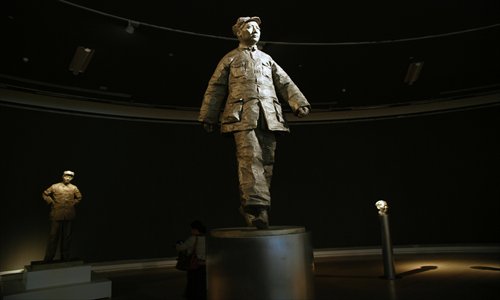
During his years sculpting those great figures, what Li tried to do was to strip away their unique social identities that people have labeled them with, and restore their human side as a common person. Just like his recent work, a statue combination of Mao Zedong and his second wife He Zizhen, that is scheduled to be located in the Bajiaolou Square in Jinggangshan (where Mao and He fell in love) in southeastern Jiangxi Province.
Recent work of Mao
Li's production of those two statues was commissioned by Kong Dongmei and her husband. Kong is Mao's granddaughter and according to her wish, these two statues will stay in Jinggangshan to memorialize her family members there. The confidence afforded Li by members of Mao's family underscores his skill as a great sculptor.
However in China, Li is definitely not the only one who is capable of sculpting a statue of Mao Zedong. Just last month a bronze statue was erected in the Linzhang county in northern Hebei Province. Wearing a straight Chinese tunic suit and holding a piece of manuscript in hand, Mao smiles with his eyes looking firmly ahead: it's the usual great image people have seen in many similar statues.
But in Li's version, Mao is wearing a Chinese tunic suit that is casually dressed with one side of the collar slouching, meanwhile holding a cigarette in hand and with a slight scowl on his forehead. "Leaders are humans too," said Li.
The historic background under which Li worked on the statue of Mao is after the failure of the 5th anti-encirclement campaign, which lasted a year from 1933 to 1934. It involved a series of battles between Chiang Kai-shek's Kuomintang Army and the Chinese communist's Red Army. After suffering heavy losses in 1934, the Red Army began the Long March (1934-36) in October that year.
And according to Li, during that period Mao was in his 30s and in the field it was impossible to be neatly dressed or in high spirits.
"The anxiety reflected by the frown is essential, only in this way does he look real," Li told China Newsweek. And the typically swept-up hairstyle Mao was inclined to wear was also trimmed a little to appear less high-profile.
However, to underline the personality of the character, Li intentionally emphasized the orderly buttoned shirt Mao wore inside his Chinese tunic suit. Different from the usual full-forehead, wide shoulder and smiling Mao image, the statue by Li is more like a common person. "What I made is the statue of Mao Zedong, not Chairman Mao. 'Chairman' is just an identity, and that's what I needed to strip off," Li stressed.
Red, but closer
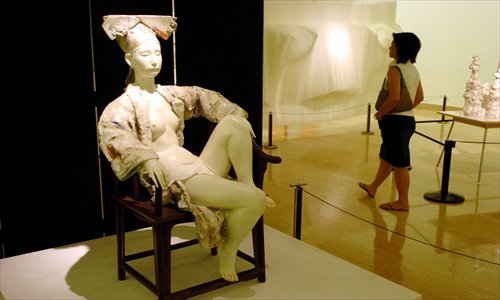
As an artist interested and skilled in sculpting great figures, Li has been concerned many times before for his works including Red Star over China, Mao Zedong in the Sunshine, Civilian Deng Xiaoping, and Heaping Cloud and Snow. In those sculptures, there are either the images of poetic Mao Zedong, neighborhood grandfather Deng Xiaoping, or feminine and motherly Empress Dowager Cixi.
"Instead of showing their greatness, Li chose to interpret those leading figures by displaying their common feelings and life circumstances as common people," said Zhang Gan, vice president of the Academy of Art and Design of Tsinghua University. "This is in line with modern people's feelings since after all, we are not in a specifically historic period," said Zhang.
Being famed for his sculptures of political figures, Li seems to always draw a clear line between his personal identity and his views of those historic political leaders. Stressing that he is not a member of the communist party and that his association is unofficial, Li said his views toward Mao are neutral and objective, with his works neither eulogizing nor demeaning.
Claiming not to be a red artist, Li nonetheless is engaged in bringing red culture closer to the people. As a member of the CPPCC national committee this year, during the session in March Li pointed out in his proposal that red culture should be part of the mainstream culture, and that it cannot replace or cover the significance of other styles of culture.
He also emphasized that promoting red culture underlines the fact that social culture is developing in a diverse way. Only sometimes, due to insufficient information or different perspectives, misunderstandings will appear between the two.
To minimize this kind of misunderstanding, Li will continue to focus on reflecting the common side of political figures through his art works. This March he had the experience of learning about the history of when Mao was in Jinggangshan, which in his words, "enabled me to learn about a different Mao who was in such a desperate situation but still finally turned it around." The enlightened understanding added inspiration to Li's recently completed work.
Next, Li said he will focus on the artistic production of Mao's later years. "During that period he was [often in a state of] insobriety and at a loss: it was also part of Mao," he said, "As an artist, I'm interested and should display it."