Forging ahead
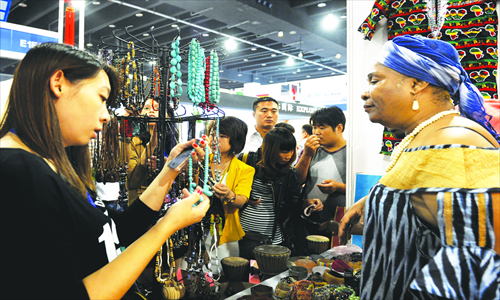
Yiwu, a trade hub of about 1.2 million people in East China's Zhejiang Province, is well-known as a flourishing business center in the country.
After China became a member of the World Trade Organization in 2001, the city became a gateway to overseas markets for sales of small commodities ranging from jewelry and makeup to home decorations and household gadgets.
Last year, amid deteriorating overseas economic conditions, China saw its foreign trade growth slow to 6.2 percent year-on-year, with exports rising 7.9 percent and imports increasing by 4.3 percent.
The 6.2 percent growth was well below the target of 10 percent, and far below the figure of 22.5 percent growth registered in 2011.
However, in Yiwu the story has been quite different. Its foreign trade last year reached $9.35 billion yuan, up 137 percent from the year before, and exports shot up by 150 percent to $9 billion.
Booming trade
"The reason why the city's products have shown resilience to the slowdown in overseas economies is that our products are consumer goods. No matter how bad the local economy is, people can not live without their daily necessities," Lou Zhangneng, director at the Bureau of Commerce of Yiwu, told the Global Times Wednesday.
Lou noted that as economies of some overseas countries and regions are still in recession, the competitive prices of products from Yiwu have also made the goods more appealing to consumers.
For example, in the 4-million-square-meter Yiwu International Trade Mart, the world's largest wholesale marketplace for small goods, an iPhone 4S case made with feathers sells for about 5 yuan ($0.81) at wholesale prices, but the same case will eventually be sold for about 100 yuan in a brick-and-mortar shop.
Walking around the market, which draws more than 40,000 visitors per day, with around 13 percent coming from overseas, it is difficult to believe that the world's second largest economy has undergone a dip in foreign trade growth.
Meanwhile, Yiwu's business people are eyeing e-commerce as a way to expand their business channels.
"Once we all go online, consumers will soon find that our products are competitive, and it is expected that many online shop operators who buy our products via wholesale and sell them online will soon feel the competition pressure," said Zhou Tianquan, vice president of East Star Holding Group based in Yiwu.
East Star, a commodity manufacturer and trade service firm that provides export services to more than 10,000 local manufacturers, is mulling an online platform to tap into more business opportunities.
All of the 62,000 retailers in the Yiwu Trade Mart have already begun to operate online shops.
Complementary channel
The country's burgeoning e-commerce industry has put heavy pressure on brick-and-mortar retail businesses.
Some stores have even complained to the media that they have become fitting or testing rooms for e-commerce stores - consumers come in not to buy goods, but in order to inspect the actual product before buying it online.
But Yiwu's retailers hope to build a connection between their brick-and-mortar and online stores.
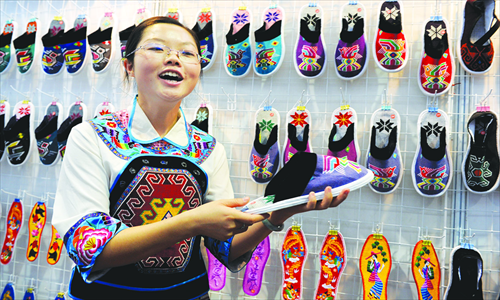
"We started our online shop last year to offer it as a complementary sales channel," Zhu Zhibin, a wig shop owner in the market, told the Global Times Wednesday, adding that he has not noticed any negative effects from online sales.
Charging about 10 yuan ($1.63) a wig, Zhu said his shop earned about 2,200 yuan per day in revenue, of which 200 yuan was contributed by his online shop on yiwugou.com, the official online shopping platform for the Yiwu Trade Mart launched in October last year.
Lai Zhenjie, deputy general manager at Zhejiang Dishini Knitting Co, told the Global Times Wednesday that his online shop mainly sells inventory products, while the physical shop sells newer goods.
"The online platform offers me another channel to sell my goods, which works well for me," Lai said.
According to statistics from the Bureau of Commerce of Yiwu, during the first quarter of this year, the city's daily international e-commerce shipments reached 15,000, an increase of 50 percent over a year earlier.
Mind the risk
But as impressive as the city's increasing sales figures are, difficulties in overseas economies have also created some risks for local businesses.
"Some small commodity manufacturers and retailers have found it difficult to get the money from buyers after shipping their products overseas, and some suffer capital shortages when they only get a down payment for the entire order," said Zhou of East Star, adding that in an uncertain market, default is a common phenomenon.
He also noted that East Star has no clients in developed countries, because business there involves higher product quality requirements. "But we will work on that," said Zhou.
Lai of Dishini Knitting noted that the yuan's appreciation has caused increasing risks for his business.
Moreover, owing to increasing costs of labor, raw materials and rent, an industry insider told the Global Times that some small companies have closed their factories and relocated to somewhere cheaper.
"The profit margin from our small commodities is already very low anyway, so if costs go up, the business pressure will be big for sure," said the insider.
Zhou said that East Star had come up with a way for its clients to control risks. If a retailer or manufacturer receives an order from overseas, the local Industrial and Commercial Bank of China offers a loan for the business involved, and China Export & Credit Insurance Corporation will insure the order based on due diligence.
"During the past two years, no default has occurred," said Zhou, adding that last year goods worth $817 million were exported this way, up from $700 million in 2011.