Weekend warriors
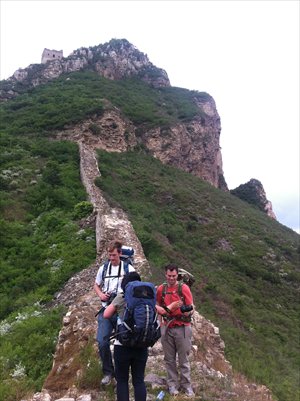
Intrepid campers, led by a professional, prepare to hike the trail up to their home for the night, a Ming-era watchtower. Camping along Beijing's Great Wall stretches and mountain ranges is gaining new followers lately. Photo: Jiang Yuxia/GT
Darkness had fallen and the night was settling in. In intervals, a whirl of wind would rustle through the heavily forested Wohu, or Crouching Tiger Mountain, in northeastern Beijing's Miyun county. The campfire flames flicked up within the 600-year-old watchtower on the Gubeikou Great Wall.
Inside this temporary shelter, Fred Halewyck, 36, a veteran hiker and camper from Belgium, became lost in the dancing fire while chitchatting with six enthusiastic campers who were sleeping on the Great Wall for the first time.
"I can watch the fire for hours," Halewyck said. "Peace and tranquility are what [draw] me away from the city."
Halewyck, co-owner of the China Hiking travel agency, which organizes camping and hiking tours, has traversed almost all of Beijing's mountains since settling down in the capital three years ago. Much to his delight, he has discovered many rarely visited and hidden spots.
"I wonder why people don't want to get away from the city where there is so much pressure from life and work," said Halewyck, who quit his office job in Belgium six years ago to travel.
Camping has surged in popularity over the past few years as more weekend warriors - Chinese and expat alike - are seeking an escape from urban life by setting up camp in Beijing's outskirts during the April to October camping season.
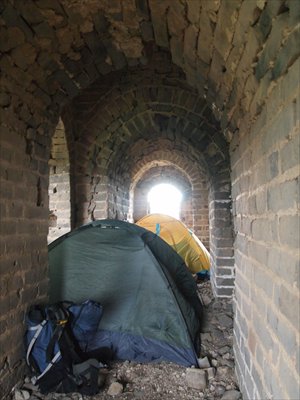
Tents set up in a watchtower at the Gubeikou Great Wall. Photo: Jiang Yuxia/GT
Find the best campsiteLying on the flatland of the North China Plain, the city of Beijing itself doesn't have many established campgrounds, especially when compared to mountainous Jiangxi Province. Yet the Xishan and Yanshan mountain ranges that run across the northern and western suburbs provide gateways for city dwellers wanting to get closer to Mother Nature, said Beijing resident Xiao Du, 32, an inveterate camper of 10 years and owner of online camping retailer Xiaodu Outdoors. He estimates that there are about 1,000 regular local campers.
Popular camping grounds include the towering, cloud-covered Yunmeng Mountain in northern Beijing's Huairou district and Miyun county, Mangshan in the northeast of Beijing's Changping district and the rugged Jingxi Ancient Road in Mentougou district, linking ancient Beijing and Zhangjiakou in Hebei Province.
Xiao and his friends often head to the alpine meadows about 2,000 meters above sea level, such as Lingshan Mountain in Mentougou district, or cooler getaways such as Baihebao Reservoir in Yanqing county to break free from the oppressive summer heat.
Besides the mountains, the most appealing local campsites is the "wild" Great Wall: 600 kilometers of undeveloped terrain, which includes the Jinshanling, Gubeikou and Jiankou segments.
The natural beauty, historical significance and unique architecture of the Great Wall have a singular appeal, said Xiao, adding that the favored spot for campers is Jiankou thanks to its impressive view from higher up.
Though sections of the Great Wall under official government management prohibit overnight stays, the unrestored areas, such as Gubeikou and Huanghuacheng in Huairou district - so named for the yellow flowers that bloom there midsummer - are available to campers as long as they can dodge locals or police who might try to charge for access.
Your own little piece of history
Metropolitan attended a Halewyck-led camping trip earlier this month at Crouching Tiger Mountain, which is a two-hour drive from downtown. The trek kicked off at 2 pm, and after an hour and a half of uphill hiking, tackling fallen stones and shattered bits of wall along the way, we arrived at our destination - a well-preserved, 600-year-old watchtower.
Boasting lush woods in a variety of verdant shades, the 660-meter-high mountain is topped by the Great Wall, built in the Northern Dynasties (386-581) and Ming Dynasty (1368-1644). While the secludedness has its perks, most of these neglected, weather-worn watchtowers slump over in disrepair and some of the brick walls lie in ruins.
Fellow camper Hans Peterson was in awe of the history around him. An American working as site coordinator of Minnesota University's MBA exchange program with Tsinghua University, he said there aren't structures as old in the US, and ones that do have historical significance are roped off and secured.
"Camping at the Great Wall is a chance to interact intimately and respectfully with a piece of history," he said.
The group dutifully put up the tents and collected wood. We started up a small fire, and the humble beacon tower turned into a welcoming shelter. While tranquility prevailed on the isolated mountain, the group gathered around the fire for a lively chat coaxed out by two bottles of wine.
The talk and laughter continued late into the night. The return of the whirling wind didn't keep the campers from falling into a comfortable slumber amid Middle Kingdom history.
Woken up at first light around 4:30 am, the crisp early-summer morning was complemented by chirping sounds emanating from deep within the woods.
"This might sound a bit philosophical, but camping is about getting back to nature," said John Hanna, an American who was visiting Beijing for work.
Trailblazers' travails
Having camped extensively in the West and other Asian countries, Halewyck attributed the difficulties for foreigners going on camping trips in China to the lack of good information.
In the West, he noted, it's easy to get detailed maps illustrating all the mountains ranges with accurate altitudes and hiking trails. In China, those maps seem to be available only to the military, he noted.
When Halewyck climbed the Himalayas from the Nepali side in 2008, he had a well-illustrated map of all the bases at different altitudes. But with the mountain ranges in Beijing, he hasn't come across any such maps with comparable detail.
When developing a new trail, Halewyck has to rely on the help of locals, take detailed notes and make at least five visits to the trail before he can include it in his guided tour offerings.
Xiao sticks with GPS devices for navigating Beijing's "narrow and undeveloped" trails. It's worth noting, though, that GPS capabilities of cell phones are not dependable in more remote areas.
Keeping the wall wild
Despite the pleasure from camping in the wild, the environment has also become a concern for many veteran campers.
Xiao has been following the "Leave No Trace" philosophy and calls on fellow campers to collect the trash they produce on trips. But Xiao's more concerned about preserving history.
Sleeping on the Great Wall has always been controversial in terms of heritage preservation. In the past 10 years, the Jiankou section has suffered significant damage due to the large influx of visitors, Xiao said. In summer, Beijing's dry season, the earth under the wall is loose and the bricks on the wall are more likely to fall under the weight of a hiker. Hiking poles only exacerbate this problem.
On Saturday, Xiao is looking forward to exploring Haituoshan Nature Reserve, a relatively untouristed spot criss-crossed with fresh springs. He suggests other people help preserve nature and also take the path - or the wall - less traveled.
Best spots to pitch a tent around Beijing
Lingshan Mountain Scenic Area
The highest mountain around Beijing, Lingshan Mountain is home to lush woods and diverse flora and fauna.
Where: Qingshui county, Mentougou district
Getting there: Take Bus No.892 from Pingguoyuan Subway Station on Line 1 and get off at Shuangtangjian. The mountain is 10 kilometers away. With no public transportation available, either walk or take an illegal taxi for about 50 yuan on Lingshan Lu to Jiangshuihe village. Follow the signs in the village to reach the scenic area. Campers can set up tents anywhere in the park.
Ticket: 35 yuan
Yunmengshan National Forest Park
This park at the border of Miyun county and Huairou district offers a diverse smattering of nature with towering peaks, flourishing trees and winding streams.
Where: Shuibaozi village, Shicheng township, Miyun county
Getting there: Take Bus No.916 from Dongzhimen Bus Terminal to Yujiayuan Station. Change to Bus No.936 towards the Tangjiakou direction and get off at the park's entrance.
Ticket: 35 yuan
Xiangshuihu Lake Scenic Area
Just west of Jiankou and Mutianyu Great Wall segments, this spot sits about 85 kilometers from downtown. The valley is the best spot to camp.
Where: Dazhenyu village, Bohai township, Huairou district
Getting there: Take Bus No.916 from Dongzhimen Bus Terminal to the Huairou International Convention Center, then transfer to a local bus. The valley is a short hike away.
Ticket: 20 yuan
Baihebao Reservoir
About 85 kilometers north of Beijing, this reservoir is popular among campers, particularly the Baihe River's banks.
Where: Xiangying village, Yanqing county
Getting there: Take Bus No.919 at Deshengmen to Nancaiyuan Station, the penultimate stop. Change to the connecting bus No.925 and get off at the reservoir. There is flat land behind the gate of the reservoir where campers can put up tents. The bus is available only at 7 am and 3 pm a day, and it takes 90 minutes. Visitors can also hire minivans that cost about 100 yuan.
Ticket: Free