The passion to express
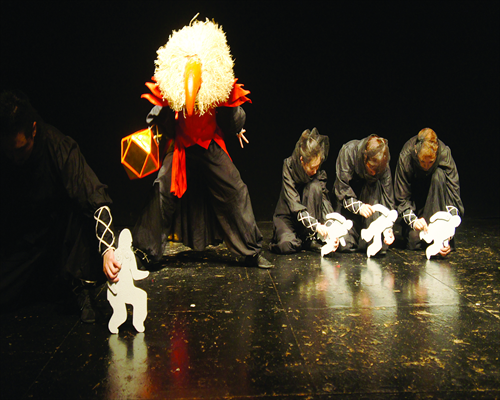
Publicity photo for Thor of Common Man
Many people participated in sport, music or drama societies during high school, but few managed to keep their hobby after graduation. Zhao Miao did for his Theatre of Santuoqi. Now the group is 16 years old and last year won a prize at the Avignon Theater Festival in France for the physical drama Aquatique. This summer, Theatre of Santuoqi is taking their new show Thor of Common Man to Avignon as well as to Danse le Monde (World Dance Festival) and to Edinburgh in Scotland.
Starting small
Zhao founded Theatre of Santuoqi when he was still a high school student back in 1996. The theater was initially a small eight-member society, whose first serious and rather academic name, Drama and Film Research Institute, only lasted for a year. These young people soon found out that they were more interested in acting than researching.
"In the first five years, it was stubbornness. Why would my group end up falling apart? We must keep going on," Zhao wrote in an e-mail to the Global Times.
The promise Zhao made to himself helped Santuoqi survive after graduation. Gradually, the troupe transformed into a productive theater offering audiences quality dramas every year.
Zhao and most of the members of Santuoqi were graduates of The Central Academy of Drama in Beijing. Last year, they held a season of performances to reward their fans as well as reporting to their former tutors about what they had done over the previous decade.
Getting physical
Some readers may wonder why a stage drama could attend a dance festival. The answer comes from an explanation of Santuoqi's body poetry.
From 2002 to 2007, Zhao and his team first learned about physical drama and started to try some silent projects. The 6:3 series, consisting of several fairy tales, were produced during that period.
Zhao said that the unique style of his play was inspired by French playwright and acting instructor Jacques Lecoq whose dramatic concepts and methods consist of numerous possibilities. So many moving moments in life are done in silence and he finds there is a strong way to represent these moments without language.
"I think what is great about Lecoq is that he never restrains his students from pursuing their individual art. He likes them to seek out their own way of expression," said Zhao.
As their understanding about physical theater developed, Zhao and his team tried to apply the Western way of body training to represent Chinese social and family stories like On the Road and Light.
For Zhao, the concept of physical drama became broader.
"We do not object to language but we emphasize the body movement," he said.
In 2011, the group's exploration turned into Nine Moments, which consisted of short performance pieces. At the time, it was a breakthrough for both performers and audiences.
Zhao said that physical drama emphasizes all aspects of theatrical production to work toward the ultimate way of theatrical expression.
"Stage performance in the end is an art centered on performing, not reading a script. The way of thinking itself is in movement," said Zhao.
Last year, Santuoqi's exploration switched to traditional Chinese cultural and more philosophical themes.
Physical drama Aquatique (2012), a story about a water ghost, was based on Pu Songling's Dark Tales. Different from many other ongoing big-budget productions, Aquatique was presented in a minimalist way with a very simple stage design and few props.
The training process borrowed from gymnastics, contemporary dance, yoga, the wing chun style of martial arts, and many other body movements. Such open-minded principles benefited Santuoqi in their choreography.
This year, Thor of Common Man pushed the exploration of modern theater and traditional Chinese culture to a higher level, drawing inspiration from Nuo Opera, Tibetan opera masks, Sui-style military costumes, Peking Opera, tai chi and many other folk arts.
The story of Thor, the ancient Norse god of thunder, has been told many ways, and to avoid copying past interpretations was not easy. While in rehearsal for Thor of Common Man, Zhao and his team struggled to find the optimal way of telling the story. They abandoned their plans over and over until finally reaching the result they have today.
Zhao said that he has always been interested in stories about ghosts and gods because they are usually full of morality and values, which can lead the audience to have thoughts on life and death.
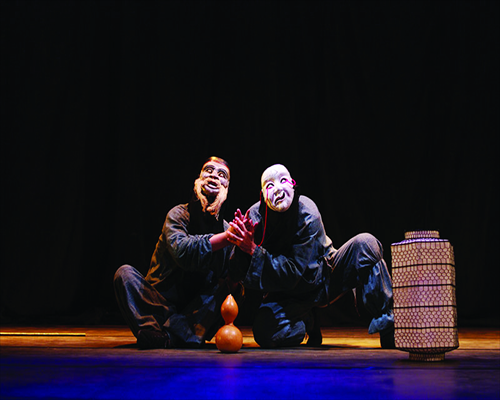
Publicity photo for Aquatique Photos: Courtesy of Theatre of Santuoqi
Make it strong
Theaters have developed fast in recent years and today's audiences have more options when they want to see live theater works. However, not many independent groups are like Santuoqi, which has been so persistent and determined regarding what they want to do.
Their works were never about making people laugh or attracting crowds by hiring celebrity actors. Without a bit of idealism, one can hardly make it through the decade in the crazy competitive market.
Zhao described members coming to Santuoqi a bit like searching for a Utopia, with many of them holding other jobs and only going there to act. It was not until 2010 that Santuoqi finally found a producer Meng Xing to take in charge of all the costs and financing.
Now as Zhao and the team are able to travel many places to learn about the different dramas and the cultures, their focus has become more pure and simple.
"I used to think that choosing topics and ways of expressions was a bottleneck. Now, there are so many choices for me in terms of projects. The only real bottleneck is that what you expressed is not strong enough. It would be terrible if we lost the passion to express," said Zhao.
The summer of 2013 in China is filled with all kinds of drama festivals created for many reasons such as tourism or a way for the government to promote cultural projects.
For Santuoqi, the summer will also be about attending festivals, but they will be in Europe. Of course, the content in China will be different. But for Zhao, the fundamental difference lies on the reason the festival was created - is there one reason that is close to the real art of theater itself?