Roll up the red carpet
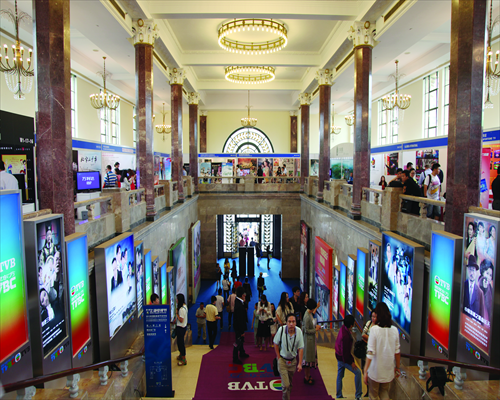
The 19th Shanghai TV Festival sees few visitors attending its second day on June 11. Photo: CFP
This June is quite busy for Shanghai as both the 19th Shanghai TV Festival (STVF) and the 16th Shanghai International Film Festival were held almost at the same time. But interestingly, while the latter attracted a lot of attention and numerous stars, the TV festival was comparably cold and starless.
Even the red carpet event for the opening night gala was cancelled, which many media saw as the coldest thing to happen at STVF in recent years.
Not-so-grand opening
Zhang Ming, marketing director of this year's STVF, explained that the evening gala was cancelled following the government's recent call to curb extravagant spending.
Even so, during the festival's first days (June 10 to 12), the main exhibiting venue of the festival - the Shanghai Exhibition Center - was sparsely populated due to the lack of TV personalities, especially the overseas ones.
The local media in Shanghai also found that the number of press conferences at this year's festival was markedly less than in previous ones.
Most of the celebrities from China and abroad that finally appeared did so only for the closing ceremony on June 14, including two American actors, David Harewood and Navid Negahban, who both play the roles in the popular American television series, Homeland. That show received the Magnolia Award for best foreign television series at this year's STVF.
As a media insider who has attended the STVF for about five years, Jian Wenjuan said that the festival has been going downhill since 2008. "The number of participating TV show production companies has decreased year by year," she told the Global Times.
While production companies from Zhejiang Province comprise a large percentage of attendees, including those known for producing leiju (dramas that are weird and shocking), Jian pointed out few big companies from Beijing that produce quality works went there.
Zheng Qi, distributor at Beijing-based Ao Ying International Advertising Media, felt the same way when she represented her company at this year's STVF.
"The number of TV dramas [brought to the festival for promotion] is very limited, the stars in TV dramas are not heavyweights, and big companies like Huayi were absent," Zheng said.
Declining numbers
It was the first large-scale TV program communication event since The State Administration of Radio, Film and Television released 22 new rules this May regulating anti-Japanese dramas and costume dramas. Jian found that the market was obviously influenced: the number of anti-Japanese dramas had a significant decrease and costume dramas, though still many, had difficulty finding buyers.
Zheng agrees, admitting that a new work produced by her company originally sold itself as an "anti-Japanese drama," but now she has to omit using related words and change the identity to that of a "contemporary legend."
Reporters from Yangcheng Evening News also found "costume dramas take more than half" of all the TV dramas being promoted. But the majority are reproductions of classics or sequels of popular shows.
Yet Peng Fuli, president of TV drama and star statistical analysis company Vlinkage, still looks optimistic about the future of costume dramas. He explained most of them have a fixed audience base, because many such stories are adapted from ancient legends, classic wuxia novels, or popular online novels. Additionally, Chinese audiences enjoy costume dramas, for they can project themselves into the lives of the fictional characters.
A sober market
Many insiders see the cheerless TV festival a sign of a sober market.
Jian noted that starting from 2011 when hot money flooded the domestic TV producing industry, companies were able to sell their products only with a story draft and several actors. TV stations were afraid of missing any opportunity, and therefore competed for dramas with big name directors or well-known stars and big investment.
"But because [TV producers] sold their programs in advance, not all producers were responsible enough to make a good product," Jian said.
Over the first half of 2013, the situation took a new turn. When a number of TV dramas featuring big directors, big stars and big investment did poorly with audiences, previous methods of judging a good series had to be scrapped. TV stations are now more cautious and rational when buying shows.
Jian pointed out that TV stations now demand to watch full episodes of a program. At the same time, more and more TV stations are signing contracts that determine payment based on a drama's rating.
Multiple factors
Despite the easy observation that there has been a chill in the air from late 2012 through the first half of 2013, both producers and TV stations are at a loss about how to heat things up. But Zheng thinks there are many other factors that have led to the lack of cheer at STVF this year.
"Over the recent few years, [many insiders] see the Shanghai TV Festival as an occasion that they do not have to attend, and the Magnolia Award (for annual best TV shows, best actor and actress and so on) is not one that enjoys wide recognition. Also, before the Shanghai TV Festival, a TV promotion and trade fair was held in Beijing, and Shanghai Media Group hosted an [event] for insiders," Zheng said.
Both TV dramas and movies ultimately depend on audience feedback, but the ways they get to the audience are different: movies depend more on multi-media marketing to persuade audiences to buy tickets, but in the Chinese system TV dramas have to maintain a good relationship with those who buy their shows - the TV stations.
It is very possible, as many insiders have pointed out, TV program producers reach agreements with TV stations via other means and have little motivation to take part in such festivals.