Red song sung blue
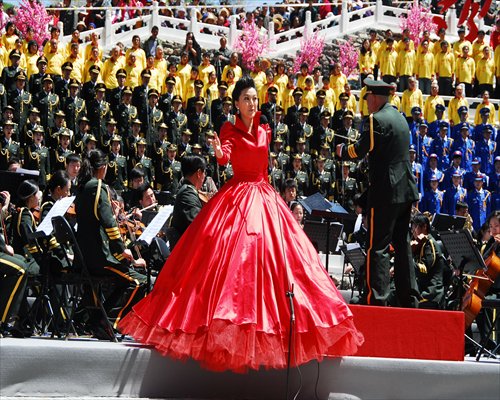
A red-themed concert is held outdoors in Fangshan district of Beijing in May of 2011. Photo: CFP
In December last year the Eight Provisions on how to improve government work methods and relations with the public was promulgated. It took less than half a year for the resulting slump in the consumption of high-end goods to make headlines.
A variety of industries including wine and luxury goods, catering and hotels have been hit hard: They are all tied to "the three public consumptions" that government frugality policies target - receptions, vehicles and overseas trips.
But it's not just those industries being affected. The performing arts market is also feeling the chill.
"Since the end of last year, government sponsored performing activities for holiday occasions shrank by 60 to 70 percent," said Fu Nan, president of Central Asian Culture, a large private performing and planning company based in Chengdu, Sichuan Province.
No more Mr Moneybags
Without the government backing, relying merely on commercial performances is far from enough to make ends meet. "Up to now the revenue this year is only one third of last year during the corresponding period," Fu told the Global Times.
"There are two types of performance in the current Chinese market. One is purely commercial, and the other is government sponsored, usually for large-scale galas, holiday festivities and anniversaries," Fu introduced. And with the commercial performances, entertainment companies would also make use of government funds since the latter would buy groups of tickets for their employees as a kind of perk.
"Now those two sources of profit-making are both cut off," said Fu.
The rapidly growing domestic performing market got rich fast in past years with government spending always on the rise, but now they must suffer as officials across the nation hit the brakes.
Before the regulations to enforce frugality came out late last year, government sponsored performances were one of the pillars of profit-making for many Chinese performance companies. The market ballooned to 10 billion yuan ($1.63 billion) last year with a total of 20,000 performances.
"But more than half of those companies are in deficit now," said Fu. Most are still fledglings when it comes to operating in a purely commercial environment.
According to statistics from the Beijing Association of Performing Arts, in 2012 the average ticket price for performances in large-scale performing venues was 692 yuan, and 260 yuan in ordinary places. And based on Fu's 20 years experience in the performing industry, the average ticket price for a large-scale concert usually adds up to thousands of yuan, and hundreds of yuan for smaller-scale plays: this is not a price common Chinese people can afford on a regular basis.
As the public's consumption habit for the performing arts is to be nurtured, it's impossible for domestic companies to stand steady on just one leg - that being the commercial market.
"The Eight Provisions have scraped 30 percent of the revenue for the performing market," said Tian Zhihui, CEO of the show160.com, a leading performance industry website.
Singers grow silent
In fact, it's not just the companies that are feeling the pinch: so are singers. Haodi, who came from Nigeria to China in 2008, rose to fame in 2011 as a video of him performing the Chinese red song "Remembering Chairman's Words in Heart" became popular on the Internet.
He then took part in a series of red song contests on local and central television stations, with his appearance fee soaring to 50,000 yuan from the early 350 yuan when he first came to China.
Singing red songs (created during the War of Resistance against Japanese Aggression (1937-45) and the period of building socialism after the founding of the PRC) swept part of the country in the past several years, especially since 2009 - the 60th anniversary of the founding of New China.
Over the next three years, red song singing contests were a common sight on television. Chongqing in southwestern China was the most famous place then for encouraging the singing of red songs by the local government. But when the region's former helmsman, Bo Xilai, was brought down by scandal in March 2012, the trend of singing red songs on TV declined sharply.
And with the Eight Provisions coming out late last year, red song activities were further scaled down. Now, Haodi has seen a sharp reduction of invitations to perform, some 60 to 80 percent less, according to an interview with the Southern Weekly.
"The Eight Provisions are actually helpful for the healthy development of the performing market," said Tian, "Not only does the group-buying of tickets distort the normal market, but government sponsored performances sometimes inflated the value of a singer, especially those red song singers."
Healthy adjustments
As the new administration shows a firm determination to adjust work methods and adhere to the principles of frugality since taking office in March, it's high time various players in the domestic performing arts market adjust themselves to the current reality. Still depending on government benefits clearly doesn't work anymore. So some of them are pondering ways to innovate their businesses to become truly competitive.
"On one hand, we are looking at setting up cooperative relationships with capable enterprises or sightseeing spots to help them establish their brand," said Fu, "and on the other, in terms of what to perform, we will only choose those things popular enough to survive the market - not some long out-dated songs (once common at government sponsored performances)."
And the government is also making efforts to help build a more healthy and market-oriented performing industry. On Monday, the Ministry of Culture published a new regulation on its website about removing and delegating its authority to examine and approve commercial performances by foreign individuals or groups in China.
"Besides the delegation of powers, the government is meanwhile helping private performing companies in terms of financing and taxes," said Fu. "Of course the whole market climate has changed since late last year, but now it's actually a good thing for the sustained development of the industry. With a potentially huge audience base, China may someday produce its own classics parallel to Cats."