Public bodies blind to own entitlement
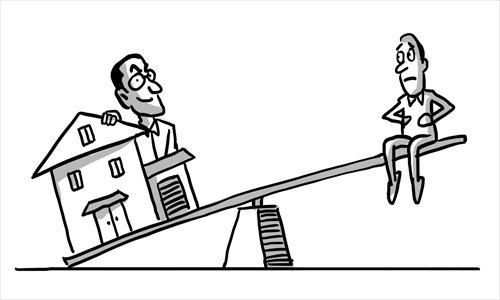
Illustration: Liu Rui/GT
Editor's Note:
It was revealed recently that Shenzhen customs has built more than 10 subsidized housing projects for its staff since 1984. In a time when commercial housing prices are soaring and people call for equal access to housing ownership, subsidized housing has definitely touched upon the public's nerves. Why does the public feel unhappy about subsidized housing for official staff? Is it really drawing a line between different classes of people? The Global Times invited three writers to share their views.
It can be as small as a piece of soap, and it can be as big as a house. Both have been perks of different State-owned enterprises (SOEs) or public institutions, and they both cause envy.
People can bear the largest gap of the annual bonus between different companies, but they cannot bear the contrast between working for private companies and for SOEs and public institutions, which means that some have to spend almost all their lifetime in humble abodes while others can be granted a house at far below the market value or even for free.
Houses nowadays in China aren't just for living. A man needs to have a house if he wants to get a decent date. A house can facilitate a marriage, but it can also ruin the relationships among family members.
As houses have been endowed with such great significance, and the prices of land and property keep skyrocketing, no wonder people gripe about the unequal access for ordinary people and those working for SOEs or public institutions.
In 1998, the State Council released a regulation to abolish subsidized housing for public servants. However, this regulation has apparently proved to be a rubber stamp.
In 2011, staff in Tsinghua University were reported to have been granted subsidized housing, which triggered much criticism at that time.
Subsidized housing is often seen as the epitome of power abuse. It can be funded by public finance, which burdens taxpayers, or by extra-budgetary money, which means exploiting positions of power for personal gains. Both are hotbeds of corruption.
This is all well-known. Nonetheless, people working in SOEs and public institutions have complaints, too. Once I talked to a friend who works for a SOE. He said employees in the company got subsidized housing in order of seniority regardless of how hard-working they were. "We have to wait for years. It's not fair. But when we are granted it, that's what we deserve."
Can you sense his feeling of superiority? I believe it comes out of the monopoly of SOEs and public institutions.
They are all undergoing a reform process now, although it is rather slow. It remains to be seen when stumbling blocks of reforms can be moved away and when fairness can be fairly achieved.
The author is a company employee based in Wuhan, Hubei Province. opinion@globaltimes.com.cn