Quick march – to a degree
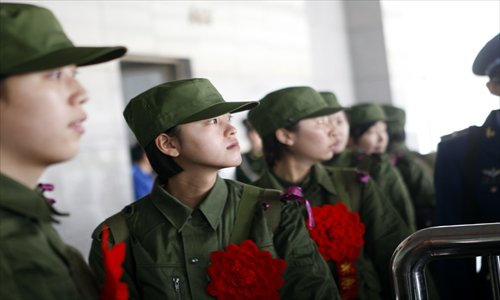
Fresh recruits for the PLA set out on their big adventure. Photo: CFP
This month, the Shanghai Conscription Office for the People's Liberation Army (PLA) started its campus campaign. The campaign, to attract college and university students to join the army in return for a string of educational and welfare benefits, was usually launched in winter.
In 2001 the PLA changed its recruitment rules and began actively pursuing college and university students who could join up for a set period. The program has been a success and is growing in popularity. Last year about 7,000 students in the city applied, and eventually about half the total number of PLA recruits in Shanghai for the year were students.
The campus recruitment campaign offers the students, who are accepted for their two-year military service stint, a chance at seeing other parts of the country, extending their degrees and possibly training in a trade. For the high-minded, the young people will see themselves as helping their country. For the more practical, it's a good way of easing their way through their degree courses.
Life as a soldier is very different from being coddled by parents and kindly teachers. But the program is proving a hit for both the students and the PLA. Yu Zhaoming is the executive director of the Shanghai Conscription Office. Last year he said: "We'll recruit more soldiers from colleges in future. In the past, most of our recruits were young unemployed people but fewer of this group are being recruited now."
Campus lectures held in the city's universities earlier this month featured former-students-turned soldiers, Wen Fan, Jiang Yuyun and Chen Danjie.
Uncertain future
Wen Fan is now a fifth-year student at the College of Architecture and Urban Planning of Tongji University. The 25-year-old sports a crew cut and a mature approach to life. He signed up in 2007 after he attended campus recruitment lecture. He admits at that stage as a sophomore he had no real purpose in life.
"I was studying a major that my parents had selected for me because they thought it would lead to good career. But I was uncertain as to whether this was what I wanted to do. I felt there should be something more important in life than study. I wanted to make a contribution to the country and the people in another way," Wen told the Global Times.
When he learned about military service, he knew instinctively that was what he wanted to do. He filled in the application forms immediately even though his family fiercely opposed the idea.
"My parents and other relatives thought I was crazy to suspend my studies. They thought I was way off track and I should be trying to finish my studies and find a decent job. They came down to the school to talk to me and we argued furiously. In the end, I threatened never to see them again if they continued to try and stop me."
After eventually making peace with his parents, he found himself in the PLA and in Shanxi Province in the winter of 2007. Over the first three months, Wen and the other recruits slogged through basic training, learning how to stand to attention, how to march and how to make a bed the army way.
After training Wen joined an engineering corps and was posted to a remote mountain area in Shanxi. Every morning there was the same: getting up at 6 am, half an hour of exercise, breakfast and political class at 8 am. After two hours of studying politics, Wen would be sent out to work, mixing concrete, paving roads or planting trees.
Wen said the life was not what he had expected - he had wanted to be out and practicing firing rifles and guns. "I was depressed and disappointed with the regular political classes and the tedious training. The daily two-hour political lessons, which emphasized a soldier's obligations, seemed like brainwashing to me, a student who had been familiar with democracy and freedom. I couldn't help questioning whether it was worth spending a morning memorizing regulations for soldiers or taking half an hour learning how to use a mop correctly."
Being a college student caused other problems in the barracks. "The other soldiers and officers expected a higher standard from me. If I made the smallest mistake, they would sneer and say, 'You college students are good for nothing.' I told myself that I was representing all students and shouldn't lose face." His determination kept him going through the bad days.
Daily abuse
For two years Wen was confronted daily by abuse. "I was abused for wearing shoes without socks or for not having my hair cut. We used to push each other when we ran down the stairs after we were called to drill. I was afraid that the creaky banisters would give way in the melee so once I yelled out to the guys around me to slow down. For this I was slapped and abused by the class monitor.
"At first I was furious at these injustices but as time passed by, I understood that in the army, following orders is the only thing a soldier has to do. It's the basic qualification for a soldier. This is the only way an army can work if there is a crisis."
Wen credits the discipline as the reason why he has become a young man who now thinks carefully before taking any action. "I used to complain about anything I felt was unfair or unreasonable and took my responsibilities casually. Two years of life in the army has made me a responsible man who constantly remembers his obligations as a soldier, a son, a student and a man. I know actions always speak louder than words."
However, Wen said a military education had disadvantages. "In the army, a soldier just follows orders. We lack flexibility and initiative. Nowadays I feel I'm too rational, always trying to think carefully before making a move. I'm good at finishing a given task, but I lack creativity and effective thinking which are important in architectural design."
Wen said military service has certainly changed his life. Three years after returning to campus, Wen still makes his bed to the army's standard every morning. "I had a break from studies and I really enjoyed the process in the end."
More colorful
Unlike Wen, who did think about staying in the army and who even now follows a regimented schedule throughout the day, Jiang Yuyun and Chen Danjie said army life hadn't changed them greatly. Both said their two years with the PLA were another life experience that just helped make their life more colorful.
Jiang is a tall girl who smiles a lot when she talks. She served in the PLA in Fujian Province working as a typist between 2005 and 2007 and she will finish her graduate studies at Tongji University next spring. "When I applied for military service I just wanted to see the outside world. I'm an ordinary Shanghai girl and I had never studied or lived outside of the city. I felt serving in the army was my only chance to get away from my parents and have a different life," the 26-year-old said. She was the only female recruit from her school that year.
"The first three months of training were really tough for me. But once I made a mistake, I learned quickly and never made the same mistake again," Jiang said. Although she was also abused by officers for doing the wrong things, she reflects on life in the army as being quite happy. "Sometimes I really miss those simple days, when I didn't have to plan for the future. There was nothing to do except follow orders. No choice was the best choice."
She recalls how everyone looked forward to the monthly leave they were allowed - four hours off the base to go shopping or walk around on their own.
Although she adapted quickly to a military life, it took her a lot longer to get back into life on campus.
"When I first returned to university, I felt everything was inappropriate. I even wanted to cut the hair off those students who had dyed their hair in different colors," Jiang laughed. Apart from the different approach to life, study is a challenge. "I have to spend extra time catching up with my classmates."
Chen Danjie is a graduate student at Donghua University but, when she was 18, went to serve in a Nanjing regiment in 2005 as a telephone operator. Over her two years in the PLA, she had to remember hundreds of phone numbers and handle emergency calls as well as filter out crank calls.
"At the time, I felt the job was quite boring. But now I realize that I have learned a lot from the training. My management skills have improved and I focus more on details - these qualities have impressed teachers and employers."
After she returned to campus she played a leading role with the college's Red Cross Society and later she became the class monitor. "People felt I was responsible and reliable. I was given more and more work." Chen also began working as a part-time counselor after she started graduate study three years ago.
Big incentives
To encourage more students to join the PLA, the government offers several incentives. Out-of-town college students can be granted a Shanghai hukou (household registration). Their families can receive a grant of 32,810 yuan ($5,349). The central government can also pay for the student's tuition fees. During their two-year military service, the government will cover their welfare and medical insurance. PLA students can go on to study at university or college, and further their studies without having to sit entrance exams, and they are given priority if they apply for work with the government.
Although both Chen and Jiang used their status as PLA students to go straight into graduate studies, both warned that young people should not think of joining the PLA just because of this. "If students just sign up because of the incentives, they could regret this and will probably drop out within three months."
"It's better for students to think clearly about what they want. It's not worth spending two years in the army just for the incentives. But for students who want to experience a different life or to do something consequential, I think the army is ideal," Wen said.