Gallic films galore
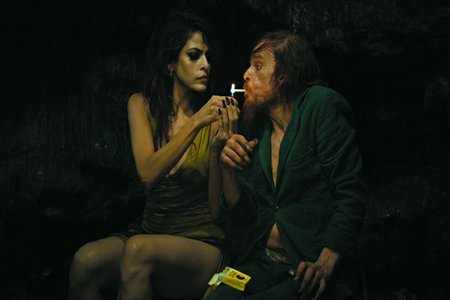
A still from Holy Motors Photo: Courtesy of uniFrance Films
"Every time, when I finish a film, I hope to have a phone call from someone telling me, 'I saw your film, and I believe you were just the right person to make it.' It doesn't matter who that person is. It could be anyone, even God," French director Leos Carax recently told the Global Times in Shanghai. His latest film, Holy Motors, is being screened in the Panorama du Cinéma Français (Panorama of French Cinema) section at the 16th Shanghai International Film Festival (SIFF).
The director, hiding behind a pair of dark glasses, was spare with words during our interview. He said that he really didn't know how to explain many of the details in his films, and most of the time, he was just hit by sudden flashes of inspiration.
Carax's Holy Motors depicts a day in the life of the protagonist, Monsieur Oscar, as he transfers from one identity to the next by playing different roles, including a captain of industry, an assassin, a beggar, a monster and a family man. The film received widespread acclaim upon its release last year. It was in competition for the Palme d'Or at the 2012 Cannes Film Festival and won the Los Angeles Film Critics Association Award for Best Foreign Language Film.
When asked where the inspiration for Holy Motors came from, Carax shrugged helplessly and replied, "I think inspiration is also unexplainable, it's a very mysterious thing. Even I myself have no idea where it comes from."
After considering the question a little longer, Carax continued, "The moment that inspired me to have the idea of making a film like Holy Motors is when I observed that stretch limousines were being increasingly used for weddings and I was interested in the cars' bulkiness.
"And I was interested in different life experiences of human beings and how many different identities we are able to play and how we always can reinvent ourselves," he added.
Highlights from the Global Times' Q & A with Leos Carax are excerpted below.
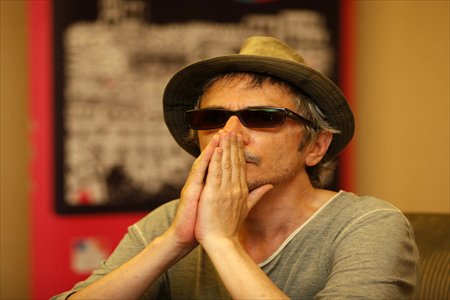
French director Leos Carax Photo: Cai Xianmin/GT
GT: You said before that you can't consider yourself a filmmaker, even after Holy Motors. How about now?
Carax: No. It is really hard for me to believe in myself as a filmmaker. As for me, since I discovered the cinema world at the end of my boyhood at the age of 16, I have regarded cinema as an island, and I myself am just an inhabitant and I'm always eager to live there. For me, it is a miracle that I was able to make this film.
GT: You've said on many occasions: "I make films for dead people, and show them to living people." Are there any particular references for "dead people" and "living people" here?
Carax: Oh, it is just an answer when I don't know how to answer people's question. There are no references. Living people probably could be people I know, or my friends, my family. But dead people, I don't know, could be anyone.
GT: Do you think you are a person who prefers to be in solitude? And does this kind of personality influence the style of your films?
Carax: It depends. Sometimes, I indeed want to be alone. And at this time, I will go to make a film, because I think it is the best way for me to be in solitude.
GT: When Holy Motors won the Los Angeles Film Critics Association Award for Best Foreign Language Film, you gave a speech that made it sound like you were not so glad about winning this prize.
Carax: It was my satire on these kinds of awards in America, which are called "Best Foreign Language Film." I don't think films should be separated because they're from different countries or in different languages. Film itself is a foreign language.
French showcase
Holy Motors is one of over 20 of the latest French movies being screened for Shanghai audiences at this year's SIFF. The Panorama of French Cinema, co-organized by uniFrance Films and the Institute of World Film at Shanghai Normal University, will also screen Le Fils de l'Autre (The Other Son) directed by Lorraine Levy and Thérèse Desqueyroux directed by Claude Miller.
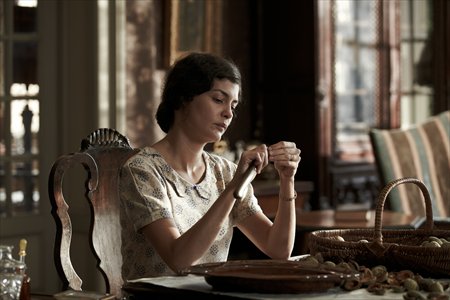
Stills from Thérèse Desqueyroux Photos: Courtesy of SIFF
The Other Son tells the story of two young men, one Israeli and one Palestinian, who discover as adults that they were accidentally switched at birth. The film won the Tokyo Sakura Grand Prix, the top award at the 25th Tokyo International Film Festival.
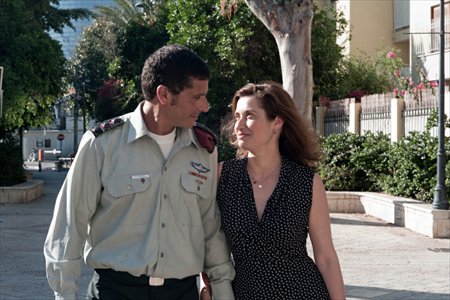
A still from Le Fils de l'Autre Photos: Courtesy of SIFF
Levy told the Global Times that although the Palestinian-Israeli conflict is a serious political issue, she didn't want to make a heavy drama, but wanted to explore the situation from a more human perspective.
Thérèse Desqueyroux, starring Audrey Tautou, was the last film made by Miller, who died in 2012. It was adapted from the 1927 novel of the same name by the Nobel Prize-winning French writer François Mauriac.