Good times, bad times
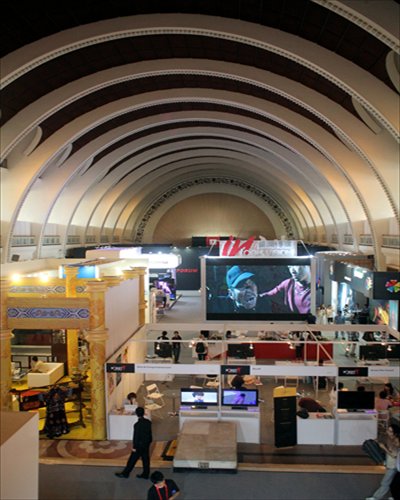
A glimpse of the film market that was attended by over 800 film production companies and held during the 16th SIFF Photo: CFP
"It was the best of times, it was the worst of times." The opening sentence of A Tale of Two Cities by renowned British novelist Charles Dickens in 1859 still holds true for China's film market today.
Since the great success of Lost in Thailand, which set a new record for Chinese domestic films earning 1.26 billion yuan ($205.5 million) at the box office at the beginning of this year, China's film market seems to have entered into an era of unprecedented flourishing.
The first half of the year saw the domestic box office surge above 10 billion yuan, with a series of popular domestic films such as Journey to The West: Conquering the Demons, Finding Mr Right, So Young, American Dreams in China, and foreign blockbusters like Cloud Atlas, Iron Man III and Star Trek Into Darkness. And the trend is likely to continue, allowing China to repeat is success last year in becoming the No.2 box-office market globally, second only to North America.
"China has become a giant producer of films as we now make over 700 films per year, and we have a huge market now with over 15,000 screens throughout the country... However, there's still a long way to go for China to become a powerful film-producing country whose films will also achieve success beyond its borders," said Yu Dong, founder, chairman and CEO of Bona Film Group, at Peace Theatre in Shanghai during the ongoing 16th Shanghai International Film Festival (SIFF), which lasts from June 15 to June 23.
Still in early stages
"We must be fully aware of the fact that the film market in China is still immature," Wang Zhonglei, president of Huayi Brothers Media Corporation, also showed his concern on the industry's development at a forum during SIFF Tuesday.
The businesses of Yu and Wang now share roughly 40 percent of the whole box office in the country.
During a series of film forums presented by SIFF, in total some 90 influential figures in the film industry of both China and abroad have joined the talks to shed some light upon the development of Chinese films and China's film market.
"A number of Chinese audiences pay money to cinemas not only for the one to two hours watching experience inside the venue but also for a topic that they can talk about with others within the following one or two weeks. This has also contributed to the growth of domestic box office," said Wang, but he takes the phenomenon as a sign of an immature market, one that can still create profit for films that can find ways to generate a buzz on social media.
Meanwhile, Taiwanese producer Lee Lieh, one of the three jury members at China Film Pitch and Catch (CFPC) project during SIFF, expressed her worries about the copycat phenomenon that she witnessed during the event. As Lee put it on Tuesday, some directors were so money-oriented that they thought their stories were good ones simply because they had integrated different elements from several earlier hit films.
Such blind copycat behavior, however, may make the ongoing shortage of qualified directors and scriptwriters in the country even worse.
"Many directors recently focus on comedies and love stories of young people, but instead there are few talents in such genres like crime film, sci-fi film and cartoon films," said Yu, voicing his agreement with Lee on this point.
Opportunities and challenges
Film experts believe that China needs at least 200 proficient directors to increase the diversity, but only 50 to 60 such directors are available nowadays. One side effect to this situation is that new directors are more likely to become known by the audience.
At the CFPC project, a number of young directors and scriptwriters have realized their dream of bringing their stories onto the big screen. Among them is the 38-year-old Zhang Meng, whose The Piano in a Factory was shortlisted at CFPC in 2009 and won the Award for Best Actor at the Tokyo International Film Festival in 2010.
Zhang, renowned for his persistence in literary films, made an address as a featured young director speaker at a SIFF forum Tuesday, joking that each time he decided to start a literary film, people would mock him for making films for nobody.
"I do hope that the diversity of Chinese films can be increased, and both audiences and investors can pay more attention to not-so-popular genres," said Zhang, whose wish was that his next film, The Uncle Victory, would achieve 60 million yuan at the box office. The film was shortlisted at the CFPC in 2012 and is currently in post-production.
Zhang's peer, director and scriptwriter Xue Xiaolu, famous for her medium-cost films Finding Mr Right and Ocean Heaven, offered her advice to Chinese directors in the current situation at the same forum.
"Chinese film's storytelling capacity is relatively low, especially in terms of films of distinctive genres. But if we would make up the storytelling lessons now, it's possible that Chinese films can embrace a period as glorious as that of Hollywood in the 1990s," Xue suggested. She believes that Hollywood blockbusters have begun to rely too heavily on CGI (computer graphic imagery) in recent years, and that this has weakened their storytelling ability.
Doing what's necessary
Xue's suggestion corresponded to the prediction of several film industry insiders who believed that the most successful films in China in the future will still be films of certain typical genres.
Meanwhile, China's box office is expected to exceed 20 billion yuan by the end of this year.
Yu of Bona also predicted that in five years China's box office will reach $10 billion, equal to current figures in the US.
As a predictor of the future of China's film market, the SIFF sends up its own signals. This year's first-ever IMAX film screening section indicates that Chinese filmmakers are determined to keep up with the latest technologies in the film industry. Also, both the film pitch and catch market as well as the Film Finance Forum from the US emphasized the domestic industry's need for co-productions and co-financing. These festival activities demonstrated the trend for filmmakers from China and abroad to cooperate more and more frequently in production and distribution in the future.