Vanishing stands
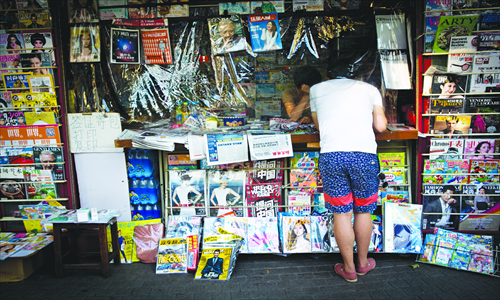
A person looks at magazines at a newsstand in Shanghai earlier this month. Photo: CFP
Wen Zhongju sat in a newsstand filled with more than 100 kinds of newspapers and magazines with contents ranging from political affairs to celebrity gossip in Beijing's central business district, with several modern office buildings standing behind her narrow kiosk.
"Nowadays fewer people buy newspapers and magazines. I can only sell around 30 pieces of newspapers and 20 copies of magazines every day, and customers are mainly elderly people," said the 38-year-old woman who has run the newsstand for more than five years.
The business is becoming challenging, as the profit for selling a newspaper is only 0.1-0.2 yuan ($0.02-$0.03) and for a magazine about 20 percent of its retail price, Wen said.
And for the unsold newspapers and magazines, some can be returned to the publisher, while others can only be sold as junk, Wen said.
To make a living, Wen also sells cold drinks and SIM cards. Besides handing in 3,000 yuan in monthly commission fee to China Post, a State-owned operator of most newsstands across the nation, she could earn about 2,000 yuan per month.
"If my son was not studying at a school nearby, I'll give up the business," she said.
Changing habits
The average daily sales revenue of newsstands in Beijing fell by over 50 percent this year from a year earlier, mainly due to the impact of the Internet, Li Guangdou, head of Beijing-based brand consultancy Wondersee, wrote in an article published last month on ftchinese.com.
The regular customers of newsstands are elderly people and primary and middle school students. Their purchasing power is limited, and they seldom buy magazines priced at more than 20 yuan, Li noted.
"Many young people are now accustomed to reading news on their smartphones and tablet PCs, posing challenges to the business of newspaper kiosks," Cai Ling, a culture industry analyst at Shenzhen-based CIC Industry Research Center, told the Global Times Thursday.
In the Beijing Subway carriages during peak hours, the number of people holding smartphones in their hands far exceeds those with newspapers.
Although data from World Press Trends show China has surpassed India to become the world's largest newspaper market with a circulation of 114.5 million daily newspapers in 2012, the country's retail sales of newspapers fell by 3 percent last year from a year earlier, according to Cui Baoguo, director of the Center of Media Management and Economic Studies at Tsinghua University.
"Metropolitan newspapers in big cities such as Beijing and Shanghai have been most affected by the Internet, while in second- and third-tier cities, the impact is not that obvious at the moment," Xu Yuan, an industry analyst at Media Dream Works, a research institute with Zhejiang Daily Press Group, told the Global Times Thursday.
Shrinking space
Besides the drain of buyers, newsstands are also becoming a victim of incessant urban construction and refurbishment by local governments to improve the amenity of the city's streets and footpath.
The last remaining newsstand in Zhengzhou, capital of Central China's Henan Province, vanished on April 2, a year after the local government's decision to remove the city's 421 newsstands because local authorities claimed the kiosks present a lot of problems for urban management, such as affecting road transportation and unauthorized sale of products. Now local residents can only buy newspapers and magazines in supermarkets.
"With all the newsstands demolished, I can seldom see newspapers besides those subscribed in the office, let alone buy newspapers," a Zhengzhou-based Internet user named Ye Zhimo commented on her Sina Weibo on August 5.
Local authorities in Nanjing, capital of East China's Jiangsu Province, has also strengthened management on the city's newsstands, including removing them from the city's main streets ahead of the Second Asian Youth Games, scheduled to be held in the city between August 16 and 24.
There were 665 newsstands in the city, but according to the local government's plan unveiled on April 22, only 600 newsstands will be kept.
Local newspaper Jinling Evening News reported on June 6 that only 390 newsstand operators have decided to continue the business under the government's new plan.
The rest of them chose to exit the business and got a 50,000 yuan subsidy from the government, the newspaper said.
Nationwide, about 10,468 newsstands managed by China Post were dismantled between 2008 and 2012, and currently there are 30,662 outlets under the management of the State-owned company, People's Daily reported on May 30, citing Liu Shaoquan, general manager of China Post's newspaper and periodical distribution bureau.
Liu said Zhengzhou authorities' action has not only hurt the sales of newspapers and magazines, but also reduced job opportunities.
According to him, previously the monthly sales revenue of newspapers and magazines in a newsstand could reach 3,000 yuan, but now the sales in a supermarket are only amount 500-600 yuan per month.
Newsstands also provide opportunities for those who are less competitive in the job market, the official said.
For instance, among around 5,000 newsstand job vacancies in Beijing, 20 percent have been provided to laid-off workers and 10 percent to disadvantaged people.
Lease of life
"Traditional newsstands that rely on sales of newspapers and magazines can not survive long, as the falling sales of print media is a global trend and an increasing number of print media have turned to launch digital editions," Cai said.
Newsstands can exhibit a city's cultural characteristics and are important to the country's spiritual civilization, so they should not disappear, Liu said, noting that local governments should support the development of newsstands.
According to him, China Post plans to invest 500 million yuan for building and renewing 10,000 newsstands across the country in the next two years, with the aim to provide local residents easy access to cultural products, he said.
Newsstands' business will also be diversified to cover express deliveries services, lottery sales and temporary medical care, Liu said.
Liang Fei contributed to the story