A Chinese soldier at heart
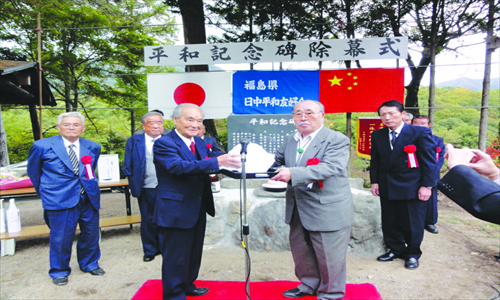
Yasuyuki Sato (front left) presents a gift to Masanosuke Inomata, head of a monument founding committee in Aizuwakamatsu, Fukushima, at an unveiling ceremony of a marker commemorating the Sino-Japan friendship in 2011. Photo: Courtesy of the Consulate-General of the People's Republic of China in Niigata
Old photographs from his days in China during wartime decorate the walls of a 13-square-meter room inside Japanese war veteran Yasuyuki Sato's house.
The 86-year-old welcomes visitors to his home in Fukushima despite his ailing health, showing gifts from Chinese friends and books about him and his lesser known comrades, who are among those who joined China's People's Liberation Army (PLA) after the Japanese surrendered in 1945.
An interview clip of Sato recalling his experiences in China plays on a TV set in the center of the room, which no more than a few dozen visitors have seen since he formally opened the home exhibit in June.
Sato decided to put together the exhibit this year, wanting to ensure that their voices would have some permanency in the world after he is gone - few of the Japanese soldiers who fought alongside the PLA are alive to tell their stories today.
"I especially want the younger generation to have a correct understanding of history, so that they can contribute to world peace," Sato, who is hard of hearing, told the Global Times through his good friend, Cheng Zixue, a founder of the Multicultural Reciprocal Creation Network (MRCN), a non-profit organization dedicated to bringing young foreigners and Japanese seniors together, who helped make the exhibition a reality.
The War of Resistance against Japanese Aggression (1937-45) is still an open wound for Chinese people in their memories, history books, museums and even TV productions today. Many Chinese people have grown up with feelings of hatred toward the Japanese, calling them "Little Japan" or "Japanese devil."
But not much is known about the estimated 33,000 Japanese soldiers like Sato, who were left behind in China after Japan surrendered in 1945. They fought battles with the Chinese army and people, Beijing-based Earth Weekly magazine noted in a 2001 issue - a chapter of history not found in Chinese textbooks.
A new frontier
Born into a poor family in a rural village of Fukushima in 1927, Sato only received six years of education before dropping out of high school. Like many Japanese people who believed that Japan would be victorious, he joined the army at age 17 in 1944.
That year in July, he was sent to Suiyang county in China's northeast border province of Heilongjiang. He was in charge of the border and railway security. A year later, Japan lost the war. Sato and his comrades were received at a Japanese school in China.
That was where he met members of the PLA. Sato cannot recall the exact date in October of 1945, but he clearly remembers the day when PLA soldiers broke into their school - Sato thought they were there to kill him. Surprisingly, they said they wanted their help.
"Through a translator, they told us that those who launched the war were Japanese militarists; they were like, but 'you are our friends. We need your help to liberate China, to fight against the troops led by Chiang Kai-shek,'" he said.
The demand eased Sato's anxiety of being killed, and he and 19 of his Japanese comrades joined the PLA even though they still had doubts about whether the Chinese soldiers could be trusted.
Sato was assigned to a hospital in Fengcheng, Heilongjiang to take care of wounded Chinese soldiers. Due to his outstanding service, he was chosen by the PLA to be the team leader of a medical team. The PLA taught Sato revolution theory, self-criticism and Chinese, different to the militaristic education he had received back home.
But worried that his Japanese identity might bring him trouble in China, Sato was instructed by the PLA to tell Chinese people that he was Mongolian.
By 1949, Sato had somewhat grown accustomed to life in China. And then, one day, upon a visit to an elderly woman's home in the countryside of Hunan Province, where he had been moved to work at another hospital, he fell under heavy questioning regarding his identity by her and several other villagers.
But after learning that Sato, a Japanese soldier had joined the PLA, they eased up and eventually let him go after telling him of the crimes that Japanese troops had committed in their village.
Sato spent a total of nine years in China before returning to Japan in 1953, four years after the birth of a new China.
His time away from home was influential on him and later led him to set up the Japan-China Peace and Friendship Association in Fukushima in 1997.
Even today, Sato, who has been back to China several times over the years to visit the places where he once joined forces with Chinese people, still considers China his second home.
Complex ties
In spite of steps taken by both sides over the years to repair ties, the Sino-Japanese relationship has always been a complicated one, and recent disputes over the Diaoyu Islands in the East China Sea have only stirred up tensions again.
The anti-Japanese sentiment in China exploded last year when thousands of Chinese people across the country took to the streets in protest against Japan's claims to the islands.
In Japan, stories like Sato's are rarely heard, partly in fear of retribution from national extremists.
But 94-year-old Japanese war veteran Ryokichi Kawashima surprised his people last year when he decided to run for a parliamentary seat and told the Tokyo Times that he had "had enough of nationalism talk in Japanese politics."
Like Sato, Kawashima fought during the war and said that Chinese people had helped him to get through the post-war years.
MRCN's Cheng, who befriended Sato when the two met 10 years ago at a local university Sato was invited to talk at, said that the exhibition has been warmly received by both Japanese and Chinese visitors.
"I hope that this personal exhibition will last forever, so that when people visit it they can learn an important part of history through Sato," said Cheng.