SCO faces regional challenges: Xi
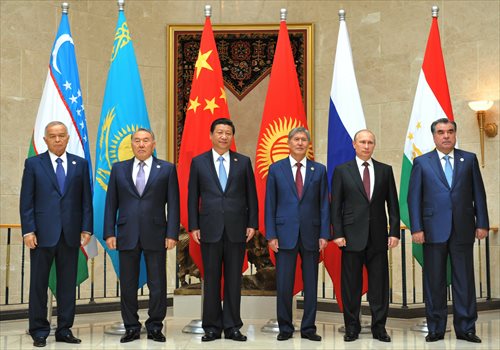
The Shanghai Cooperation Organization (SCO) is facing a combination of opportunities and challenges in the current complicated and volatile international and regional situations, Chinese President Xi Jinping said in a speech delivered to the 13th SCO summit held in the Kyrgyz capital of Bishkek on Friday.
"The three forces of terrorism, religious extremism and separatism, drug trafficking and transnational crimes have severely endangered the region's security and stability," Xi remarked, calling for concerted efforts to improve the legal basis for cooperation.
"SCO member states need to join hands in safeguarding regional security by fully implementing the Shanghai Convention on Cracking the Three Forces, further consolidating the cooperation system on law enforcement and establishing a response center to regional security threats," Xi noted at his first SCO summit since the country's new leadership took office in March.
Chinese experts saw anti-terrorism work as topping the agenda of this year's summit when reached by the Global Times, due to the complicated regional situation in the wake of the global economic downturn, the possible spillover of the Arab Spring movement, as well as the US decision to withdraw its military from war-stricken Afghanistan in 2014.
Ahead of his visit, Xi said during interviews with Russian and Central Asian media that new challenges to regional security and stability have been brought by a variety of factors, including the deepened adjustment of the world economy, the volatile situation in Western Asia and North Africa and the new situation facing Afghanistan, and also to the SCO's development and cooperation among its member states.
Among Afghanistan's neighbors, five are current SCO members or observers.
"The organization has been keeping track with the conspicuous domestic changes, as well as variables to the regional security situation," Chen Yurong, director of the Department for European-Central Asian Studies at the China Institute of International Studies, told the Global Times on Friday.
"The SCO is indispensable in meeting the new security challenges," Chen said.
The Afghanistan War, religious extremism and drug trafficking have become the external threats that could put Central Asia in jeopardy, Sun Zhuangzhi, secretary-general of the SCO research center of the Chinese Academy of Social Sciences, told the Global Times on Friday, pointing out that the organization also hopes to take part in Afghanistan's reconstruction from scratch and has been sticking to a long-held stance of "letting the Afghan people decide for themselves."
A long-term crackdown under the framework of cooperation among SCO member states is also needed against the "three forces", said Shi Ze, a research fellow with the China Institute of International Studies.
Ability to handle intelligence information, coordination in fighting terrorism and supervising the Internet should all be improved in the anti-terrorist move, SCO's Regional Anti-Terrorist Structure (RATS) Director of the Executive Committee Zhang Xinfeng was quoted by the Xinhua News Agency as saying on Friday.
Zhang said terrorists have been using the Internet to spread and propagate malicious information and instigate riots, and weapons have also been smuggled into the region.
"It is a fact that violent attacks seen in Northwest China's Xinjiang Uyghur Autonomous Region were also influenced by terrorist groups hiding in Central Asia, due to their close ties in history, ethnicity and religion," Zhang noted.
Sun said over the past 12 years or more, since the organization's establishment, it has been dedicated to the notion of "enhancing security on the basis of cooperation."
"Apart from new concepts and ways of cooperation, regular meeting mechanisms for senior officials from member states on economic, social and security issues have also been established to play a vital role in maintaining regional peace and stability," he said.
In this regard, several joint anti-terrorism military exercises among SCO state members have also been launched, according to Sun.
Since RATS was established a decade ago, it has passed over 300 resolutions and established more than 10 key cooperation mechanisms on maintaining regional security and combating terrorism, Zhang Xinfeng said.
Experts also said the joint military exercises among SCO member states are based on the diplomatic negotiation mechanism in a concerted effort to strengthen the anti-terrorism ability.
"The military exercises, totally different from the US-led strikes, showcase a political determination based on political cooperation," Sun said, adding that joint drills serve to establish and strengthen communication and mutual trust among member states through cooperation.
The SCO is destined to develop itself into a new model of regional cooperation and cannot become another European Union or NATO, Chen Yurong said.