A new high for the Chinese artist
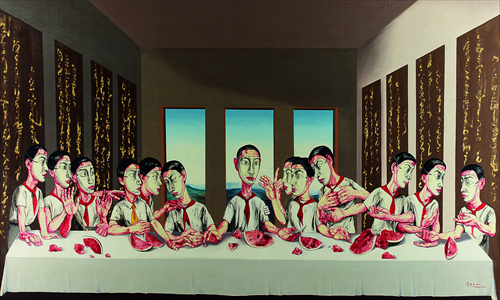
The Last Supper (2001) by Zeng Fanzhi sold for well over 100 million yuan at a recent Hong Kong art auction. Photo: Courtesy of Sotheby's
One of the biggest pieces of news shaking the art world this October is the record-breaking auction deal at Sotheby's Hong Kong 40th Anniversary Evening Sale on October 5.
The most famous piece of Zeng Fanzhi's Mask series, The Last Supper, was sold at a price of HK$180.4 million ($23.1 million), setting a new record both for a work of contemporary Asian art and for any living Chinese artist.
Created in 2001, Zeng's oil-on-canvas work is the biggest painting in his Mask series.
The huge bid caused a great many discussions in the Chinese art scene about Zeng and his high-priced piece.
In the booming market where every new high price sounds unbelievable, what does this record mean for the artist and the whole art market in Asia?
Name recognition
In this year's Hurun Best-Selling Chinese Artists rankings, released in May, Zeng's name was placed in the No.2 spot for living artists, making him the youngest in the top 30.
Just five months later, his name is back in the headlines for this sale.
Based on the total sales volume of the artist's work at public auctions in 2012, Zeng's artwork generated $73 million last year.
According to data from Art Market Monitor, Zeng's artwork has an 88.9 percent deal rate in recent years, meaning his work is successfully sold at nearly every auction it's presented in.
In fact, back in 2008, when Zeng's Mask series No.6 was sold for HK$76 million as the most expensive contemporary Chinese art at the time, the accumulated total capital generated for his pieces in the market was already No.1 in China and No.6 in the world.
Bao Yifeng is an art collector whose collections include pieces from Liu Ye, Ding Yi and a smaller piece of Zeng's Mask series as well as a print of The Last Supper.
Bao told the Global Times that one of his criteria for selecting artwork is knowing the artist personally.
In 2003, Bao worked on public relations for Zeng's exhibition at the Shanghai Art Museum and was impressed by Zeng's professionalism.
"He kept a very rigorous attitude. Both the technique and academic value in his work has foresight," said Bao, adding that Zeng sets very high standards in every aspect of his exhibitions, from creating a model to other smaller details.
An outlier or a trend
Commenting on the high price of The Last Supper, Bao sees it as a result of many factors - a special piece sold at a special time.
"The Mask series and the Xiehe Hospital series were both special," he said.
Bao explained that Zeng changes style about every five years. Works of the Mask series were created from 1996 to 2001 and after The Last Supper, Zeng went through a transition period and later started an expressionistic landscape series.
He finds that it is also a special time now with things happening such as the launch of the first Chinese mainland auction of Christie's and the China (Shanghai) Pilot Free Trade Zone, which may all influence the art market.
Evelyn Lin, Sotheby's head of contemporary Asian art, told the Global Times that the predicted price was HK$80 million, which was based on previous dealing records.
According to Lin, the fact that The Last Supper had been part of the collection of the Ullens couple Baron and Baroness Guy Ullens de Schooten since 2002 might have also played a role in this exceptional result.
"The collectors know about the Ullens and know about this particular work as the most famous one in Zeng's Mask series - the biggest one, which portrayed the largest number of people," said Lin.
She also mentioned that what is interesting about the work is the time period it represents.
Inspired by Leonardo da Vinci's world-renowned mural, Zeng transforms Judas into a man wearing a golden tie.
"The golden tie is a representation of capitalism, ... which suggests China's transition to capitalism," Lin interpreted.
With the attention comes controversy. Some critics say that the political connotations of the Mask series exceed its artistic value.
Bao sees the myriad connotations behind the series as a typical feature of contemporary art - the thoughts, ideas and interpretations are as important as the technique.
The 100 million era
Are we standing in the middle of a 100 million yuan era? The question has been asked by both media and critics since 2010 when several works from Qi Baishi and Li Keran entered the 100 million yuan category.
Wu Jin, editor-in-chief of Hi Art magazine, explained that although The Last Supper was sold at an unexpectedly high price, there were still works of art that were more expensive than The Last Supper in Sotheby's auctions lately.
There were also new personal records for other artists including Zao Wou-ki, Pan Yuliang and Liu Ye on the same night The Last Supper was sold.
For most living Chinese artists, the price of Zeng's The Last Super is a boost in confidence, but the effect won't be a direct one.
For Lin, The Last Supper is a special case because a healthy market cares more about the importance of individual work rather than the popularity or recognition of the artist.
In recent years, Zeng has continued to put out exhibitions internationally. As a result, his artwork increasingly is considered a good choice for both new and experienced collectors.
"I don't think many other contemporary artworks would be able to enter the 100 million yuan category," she said.
In a 2011 interview with TV host Yang Lan, Zeng said that there were buyers offering to pay 100 million yuan for 20 pieces of his Mask series.
Zeng once spent more than 10 million yuan to repurchase a work he did in his third year of undergraduate studies.
He probably knows the best that once a piece of art arrives in the market, whether through art galleries or auction houses, its no longer in the control of the artist, unless it is bought back.