Sins of their fathers
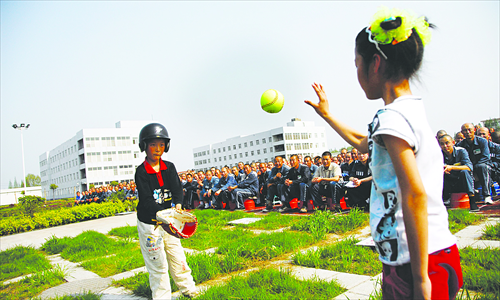
Two kids from Sun Village perform at a prison in Zhengzhou, Henan Province, during an organized visit to the children's parents serving a jail term, in April 2009. Photo: Courtesy of Sun Village
Jiejie, a 7-year-old boy, was crouching beside a coal stove, trying to skin a frog he caught in a nearby field so he could boil it for dinner, when volunteers from a non-government organization that assists prisoners' kids first found him. He had not eaten anything for two days.
"He wasn't given any meals by his uncle and aunt, who were punishing him for stealing money from them," said Li Xiaoshun, a volunteer who came to Jiejie's hometown in Handan, Hebei Province, to collect the boy. His father was jailed for robbery this May and his mother remarried and gave up the boy, Li told the Global Times.
The boy was left to his uncle, who has three kids himself, and considered taking care of Jiejie a headache.
"He lies and steals and has been very stubborn. Please take him away as soon as possible, we really don't know how to teach him," the boy's uncle told Li.
As a volunteer who has helped the children of convicts for over eight years, Li was not surprised at what she saw.
"I've seen kids coerced into becoming drug addicts, into begging and stealing," she said, adding that Jiejie was lucky to have the chance to receive assistance.
Jiejie's situation is not unique among children of prisoners, nor is it the worst. Two kids in Nanjing, Jiangsu Province, starved to death at home this summer. They had a father staying in jail and their mother, a drug addict, locked them at home and did not come back until they died of starvation.
The tragedy raised harsh public condemnation over the absence of a government role in taking care of convicts' children. As a result, the Ministry of Civil Affairs launched a pilot program, in Jiangsu, to include the children of prisoners in the social assistance scheme, categorizing them as being under a "difficult situation."
"For the government, which has ignored this issue for years, it is a big breakthrough, at least in terms of policy," said Deng Suo, a professor of children's welfare in Peking University.
The latest official survey done by the Ministry of Justice in 2006 showed that there are about 1.56 million prisoners and over 600,000 underage kids who have one or both parents in jail. Ninety-four percent of those kids have not received any form of social assistance.
"Unlike orphans and disabled children, prisoners' kids are not included in the country's children aid system, and there are no provisions in the law specifying which government department should be responsible for taking care of that group of kids," Deng told the Global Times. But for those kids, the mental sufferings is no less than for orphans or handicapped children, he said.
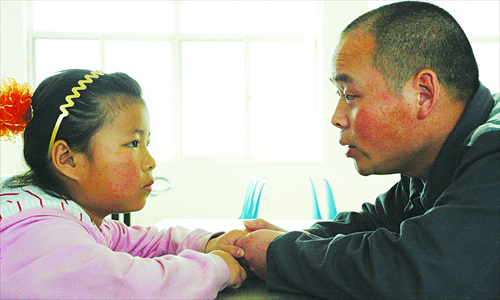
A girl visits her father He Yucheng during his jail term at a prison in Zhengzhou, Henan Province, in 2009. Photo: Courtesy of Sun Village
A labeled childhood
Li came to Handan representing Sun Village, a Beijing-based charity, after receiving a call from a Shijiazhuang prison, notifying her that the application by Jiejie's father to entrust his son to the charity was approved, and volunteers, accompanied by prison officers, could go and pick up the child.
Jiejie has been quiet and behaving meekly since moving into the Sun Village compound in Beijing, but Li soon discovered his habit of sneaking into the kitchen at midnight and gobbling down or sometimes pilfering leftover dishes.
"I just felt hungry," he said when he was caught, promising to never do it again. But after that, Li found several cold and dirty steamed buns under his folded clothes.
"It's normal for a kid who has lost parents and been despised by his relatives to feel insecure. But if he was not here being taken care of by people who understand that, he would be treated like a weirdo, a true 'criminal's offspring,'" said Zhang Shuqin, who founded the Sun Village in 2000 and has assisted raising about 5,000 children.
She said the label of "criminal's child" is hard to get rid of.
Chen Yongjie, 18, an accountant for the charity, used to be one of those kids. He still remembers overhearing a conversation between his primary school teacher and another student's parent.
"The parent told the teacher she was worried that her kid would be tainted by the criminal's child," Chen told the Global Times.
A Ministry of Justice survey showed that 13 percent of convicts' children drop out of school after their parents go to jail, and 2.5 percent become homeless beggars.
Statistics from the judicial department of Guangdong Province suggested that 9 percent of juvenile delinquents had either one or both parents in prison. The number in Beijing is 15 percent.
Song Xin, head of the Shaanxi Provincial Education and Research Association of Mental Health, said that without proper treatment, many kids who witnessed their parents being taken away by the police to be sent to prison would grow up with increasing hatred toward the police, the law, and even the judicial system, and become aggressive and violent.
The founder of Sun Village used to work as a prison officer and news editor at the Shaanxi Bureau of Prison Administration, so she said she knows better than anyone that prisoners, especially female, worry most about their kids but many don't even know where their kids are and what they are doing. "A prisoner, restless or desperate, could calm down on hearing good news from his or her child," she said.
However, the government appears not to be worried about these at-risk children, who have a higher risk of committing crime without enough care.
A study by Professor Deng showed that most assistance to these children is being done by NGOs, who are struggling to be officially recognized by the government.
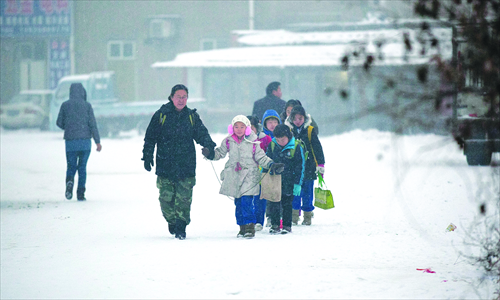
Kids walk in the snow at Sun Village of Tianjin, in February 2012. Photo: CFP
The absence of government
There are no more than 20 NGOs specifically devoted to assisting prisoners' children in China, said Deng.
Sun Village, a relatively mature one, has nine branches. Its Beijing headquarters, 70 kilometers from downtown, has 68 kids ranging in age from 1 to 18.
Many retired officials work at Sun Village, giving it a rich source of personal connections. It has managed to establish good relationships with over 30 prisons, where convicts can apply to send their kids to Sun Village and children can visit their parents in jail once in a year.
But some prisons refuse to work with Sun Village, because it is not officially registered as an NGO. Sun Village operates as a company and pays tax every year, because no government department would agree to be its supervisor, a must in China for an NGO to be formally registered.
Four NGOs that help children of prisoners reached by the Global Times share the same problem, which makes them not dare to raise money in a high-profile way.
"Again we're back to the old problem, there is no law that specifies which part of the government should be responsible. If an environmental NGO could find a part of the environmental protection department to supervise it, which department should we find?" said Zhang.
She tried the Ministry of Education, Ministry of Civil Affairs and Ministry of Justice, but none responded.
"No one will agree to be held liable if there is no law," said Lin Shidan, founder of Mercy Field Home, an NGO similar to Sun Village where 84 kids are living in Minhou county, Fujian Province. Lin said that things related to prisoners are sensitive.
"They're afraid of taking further responsibility if prisoners or their kids commit a crime," said Lin.
The Law on Protection of Minors does not say that the government should provide social aid or any form of assistance to convicts' children. When officials from a provincial women's federation visit Lin's NGO during traditional festivals, they only give gifts and money to those who are literally orphans.
Lin doesn't just face the problem of registration. Since 2011, she has been receiving calls from the local bureau of civil affairs, ordering her to stop receiving children.
Making at least two calls to the bureau of civil affairs, Lin was given the same reason. "Taking care of those kids is the government's job, not to mention that you're not a legal NGO." Yet she cannot help asking: What has the government done for those kids except for bringing more barriers to us?
While many prisoners' families call Lin and hope to place their children under her care, she is thinking about what to say when kids who are hoping to meet their parents during the upcoming Spring Festival find out they cannot because some nearby jails recently cut off their relationship with her.
Unlike Mercy Field Home, Sun Village has not encountered this type of interference. "I guess it is due to some personal relationships of many of our staff, who used to work in the government," said Zhang. Yan Mingfu, former deputy minister of civil affairs, is an adviser to Sun Village.
A late awareness
Peng Jianmei, director of the China Charity and Donation Information Center that is affiliated to the Ministry of Civil Affairs, admitted that the government hasn't done enough to help.
"The government only became aware of the problem of those kids in recent years, and it's changing," she said.
NGOs are limited in what they can do. They are not able to calculate how many children of prisoners are not receiving proper supervision. Their resources are used on taking care of the kids in their custody.
"An ideal model is that whenever a parent is put into jail, a social worker will visit his or her family, offering advice and financial support, if needed," said Peng Yan, a social worker with Beijing Fuhe Social Center, noting that only the government could initiate a policy like that.
In a forum held by the Charity and Donation Information Center, Peng said the public should give the government more time, saying it is a long process to build a concrete scheme for the care of prisoners' children.
Zhang, in response, quoted Gabriella Minstral, a female poet from Chile, saying, "Many things that we can wait for, a child cannot…to him we cannot say tomorrow, his name is today."