HOME >> WORLD
Rules of the Game
By Rajiv Theodore in Delhi Source:Global Times Published: 2013-10-24 0:48:02
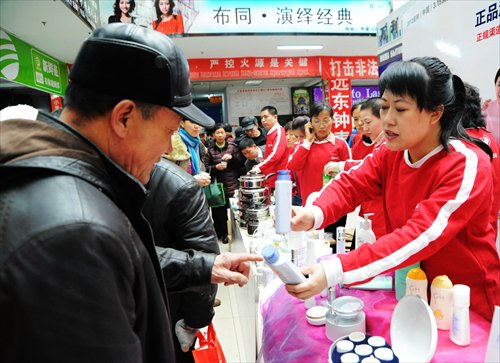
Salesmen promote Amway products in China's Heilongjiang Province in September. Photo: IC
These are trying times for direct selling companies in India. Dogged by an uncertain regulatory regime and hounded by authorities, these companies are now facing a bleak future.
Recently, leading direct selling US-headquartered brand, Mary Kay, quit India citing regulatory concerns and poor sales. The company had entered India in 2007 and invested close to $20 million. Amway, another global direct selling giant, has sounded its exasperation over the government's lack of clarity on regulations. Amway India's CEO William S Pinckney says that ambiguity over the definition of direct selling was creating confusion among distributors. A lack of clear-cut regulations has even halved their profit base.
Other firms like Modicare, K-Link and DXN are shrinking their operations and even thinking about packing their bags in the southern state of Kerala, stating police harassment ever since the arrest of the Amway India CEO in May.
Negative publicity
Their plight has been worsened by a string of recent events that created a lot of negativity around these companies. There was the high profile arrest of Amway CEO Pinckney and two top executives from the firm in Kerala on charges of duping, over-pricing and fraudulent practices.
Manish Goel, 41, who heads a multi-level marketing company, was charged with duping over 11,000 people out of several millions of rupees by promising them land. He had collected money from the public and distributed commissions to existing members for adding a new member to the scheme.
In another case, the Saradha scam that unfolded in West Bengal wiped out the savings of an estimated 400,000 people, driving many to suicide. Saradha's "chain letters" promised impossibly high returns on the assumption that investors would indefinitely multiply.
Such business activities had a bumpy ride in neighboring China too, where direct selling companies started doing business almost 20 years ago. They were accused of operating sophisticated pyramid schemes and other swindles.
Because of such concerns, China banned direct selling in 1998. Big direct selling companies disputed those claims, saying regulators simply misunderstood their business model. In 2005, after heavy lobbying from US companies, China lifted its ban. Since then, direct selling, with some modifications, has flourished in China, growing into an $8-billion industry.
Speaking to the Global Times, Zheng Xueqin, chief researcher at the China Brand Research Institute, agreed that direct selling operations are tightly regulated in China, which released long-awaited norms in 2005. There are a total of 38 licensed direct selling companies in China at present. However, Zheng said that there are still a large number of unlicensed direct selling companies in the country. "The market has a limited capacity. Some companies have to risk violating rules to grab a bigger market share," he said.
Lack of regulation
Presently in India, these firms work outside the ambit of a regulator. Over the past few decades, companies such as Modicare, Tupperware, Quantum, Oriflame, Amway, Herbalife, Forever Living and Free India did taste success in the country.
A finance ministry official in New Delhi told the Global Times that a single key regulator is required to regulate them and help identify entities that may have violated collective investment scheme norms. India is still working on a set of draft regulations for multi-layered-marketing companies which is expected to be released in a couple of months.
However, counsel for Amway K.P. Satheeshan told the Hindu newspaper, "There is no rule governing multi-level marketing in India. We would also like the government to formulate new rules so that Amway has a set of guidelines that it can follow."
Suresh Sukumaran, a former Amway user in India who was part of the chain, told the Global Times, "Principally they play on your economic insecurities by promising dream vacations and your aspirations to own cars and houses.''
An Amway spokesperson said the industry has been lobbying for regulations in order to weed out scammers. "The direct selling industry has been meeting officials from the ministry of consumer affairs, corporate affairs, ministry of commerce and finance ministry, to provide regulatory clarity," the spokesperson said. "Countries such as Singapore, Vietnam, Thailand, Malaysia, UK, etc., have direct selling laws that provide absolute clarity on what types of businesses are permissible and what are not."
New model
In China, the company claims to have reinvented its business model to suit the laws here. "After the Chinese government outlawed direct selling, Amway repeatedly revised its business model to build a reputation as an honorable corporate citizen. In 2006 it received a new license, and China is now its largest market," Amway's President Dough DeVos says in an article in Harvard Business Review in April 2013 issue. He describes the efforts the company made to stay true to the essence of its business, yet worked side-by-side with local officials to make significant shifts in the way it did business in that market.
The direct selling business in China is growing too. The sector posted combined revenues of over $16 billion in the country, or 11 percent of the world's total, behind the US and Japan, which had global market shares of 20 percent and 16 percent, according to data from the World Federation of Direct Selling Associations.
Posted in: Asia-Pacific