Scalpel as a paint brush
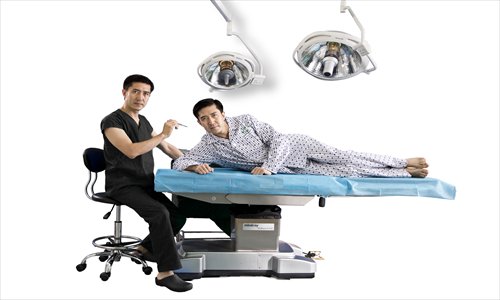
Han Xiao operates on himself in his performance art pieces. Photo: Courtesy of Han Xiao
Under the scrutinizing gaze of the audience, and with the help of two mirrors, one in front and one in the back, a man cut off a lock of his hair, injected himself with an anesthetic, and sewed the hair to his forehead.
This do-it-yourself hair transplant surgery was a piece of performance art.
Han Xiao, who calls himself "the one who performs plastic operations," turns these procedures into art. He recently brought Power of Body: Han Xiao's Scalpels to the Ullens Center for Contemporary Art in Beijing on October 20.
This is not the first open-plastic-surgery-as-performance-piece he has done. In 2012, he did double eyelid surgery and breast augmentation, the two most popular plastic surgeries right now, allowing the audience to witness the whole procedure.
But what is unique this time around, is that Han is operating on his own body - he is his own canvas.
Body as a canvas
Han is no amateur surgeon. He has extensive surgical experience and established his own plastic surgery clinic in 2008. At the same time, he never stopped pursuing his dream of art. He used to study at the Shandong University of Arts and Chinese National Academy of Arts, where he gradually turned from painting to performance.
"Performance art is the purest form of art," Han told the Global Times in an interview. "It is far away from commercial, because it cannot be preserved."
Han said that the body has long been suppressed by the mind and the spiritual realm, and that the differences between bodies determine the differences between people. Han explained that his philosophy about the body is one of the reasons why he chose the physical form as his subject of choice.
Han's philosophies and experience in plastic surgery all led him to one question: "Whom does my body belong to?"
He thinks the escalation of the plastic surgery market reflects the body-society relationship, where "the body is always being manipulated by society."
Han added that art should come from personal experience, whatever that may be.
"Plastic surgeries are the main parts of my life, so logically it became my performance art," said Han.
The choice to do the live hair transplant fits into this same logic: Because he has a small scar on his forehead, doing the transplant and healing the scar has long been one of his wishes.
Controversy
Ever since Han began incorporating plastic surgery into his performance art pieces, controversy has followed him.
Some are questioning whether a professional doctor can also be an artist, or whether this is just a commercial ploy to attract customers.
Art critic Xia Yanguo has reviewed Han's work harshly, saying that his actions were not art.
"We cannot see a clear artistic attitude and motivation. His breast augmentation is simply technical effects, not artistic effects," Xia said, referring to Plastics: Han Xiao's Action Art Exhibition, an August 2012 performance reported in the Southern Weekly in 2012 in which Han did a breast augmentation surgery in public.
Peng Feng, the curator of the 2012 exhibition, holds a different opinion. He said in his review, "Because the boundary between art and non-art is blurred, when contemporary art theorists judge whether something is art, the intention of the artist creating that work can be considered. If the creator made this work with an artistic intention, that work is art."
Peng employed art critic Arthur C Danto's theory to judge Han's work, saying that if the appearance of something caused debate in the art world, then it's art, whether the explanation is positive or negative. From this perspective, he thinks that Han's work is indeed art.
He also cited American philosopher George Dickie, who thought another way to judge whether something is art is to see whether it has already been accepted by art institutions.
Han clears that bar, as his pieces have been recognized by the China Central Academy of Fine Arts (CAFA), according to Qilu Evening News.
"Han was trained in the Shandong University of Arts and the Chinese National Academy of Arts, and held exhibitions in galleries," Peng said. "From this perspective, his works passed the tests of art institutions, and that means they are art."
New work and New York
The controversy does not seem to bother Han.
"CAFA recognized it as art. That does not necessarily mean it is art, and it doesn't matter either if they won't consider it as art," Han said. "The most important thing is that it captures people's attention and causes profound consideration."
He prefers not to be defined, since everyone has a different definition for "artist."
But he will continue to pursue his dream of art. According to Han, performance art is not the only part of his creative output, as his painting has been exhibited in Florence and New York as well.
Wednesday, Han presented a new work at the Festival Performance Malamut in the Czech Republic. The piece, titled Ji (meaning auspicious), involved Han injecting hyaluronic acid to the bridge of his nose. In Chinese physiognomy, a low bridge leads to bad luck.
Han told the Global Times that he will be spending more time overseas in the next few years. As New York is one of the main gathering places for contemporary arts, he would like to develop his skills there.
"Choosing art is choosing a lifestyle. This is what I like the best, the freedom," he said.