VW’s huge recall ‘won’t dent China market’
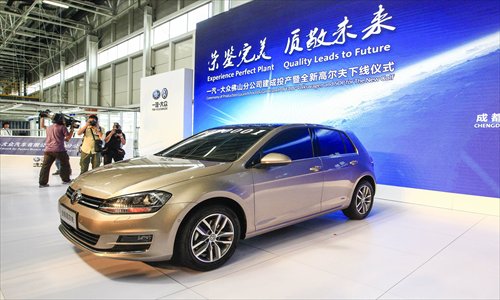
A Volkswagen Golf model shows at the launch ceremony for Faw-VW's Foshan plant in Guangdong Province in September. Photo: CFP
Though German carmaker Volkswagen's (VW) recent recall of more than 2.6 million vehicles worldwide, with a sizeable chunk of those affecting cars in China, the company's largest market, has caused confusion for Chinese consumers, it is unlikely to slow the company's quick growth on the mainland, according to analysts.
The recall, issued November 14, and one of the company's biggest in history, comes at a time when the German auto brand has just begun to speed up local production in China.
The company is recalling over 840,000 units of cars in China, 640,000 of which are being targeted due to the potential safety hazards caused by the use of synthetic oil in the vehicles' direct-shift gearbox (DSG) or dual-clutch transmission, according to a statement by China's General Administration of Quality Supervision, Inspection and Quarantine (AQSIQ).
In extreme cases, synthetic oil in the gearboxes can cause electric malfunctions, AQSIQ said. And the problem may become more prevalent in stop-and-go driving, and in hot and humid climates, said media reports.
Defects in the company's popular DSG technology were exposed by China Central Television (CCTV) in March this year, triggering a recall of over 380,000 units of cars in China.
Over 200,000 units of VW's imported and domestically produced Tiguan models are also being recalled due to faulty fuses in the vehicles' car lights, said AQSIQ.
VW has offered to change the fuses and replace the synthetic oil with mineral oil. But, the solution has been widely questioned by analysts and consumers, as mineral oil appears to be inferior to synthetic oil in terms of quality and is also cheaper cost-wise.
Perplexed customers
Wang Qiang, a VW Golf owner in Beijing, whose car is covered by the company's latest recall, said that he's quite confused over the situation.
"I don't think VW has given a clear explanation about the recall. I'm still not sure if the problem is caused by the oil or the DSG technology itself," the 32-year-old, who works in the finance sector, told the Global Times.
Wang said that he's read reports that say synthetic oil is supposed to be better than the mineral oil.
"But, it doesn't make sense [to replace the better oil with a cheaper one]," he said.
Song Jian, president of the Automotive Technology Research Institute at Tsinghua University, said that the price of synthetic oil is generally three or four times that of mineral oil, and pointed to a Chinese news portal report by chinanews.com, which said that the use of mineral oil could hasten the wear and tear of the gearbox.
But the public relations department of VW's China Group denied the oil-change was cost-related.
"Extensive research has confirmed that replacing synthetic oil with mineral oil in affected vehicles will eliminate the possibility of the issue (the default) occurring," the company said in a statement sent Tuesday to the Global Times.
VW is also assuring consumers that during extreme conditions, a driver will still be able to maintain control over his or her car until it comes to a complete stop safely.
But the CCTV report aired on International Consumer Rights Day in March said that DSG technology can cause problems such as a sudden loss or jolt of power while driving.
Gao Jian, an analyst at Shanghai-based industry consultancy LMC Automotive, meanwhile, said that VW's DSG technology is divided into two types: dry dual-clutch transmission and wet dual-clutch transmission - and that the former, applied to most VW cars in China, is more prone to incur problems like overheating, given the country's stop-and-go traffic conditions in many cities.
The DSG problem exposed by CCTV has also since prompted many discussions on the technological challenges of the system, questioning whether the use of dry dual-clutch transmission should be reduced.
"Dry dual-clutch transmission is sufficient for vehicles with smaller engines, but for vehicles with large engine capacities, it's better to use wet dual-clutch transmission," said Gao.
But despite the current problems, Gao noted that the dual-clutch transmission still represents the future trend as it is more energy-efficient.
"DSG technology has been in use for many years and we are committed to investing in and further advancing our innovative DSG technology," VW's China Group also said in its statement to the Global Times.
Little impact
Setbacks from the company's most recent recall, however, are unlikely to make a huge dent on its image in the Chinese market, as proven by VW's rapid growth sales this year - even after the CCTV exposure in March.
During the first 10 months of the year, the company sold 2.65 million units of cars in China, up 17.2 percent year-on-year. VW sales even surpassed that of General Motors in August, topping the sales list among foreign auto brands in China.
In a press release sent to the Global Times on November 11, VW's Jilin-based joint venture FAW-Volkswagen said it's set to meet its sales target of 1.5 million units this year.
"The recall won't affect much of our target," Li Pengcheng, a FAW-VW spokesperson, told the Global Times.
LMC Automotive's Gao agreed, saying that while the most recent recall may incur some negative reaction toward VW's DSG technology, it is unlikely to really affect sales numbers.
According to Zhang Yu, managing director at consultancy Automotive Foresight (Shanghai) Co, the recall was caused by minor defects and as such will not have much impact on VW, given that the cost of the recall to the company is also relatively low.
"Consumers still have faith in 'German quality,' so no big influence on sales is expected," said Zhang.
On the fast-track to expansion in China, the German automaker recently expanded local production at two new China plants through two of its Chinese joint ventures.
Its Foshan, Guangdong Province-based plant opened on September 25, with an annual capacity of 300,000 units. And a month later, on October 24, it began operations at its Ningbo, Zhejiang-based plant, which is expected to delivery the same production capacity by 2014.
"VW is very likely to continue to top the sales list among foreign auto brands in China for a long time," said Zhang, noting that the company's production capacity - a major factor that previously hindered VW's advance in the Chinese market - is taking off and is widely expected to accelerate the German carmaker's growth in China.