Bitcoin bother
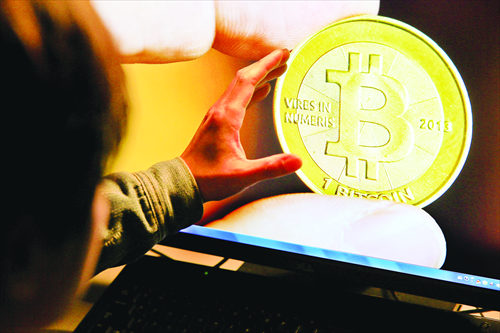
A Chinese netizen browses a photo of a Bitcoin on his desktop computer in Guangzhou, South China's Guangdong Province on December 9. Photo: IC
Once the preserve of cyber geeks or of dodgy traders, the virtual currency Bitcoin can now not only be used to buy goods online but also to pay for a degree at the University of Nicosia.
Yet the newfound popularity of the currency, which was worth almost nothing until April 2011 and which now trades at around $1,000, may well prove its undoing.
Market watchers and regulators are at odds over how Bitcoin should be handled, but as the currency gains prominence, voices warning against its use are getting louder.
France's central bank has slapped it down as "highly speculative" while China has said it should not be used as a currency and banned its banks from providing services and products related to Bitcoin.
The European Union's banking watchdog also issued a warning to the digital currency's users, telling them, "You should be fully aware and understand the specific characteristics."
Although US Federal Reserve chief Ben Bernanke said such virtual currencies "hold long-term promise," his predecessor Alan Greenspan was unable to give an intrinsic value to the currency.
Mysterious currency
Launched in 2009 as the invention of a mysterious computer guru who goes by the pseudonym Satoshi Nakamoto, Bitcoins are created through a complex mathematical formula.
Unlike hard currencies, it is neither backed up by a country's economic activity nor issued by a national authority.
Bitcoin's official website said "all that is required for a form of money to hold value is trust and adoption."
"In the case of Bitcoin, this can be measured by its growing base of users, merchants, and startups. As with all currency, Bitcoin's value comes only and directly from people willing to accept it as payment," it said.
With about 12 million Bitcoins in circulation at the moment, the currency's total market capitalization stands at about $10.57 billion. The formula used to create it limits its circulation at 21 million Bitcoins.
Germany decided to legalize it as a currency, so as to be able to tax it, while Bank of America's Merrill Lynch unit touted it as a significant tool for e-commerce.
After all, the digital currency can be transferred directly between smartphones or any other type of computers.
However, this also raises concerns that it could be used for criminal or terrorist activities.
Financial risk
In September, the currency came under the spotlight after US authorities shut down a website called Silk Road where illegal drugs and other illicit goods were being traded using Bitcoins. Some $3.6 million worth of Bitcoins were seized shortly after.
But the negative publicity also brought the currency to the attention of the real world.
Individual investors got interested, hooked by examples such as that of a young Norwegian man, who purchased $24 worth of Bitcoins four years ago only to realize that they are now worth the equivalent of $690,000.
China has become the biggest market for the currency as investors are attracted to its soaring value.
But the Chinese central bank has moved to clamp down on it, issuing a stark warning and imposing restrictions on how the currency is traded in the country.
"Bitcoin is a virtual commodity, does not possess the same legal status as currency and cannot and should not be circulated and used in the market as such," the People's Bank of China (central bank) said in a statement issued jointly with other financial regulators.
Chinese banks and other financial organizations are banned from providing Bitcoin-related services and products, it said.
It called for enhanced control of online trading platforms for Bitcoins to defend against the possibility of money-laundering, and pointed out investment risks faced by the public.
The Bank of France also underlined the same risks, cautioning that the "highly speculative" currency poses a "certain financial risk" to users.
"Even if the high volatility of Bitcoin is of possible interest for individual or professional speculators, they should be aware of the risks they are taking," the bank said.
Further, the convertibility of Bitcoin is not ensured and an investor could be unable to regain his investment, it warned.
The central bank noted that if a currency is to be used as a mode of payment, it should meet rules against money laundering, and its security platform should be monitored by the Bank of France.
Nevertheless, the bank has no oversight of Bitcoin, and called for action to prevent the virtual currency from being used in illegal transactions.
It also pointed out that the security of the virtual treasuries for the currency was not guaranteed by any authority.
In late November, a Danish company specializing in Bitcoin payments acknowledged that hackers had made away with 1,295 Bitcoins worth about $1 million.
And Chinese clients of a Hong Kong-based electronic platform lost the equivalent of 2.43 million euros in Bitcoins when the firm suddenly ceased trading.
Nevertheless, Bobby Lee, the head of BTCChina, the country's biggest Bitcoin trading platform, said the e-money offers a new investment option for Chinese people.
Bitcoin is "a global asset class" equal to common investment choices including gold, shares and real estate, Lee said.
"Bitcoin will go mainstream, I have full confidence. We hope to push this forward in China."
AFP