HOME >> BUSINESS
Party pooper
By Zhang Ye Source:Global Times Published: 2013-12-17 22:53:01
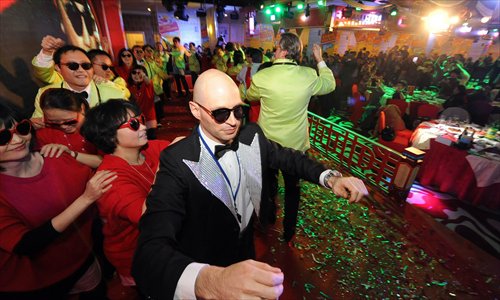
Employees of the Shanghai branch of Carrefour enjoy their year-end party on January 14, 2013. Photo: IC
With the end of the year approaching, this is normally a time when companies start organizing their year-end galas and parties, but the celebrations are looking a lot quieter this year, and companies that help organize the parties for a fee are feeling the pinch.One of the main reasons is the nationwide anti-extravagance campaign initiated by the country's new leadership last December.
Zhang Yu'nan, an employee with a State-run company in Shenyang, capital of Northeast China's Liaoning Province, said her company has not yet given an indication of whether there will be any annual party at all.
"We used to make preparations for the gathering in late November or early December, busily rehearsing our own performances, renting costumes and stage facilities from cultural services firms, and booking venues," she told the Global Times Thursday.
But this year, they might just have a simple and quick meal in early January, she said.
Many other companies are following suit, either by canceling parties or keeping them as simple as possible, giving companies that provide party services a hard time, said Liang Zi, manager of a Beijing-based cultural services company that has organized annual meetings for clients like IBM and China CITIC Bank in the past.
Fewer orders, lower budgets
"So far we have only got some 10 orders for year-end parties in both December and January, while last year we had more than 15 orders just for January," Liang told the Global Times Sunday.
Zhang Hu, founder and general manager of another Beijing-based cultural services company, also said his firm has gained a smaller amount of orders than last year.
High-end restaurants and hotels are also being affected. There has been an obvious fall in reservations of meeting rooms for annual parties, said a saleswoman at a five-star hotel located in Yanjiao Economic and Technological Development Zone in North China's Hebei Province.
"Last year, there were no vacancies for annual parties, but so far this year half of the meeting rooms have not been reserved yet, even though our average charges have been lowered by 20 percent," the saleswoman, who wished to remain anonymous, told the Global Times Friday.
Liang noted that as well as fewer orders, customers' party budgets are shrinking too. Most customers are spending less than 20,000 yuan ($3,294) on their parties this year, only about one-third of what they spent in 2012, he said.
Zhang Hu also told the Global Times Thursday that his company is under pressure as clients are trying to economize this year.
Frugality drive
The recent economic slowdown is another reason for companies cutting their party budgets, said Zhang Hu.
"The company used to have large year-end parties in places like the Water Cube aquatics center in Beijing, but with last year's business having been poor, we just had a brief meeting in our conference room, and each of us got nearly 1,000 yuan as a year-end gift. This year, we may get nothing," Xiao Ming, an employee at a Beijing-based marketing firm, told the Global Times Thursday.
The economic slowdown is a factor, but the central government's anti-extravagance policy is actually the main reason why so many clients have canceled or simplified their year-end parties, said Liang.
The new leadership has launched an effort to improve government working methods. After proposing eight measures last December - including simplifying meetings and speeches and exercising thrift - President Xi Jinping reaffirmed the importance of curbing formalism, hedonism and extravagance during a meeting in June.
State-owned companies are under pressure to adhere to the new mood of frugality.
According to media reports, some State-run companies plan to offer employees cheaper goods as gifts, such as toiletry items, rather than premium products like iPads, which reportedly have been offered in the past.
Brilliance Auto, a Shenyang-based State-run company, had already reduced its spending last year on its annual party, with more ordinary decorations in the meeting room, a person familiar with the matter told the Global Times Thursday on condition of anonymity.
The company may just have a small-scale meeting inside its factory this year, while in the past it often held its annual party in Sanya, a popular tourism destination in South China's Hainan Province, he said.
Meanwhile, many privately owned enterprises are also making more moderate party plans as they often invite local government officials, and the leaders will not show up if the party is too extravagant, said Liang.
Need to adjust
"During the past two years, many domestic enterprises wanted to introduce lots of kinds of entertainment at their parties, regardless of the cost," said Liang. But now, even though the year-end functions are partly designed to boost employees' company loyalty and morale, the firms want it to be less expensive.
Domestic party service providers are having to adjust to the new reality. Liang said that some of his rival companies are seeking ways to diversify and introduce business innovations.
Zhang Hu's company used to focus on year-end parties but now its main business is providing customized meeting services.
Liang's company is trying to expand into the advertisement sector, as well as offering services for high-end weddings. The firm is also considering setting up cooperative relationships with foreign enterprises that are less affected by domestic political guidelines, Liang noted. Guo Wen, general manager of Tianjin Ailun Vision Image Co, told the Global Times Sunday that while many domestic companies are cutting budgets for their year-end parties, all of his foreign clients are actually spending more this year.
For instance, dealerships for foreign auto brands such as Mercedes-Benz and Volkswagen have generally increased their budget to 150,000 yuan for this year's party, up 50 percent from last year, he said.
Posted in: Insight