Conquering inner space
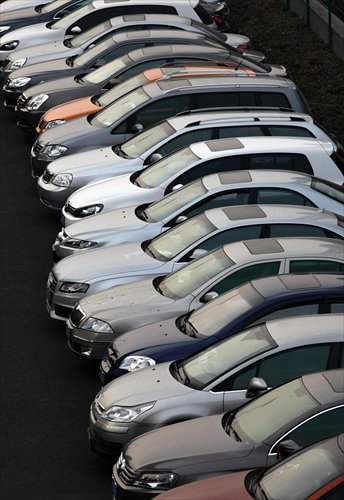
A downtown parking lot crammed with cars Photo: CFP
Parking in Shanghai's residential complexes comes at a premium as the number of private cars soars. An underground park in an average apartment complex will cost 300,000 yuan ($49,413) to buy or 800 yuan per month to rent.
And there should be fierce competition for parking spaces in the city. Shanghai, according to an eastday.com report, had 43,400 private cars on the road in 2000 and by the end of 2012 this number had exploded to 1.4 million. A city news radio station, 90.9 FM Shanghai, said that by the end of this year there were expected to be 1.6 million cars jostling for space on the roads and in parking spaces.
Many of the residential compounds where car owners live were not built to accommodate many if any cars. Before the early 2000s when the car boom hit the city, few developers had the vision to include underground garages in their buildings at all and many complexes built later did not provide underground parking.
Modern city planning regulations insist that new complexes have underground car parking but there are still problems. Not all of the space in these underground areas is available for car parking - civil defense regulations require that a certain amount of underground space should be set aside for emergencies.
An expensive increase
Parking at most top-end apartment complexes costs a fortune. Buying a parking space at Tomson Riviera by the Bund, according to the Shanghai Business News, cost 525,000 yuan in 2007 but now sells for 1.5 million yuan. However the acute demand for parking that the rest of Shanghai suffers is absent here. An underground garage with more than 400 parking spaces was built for its 180 apartments (a very small percentage of these have been sold) which, in effect, means an apartment to parking space ratio of more than 1:2.
The Top of City complex near People's Square is not quite so exclusive and an underground park here costs 450,000 yuan to buy or 1,000 yuan a month to rent. The complex here has an apartment to parking space ratio of 2:1 but residents seem to find that sufficient at present - there are no formal above-ground parking spaces. In many of these inner city complexes residents use company cars and drivers for transport.
One resident, a Chinese woman who called herself Kate, told the Global Times that she had dumped her plans to buy a car when she moved there because of its central location and access to public transport. "I think this is also related to the high percentage of expats (reportedly about 30 percent) among my neighbors - I have noticed that they tend to not drive at all," she said.
Chen Rangqiang is the complex's chief security guard. He confirmed that there were sufficient parking spaces at present but said he often received complaints from visitors. "The garage is divided into two sections - the main section is for the use of residents and the rest is for visitors. On weekends and holidays many of the visitors who drive here can't find a park underground - we have to put no parking signs around the apartments to stop them from parking."
Buying underground parking spaces in the city's mid-budget residential areas can be expensive as well. At a complex on Tianlin Road South in Xuhui district, and another complex in Dongxin Road in Putuo district, car parks cost 30,000 yuan. The Shanghai Morning Post reported that underground parking spaces in the city's mid-price neighborhoods cost between 200,000 and 400,000 yuan.
At low-budget complexes in outer suburbs, the prices are easier on the pocket. At one Songjiang apartment complex one of the 420 underground parking spaces will cost 100,000 yuan to purchase. In a 2012 report the Shanghai Morning Post said in "many housing estates outside the Shanghai Outer Ring Road," 100,000 yuan would cover the cost of an underground parking space and in some places 80,000 - 90,000 yuan was sufficient.
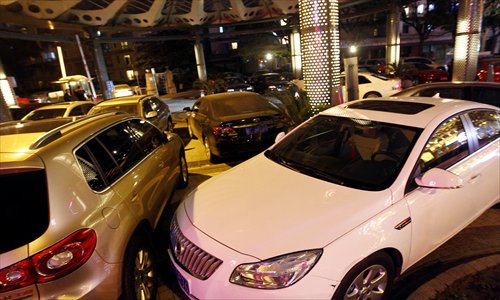
Cars park haphazardly near the entrance to the Da'an Garden complex in Jing'an district which has no space inside. Photo: Yang Hui/GT
Legal requirements
Because of the capital required most car owners choose to rent their parking spaces - a prime 300,000-yuan parking space costs 800 yuan a month to rent. Many complexes do not put all of their underground parking spaces up for sale because of legal requirements and the fact that certain amount of underground space has to be set aside for civil defense purposes.
Mr Zhang lives in an upper-mid-budget neighborhood near Zhongshan Park and his complex has an underground garage with 350 parking spaces which do not adequately serve the 1,000 apartments so many residents park above-ground. "There are 160 or so parking spaces above-ground and this helps, but I wonder what will happen when more people buy cars. For many years the complex has been crammed with cars everywhere. And they are not just in the places meant for parking but anywhere a car can fit," Zhang said.
Zhang's neighbor, Zhou Cong, told the Global Times that the difficulty in parking had resulted in him putting off buying a car. "As well as the initial expenditure, it frightens me to think of the time and energy I will have to invest to find a park. Because it's all based on a first-come-first-served basis there is always a possibility that I will have to find parking somewhere else - I know some people already have to do this. I don't want to have to face these problems after a hard day at work."
In other neighborhoods the underground garages are seldom full because residents find cheaper parking above-ground. At one Putuo district complex which was built in 2008, it costs 700 yuan a month to park underground but above-ground parking costs just 10 yuan a day.
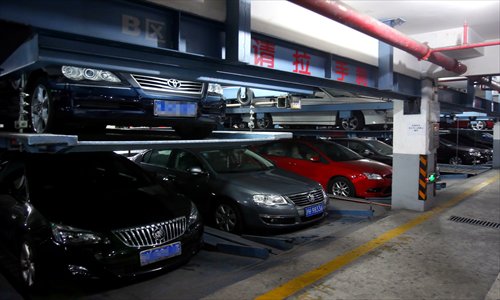
An underground parking lot at a city residential complex Photo: Yang Hui/GT
Most obvious
The shortage of car parks in Shanghai is at its most obvious in the residential complexes without underground garages. The Tianlin Xincun community in Xuhui district was built in the early 1990s and the design did not allow for parking. Half of the laneways between the buildings and lawns now serve as car parks which cost 15 yuan a day.
Inside the complex there is a food market which now finds itself blocked by parked cars. One resident complained, "The whole area now looks like a parking lot that also has buildings and stuff."
Huang, another resident said, "Nowadays the traffic jams are not confined to the streets but happen right here. The traffic is terrible and there is little room to maneuver. It's at its worst when cars are trying to get in and out and others are looking for parks." Because the lanes were so narrow, the 50-year-old man said, it was dangerous for young children and the elderly walking along while cars are moving in and out.
The danger of overcrowded complexes where cars block the access routes was tragically illustrated in the Kangtai complex in Baoshan district where in 2005 a fire broke out and later in 2008 a resident suffered a heart attack. Because the lanes were blocked with cars ambulances could not get close to the victims who both died.
Different solutions to the parking problems are being tried. The Taolin community, a 1990s-built neighborhood in Pudong New Area had 87 above-ground parking spaces in 2009 but more than 120 cars. With backing from the police and the neighborhood committee car owners can now park in 45 new "temporary parking spaces" in small nearby streets - but only during the night.
At another complex in Minhang district parked cars regularly fill the grounds and spill onto the surrounding streets on all four sides. One of the residents said he had got used to parking outside because he worked downtown and usually arrived home too late for a park in the complex itself. "This is not a real solution because parking here is riskier. It is common for cars to get scratched and I heard that a brand-new car was stolen one night."
Kangtai, the complex where parked cars blocked access to ambulances, has turned some of its lawns into parking spaces. More than 2,000 square meters have been converted to more than 600 parking spaces (varieties of climbing plants have been introduced to make up for the loss of other plants and shrubs). But when the Global Times visited the complex the lanes were still clogged with parked cars.
Layered systems
In many neighborhoods in the central Shanghai areas of Jing'an and Putuo districts underground garages have been boosted with multilayered parking systems. At a complex in Hongkou district a triple layer parking system has increased the number of spaces available from seven to 21.
But multilayered parking systems have not been widely accepted in Shanghai to date.
Li Yaren is the project manager of Local Expert, a city company specializing in these systems. "Last year a complex in Wuning Road approached us and we agreed to construct a five-layer system. We got all the equipment ready but now it just sits in our warehouse.
"Some of the apartment owners, people who weren't car owners themselves, openly protested about the plan to the developer and management office and it was cancelled. This is why most of our planned projects haven't worked out - people who aren't car owners object to it because it doesn't benefit everyone and they complain about noise and environmental problems."
Li said many multi-layer garages built in Shanghai were made too cheaply with inferior materials.