HOME >> BUSINESS
Super-cycle lives, driven on by emerging markets
By John Calverley Source:Global Times Published: 2013-12-29 21:23:01
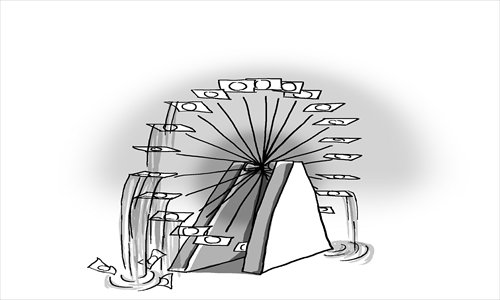
Illustration: Lu Ting/GT
In 2010, when we launched our "Super-Cycle Report," China was delivering almost 10 percent economic growth, India was thought to be catching up with China and a recovery seemed underway in the West. Fast-forward three years and China has settled back to a 7.5 to 8 percent growth pace, reflective of a more mature economy, India has slowed significantly due to reform roadblocks, while Europe is only just now emerging from a second recession.Given this mixed outlook, is it still meaningful to talk about a "super-cycle?"
We believe so. As we proposed in 2010, around the turn of the millennium the world entered a new period of unusually rapid economic development, "driven by the opening up of new (emerging) markets, increasing trade and high rates of investment, urbanization and technological innovation." We called this the third economic "super-cycle" - which was comparable with the fast-growth periods of 1870-1913 and 1946-73 - and suggested it could last until 2030 or beyond.
We have recently revisited our analysis and found that the super-cycle remains largely intact, despite the recent slowdown in many emerging markets. World growth is likely to average 3.5 percent for the 2000-30 period, well above the 3.0 percent rate in the prior 20 years, helped by an expected pick-up in global expansion over the rest of this decade.
What drives this optimism? The short answer is the continued rise of emerging markets, which is shifting the balance of economic power from West to East. In 1990, emerging markets accounted for only 20 percent of the global economy; today they account for 38 percent and they are set to represent 50 percent of the world economy by the end of this decade.
Despite their recent slowdown, we believe likely economic reforms in China, India, Indonesia, Nigeria and Brazil will provide renewed momentum to global growth.
China's new leadership is leading the way on reforms. This could enable its economy to deliver around 6 percent average growth between now and 2030. India could grow at 6 or 7 percent over the same period with the help of new reforms once the 2014 elections are out of the way. Contrast this with 2 to 3 percent average growth expected in the US and Europe.
Meanwhile, Africa, the Middle East and Latin America could grow between 4 and 6 percent until 2030, transformed by a growing population, an expanding middle class and rapid urbanization. Indeed, Africa has surprised everyone with a sharp acceleration in growth rates in recent years on the back of a growing domestic consumer base, improving governance and large energy and infrastructure investments.
Population growth is a major driver of the super-cycle, with most of the 1.1 billion increase in the global population expected by 2030 coming from emerging markets, led by Africa and South Asia. This will counter the effect of an ageing populace in China and the developed world. Even in China, where the labor force is set to decline, wages are likely to rise, encouraging firms to invest in higher value-added products and processes, boosting productivity. Also, there are still many rural workers who will move to Chinese cities over the next decade, driving urbanization.
Overall, 70 percent of global growth between now and 2030 is likely to come from emerging economies, taking their share to more than three-fifths of world GDP by 2030, from two-fifths today. Asia (excluding Japan) alone is likely to account for two-fifths of global GDP by then.
Trade will be another major engine of world growth as the global production chain continues to expand and deepen. Our forecasts show global trade could quadruple to $75 trillion by 2030, supported by new regional and bilateral trade agreements and the effects of globalization and the Internet, which are encouraging the trade in services as well as goods. South-south trade (or trade between emerging economies) is likely to account for 40 percent of world trade in 2030, up from 18 percent today.
Our forecasts are not without risks. The biggest concern is that China could slow down very sharply. But the history of middle-income traps suggests that China is in a good position. It has a relatively better-educated population, a higher share of high-tech exports and an appreciating real exchange rate, compared with countries falling into the trap in the past.
Clearly, reforms are needed to overcome structural challenges such as over-investment in some industries; high leverage in banks, State-owned enterprises and the government; and a frothy real-estate sector. If it overcomes these, China could become the world's largest economy by 2022 (against our previous forecast of 2020), surpassing the US economy. Yet, its per-capita income would still be less than one-third that of the US, offering significant catch-up potential.
Many other large emerging markets, including India, Vietnam and Nigeria, are still well below the level at which the middle-income trap looms and have plenty of room to grow further.
Ultimately, the sustainability of the super-cycle will depend on whether the emerging markets can restart stalled reforms. Many countries enjoyed rapid economic growth over the past decade, when it was easy to avoid tough decisions. Now, with slowing growth and increasingly demanding citizens, governments are under huge pressure to respond. All eyes are on Beijing, New Delhi, Jakarta, Brasilia and Abuja, to see whether governments can deliver.
The author is Global Head of Macroeconomic Research at Standard Chartered Bank.
bizopinion@globaltimes.com.cn
Posted in: Comments