The soundtrack of his life
For the record executive who offered a worldwide recording contract to a 19-year-old named Whitney Houston, seeing the decline into drug abuse that would destroy the career he'd helped build, and eventually her life, was difficult - although as a veteran of the music industry, it was not the first such tragedy he'd witnessed.

Clive Davis gave a speech at Minsheng Art Musuem last Friday. Photo: Courtesy of the venue
"She always trusted my judgment, except on the issue of drugs. She didn't listen. I wrote to her several times to persuade her to stop taking drugs. However, the power of drugs is too strong," recalls Clive Davis, the 81-year-old chief creative officer of Sony Music Entertainment who came to Shanghai last Friday to give a talk promoting his new autobiography, The Soundtrack of My Life. The Chinese translation of the book is due out in early 2014.
"For a while, I did believe that she stopped drugs," Davis told the crowd of music fans that came to Minsheng Art Museum to hear him reminisce. "Just a few days before her death, she came to visit me in Los Angeles, and I was still very sure that she was poised for a comeback. There was really no comprehension on her part or my part that she was flirting with death."
Davis, who was president of Columbia Records from 1967 to 1973, has shepherded many young talents to worldwide fame during his 50 years in the industry. These include Simon & Garfunkel, Carlos Santana and Alicia Keys.
During the talk, Davis recalled another of his most famous signings, who suffered a similar fate to Houston, albeit at the younger age of 27 - Janis Joplin.
"She was a tough girl who lived for today, and never worried about tomorrow," Davis said. He signed Joplin and her band, Big Brother and the Holding Company, soon after seeing them perform at the Monterey Pop Festival in 1967 - the height of the Summer of Love. "She hinted that the relationship between her and me was not necessarily so formally commercial, but could be more intimate, informal and closer," Davis said. When Joplin's manager was even more direct with Davis, and told him Joplin thought it only proper they seal the deal in a more physical manner, Davis politely declined. "At that time, I regarded it as a great compliment," Davis said.
Davis championed the song, "Piece of My Heart," from the band's album Cheap Thrills.
Radio at the time only broadcast songs that were under three-and-a-half minutes. "Piece of My Heart" was 5 minutes long. Davis convinced Joplin that editing a new cut of the song for radio play was a good idea. It became a hit, and helped drive sales of the album.
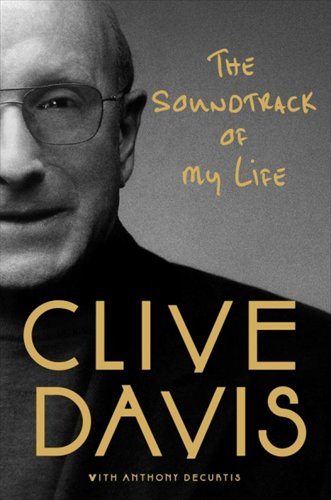
The cover to the Clive Davis autobiography The Soundtrack of My Life
Davis also signed Simon & Garfunkel in the early 1960s. He persuaded them to do the soundtrack to The Graduate, which Davis says helped turn the folk-pop duo into superstars thanks to songs such as "Mrs. Robinson" and "The Sound of Silence." At the time, the pair had been working on their own album, Bookends. The result was they had two albums in the charts simultaneously.
From such experiences, Davis has learned it is impossible and unnecessary to agree with artists all the time. "When the facts prove you are right, they will respect you much more," he said.
The book is in fact Davis' second autobiography. However, the first, Clive: Inside the Record Business, was published way back in 1975. Although by then Davis had already made a name for himself with industry insiders, there is arguably just as much that he has achieved since.
In 1972 he founded his own label, Arista Records, whose roll call would include Aretha Franklin, The Kinks, Lou Reed, Patti Smith and Ray Parker Jr. He also founded hip-hop label Bad Boy Records, which published records by The Notorious B.I.G., and LaFace, which put out discs by TLC, OutKast and P!nk.
The new book also takes a more personal slant than his previous memoir, including a look at his early years in Brooklyn, New York and becoming an orphan as a teenager, as well as him talking about his bisexuality.
When it comes to identifying how he became the record executive that people referred to as "Golden Ears" for his uncanny ability to pick out future stars, Davis says: "Of course, it is really important for a music businessman to have enough creativity and a great sense of forecasting, but I didn't realize it myself. I just did everything naturally."