Outrage as smog lingers over Beijing
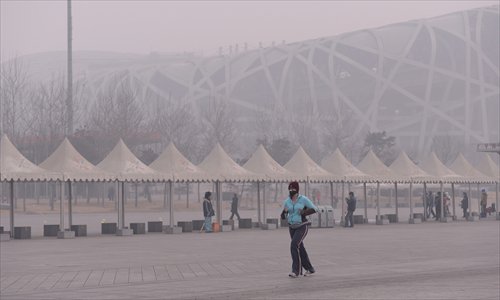
A woman wearing a mask jogs beside the Olympic Park in Beijing during smoggy weather on Saturday. Photo: CFP
Heavy smog has lasted for days in Beijing, triggering public criticism over the municipal government's inability to solve the problem.
At 8 am Sunday, the air quality index (AQI) at monitoring stations in the city's downtown areas read between 424 and 470 at Level 6, the highest level, indicating hazardous pollution, according to the Beijing Municipal Environmental Monitoring Center's website.
Heavy smog has continued for at least three days. On Friday alone, the Chinese Lantern Festival, 33 cities including Beijing and its neighboring areas saw heavy pollution, which was partly influenced by fireworks, the Xinhua News Agency reported.
Meanwhile, there has been mounting criticism over the lack of action by the municipal government.
China Central Television's business channel on late Saturday questioned why the government had failed to initiate any emergency response under such smoggy weather.
"Beijing municipal government, don't pretend to be blind in the smog," the channel said via its official Sina Weibo account. "The government should not shun its responsibility or turn a blind eye to the smog."
The channel tweeted twice on the matter in five minutes, and the comments were forwarded thousands of times as of Sunday morning.
The Beijing municipal government passed an emergency response system in October and made it effective the same month.
Under the system, high levels of smog are supposed to cause certain restrictions on car usage, and the highest levels of smog should result in schools being closed and industrial plants being shuttered.
However, since the program's introduction on October 22, 2013, the government has not initiated the emergency response once, despite periodic public accusations that smog levels were high enough to warrant it.
The government on late Saturday issued a blue alert for air pollution. China's meteorological alerts are blue, yellow, orange and red to indicate the lowest to the highest level of air pollution.
"The local government is very cautious about initiating the emergency response as doing so will cause great losses," Zhao Zhangyuan, a research fellow with the Chinese Research Academy of Environmental Sciences, told the Global Times.
"And even if the red alert is issued and relevant measures are taken, it will do little to reduce the heavy smog in Beijing," Zhao said.
To properly tackle the smog issue, all of society, especially some big enterprises, should reduce emissions, Zhao said.
On Sunday, the National Meteorological Center reissued a yellow alert for heavy smog covering Beijing, Tianjin, and the provinces of Hebei, Shandong, Henan, Shanxi and Shaanxi, which was set to gradually clear starting on Sunday afternoon as precipitation was expected in China's western Qinghai-Tibet Plateau and regions east of it in the following three days.
Xinhua - Global Times