Keeping it safe
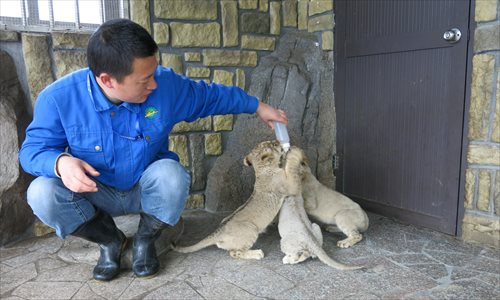
Shanghai Wild Animal Park keeper Li Shiqiang feeds three lion cubs. Photo: Du Qiongfang/GT
They are the behind-the-scenes people at Shanghai's zoos and animal parks but keepers are special breed of people, dedicated, and prepared to spend their lives working with and caring for animals.
Recently two keepers were killed in tragic accidents: a tiger killed a keeper at Shanghai Zoo and an elephant killed a keeper at Kunming Zoo in Yunnan Province.
The Global Times visited Shanghai's animal keepers to find out how they survive working beside dangerous animals every day and what exactly do they do.
Different personalities
"Animals have different personalities just like human beings. Some are outgoing, some are introverted, some are docile and others are bad-tempered," said 56-year-old zoo keeper Yao Jianzhuang who has been working at Shanghai Zoo since 1979.
A good example is the gorilla Happy who recently celebrated his sixth birthday at Shanghai Zoo. He's the most active gorilla in the family of six at the zoo and when visitors approach the enclosure he's the one who bounds up to the glass wall to attract attention while the others rest or play quietly in the background.
After decades of working with animals, Yao has become very familiar with their different characteristics. "Many of the animals have been in the zoo for 10 or 20 years and we have become very attached to them. We understand their body language and the way they make eye contact with each other, the way they tell each other that they want to play."
Yao and his colleagues start their working day at 8 am visiting the gorillas in their cages, giving them water to drink, checking and clearing up their droppings and spending time observing their behavior.
The gorillas are fed two meals a day and the keepers also give them snacks, leaves, barley, peanuts or watermelon seeds.
A grown gorilla can weigh 250 kilograms. They are strong, clever and can be violent. If a keeper leaves a cage unlocked they will reach through the bars and slide the bolt open. The zoo has strict procedures for the keepers to ensure there is no direct contact between the gorillas and their minders.
When the cages have to be cleaned the animals are moved to their play area which is also where the public gets to see them. The gorillas and keepers are separated at all times by two doors and if the doors are both open at the same time an alarm sounds.
"Gorillas can be destructive by nature. If they feel frightened or angry when they wake up, they sometimes try damaging the cage or the locks," Yao said.
Compared with primates, lions and tigers are not as intelligent but can be even more dangerous. At the Shanghai Wild Animal Park the big cat keepers know their 33 charges intimately and can tell their moods. At night when the animals have to be put back into their cages to sleep the keepers call them in from the spacious yard with whistles.
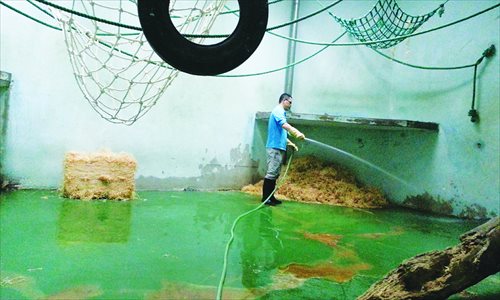
A keeper at the Shanghai Zoo cleans out the cage where the popular gorilla Happy lives and plays. Photo: Du Qiongfang/GT
Age limit
Ji Qiang has been working at the Shanghai Wild Animal Park for more than 10 years. "They are not as clever as primates, but by conditioning they know that it's time for them to come back and have meal," the 33-year-old explained. All of the keepers are young but experienced enough to stay alert and respond quickly if there are any problems. Keepers aged over 50 are not allowed to work with dangerous animals.
Whenever one of the big cats is injured - fighting between these creatures is unavoidable - Ji and his colleagues will stay with them and care for them until they recover.
The keepers who look after the gorillas are carefully chosen for their skills and dedication. There are only eight gorillas in zoos in China so the six at the Shanghai Zoo have a special status. Four of these six came from Rotterdam in the Netherlands and two were born and raised at the zoo.
"Our keepers are really devoted and don't let the gorillas fall ill. Gorillas are so big that it is difficult to treat them and give them medicine if they are sick.
"And they are very clever. If you mix medicine in their food, they can smell anything unusual and refuse to eat. It's very difficult to give one an injection. We have to lure the animal into a small cage and use a blowpipe to give it the injection. But we can't persuade it to come back into the cage if we need to give it a second injection. They cannot be tricked twice. So we must keep them healthy at all times," keeper Yao explained.
To keep the gorillas healthy the keepers prepare a range of vegetables and fruit for them and clean their food carefully. They disinfect the cages and keep the enclosure at a warm temperature. One of the biggest problems for the keepers, however, are the zoo visitors who try to feed the animals junk food, fried chicken or even cola which can cause blood pressure, cholesterol and blood sugar problems in the huge apes. Just like humans they then have to be treated with daily doses of medicine.
Unpleasant conditions
The keepers have to put up with working in often unpleasant conditions. The gorillas' enclosure is marked by a constant strong stench. Elephants eat 250 kilograms of hay per day which means that each elephant creates 60 kilograms of dung every day. The work of an elephant keeper is not just unpleasant and smelly but is physically hard as well. The 22 keepers in the herbivore section of Shanghai Wild Animal Park look after more than 400 animals. They use brooms and shovels to collect the dung and cart it to a truck. "Although the work is tiring, I still love the animals. If I close my eyes I can see in detail some of 400 animals in this section of the park," said Shen Hao. He began working at the park in 1995.
"You can only stay in this job if you really like and care for the animals. After looking after them for long periods we do feel closely for them and they return the affection," keeper Yao said. Just as keepers can tell the hierarchy of a group of gorillas, he said the gorillas can tell the relationships between their keepers.
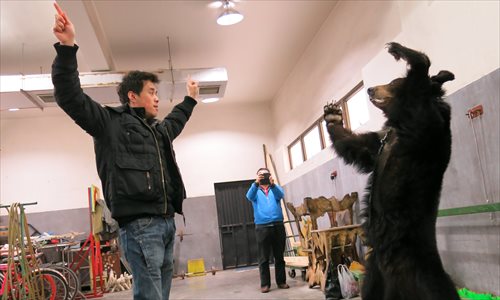
Trainer Wang Yun helps a black bear learn to dance at the Shanghai Circus World. Photo: Du Qiongfang/GT
Watching closely
Although the keepers have no direct contact with their charges, Ji and his colleagues have to know each one individually - if one of the animals shows signs of mating behavior, Ji and his colleagues watch closely and take notes. If an animal falls pregnant they have to be able to estimate the date of birth. "We need to take it to the delivery room beforehand. A lioness' pregnancy lasts about 112 days but newborn cubs struggle to survive if they are born outdoors. Although lions can give birth to three or four cubs at a time they have a low survival rate."
Many of the lions at the park were born in the park. Cubs that are weak or others whose mothers reject them are taken to the incubation rooms and hand raised by keepers.
Li Shiqiang has been looking after cubs and newly hatched birds at the park for more than 10 years. It's an often difficult job that requires patience and care - temperatures and humidity most be strictly controlled for these baby creatures.
Li's son was born at almost the same time he began taking care of newborn cubs and chicks and he was impressed at the detailed feeding instructions the baby animals had. "I thought I would feed my own baby this way and train him to eat properly. I wanted to set exact times and amounts for each meal. However the rules didn't work for him and the rest of my family were dead against my feeding rules."
A single mistake in feeding or in care can endanger the life of a cub. If a cub gets ill Li or one of his colleagues will have to nurse it back to health, spending all their time with it and sleeping beside it at night. One lion cub was born last December but it almost froze to death. Keepers found it nearly dead along with two other cubs and saved it by warming it in hot water initially and then drying it with a hair dryer. It took them a week to restore the cub to health.
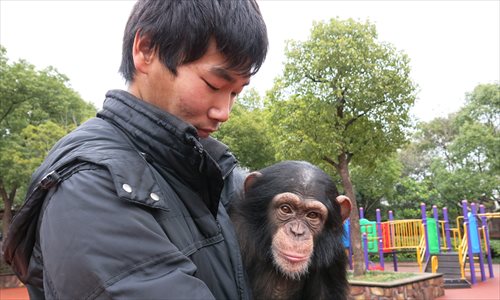
Keepers and animals grow to respect and appreciate each other. Photo: Du Qiongfang/GT
Close and personal
While keepers stay physically separated from their animals, animal trainers have to get close and personal. Wang Yun is a 33-year-old animal trainer with the Shanghai Circus World and has been living and playing with his bears, lions and tigers since they were cubs. He has formed a closeness with these otherwise dangerous animals and over the past five years has taught them to perform tricks.
By taking his pets for walks and playing with them Wang ascertained what they were naturally capable of and inclined to do. With rewards of bits of carrot or apple, for example, Wang has taught his three bears to clap, ride bikes, balance on a seesaw and walk upright on a ball. It takes at least two years to train a bear to perform at this level.
"It doesn't matter if they are primates or beasts like tigers or lions, I think they can all connect with and understand human beings. And the more time they spend with human beings, the cleverer they become. Whenever they make a mistake, they know this from the tone of my voice and they have good memories.
"Animals can be nasty. Sometimes, tigers will urinate on strangers and chimpanzees will throw their droppings at people. But they can also be very human. A friend who was talking to me once patted me on the arm and one of my bears ran up to attack him. It looked as if he wanted to protect me."
Curiously Wang was scared of animals when he was young.