HOME >> WORLD
Israel bombs Syrian posts over Golan attack
Source:Reuters Published: 2014-3-20 0:48:02
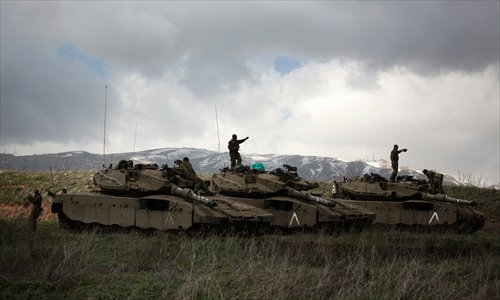
Israeli soldiers stand on alert on their Merkava tanks after being deployed on the border with Syria on Wednesday. Israel launched air raids against Syrian army positions and issued a stark warning to Damascus just hours after a bomb on the Golan Heights wounded four of its soldiers. Photo: AFP
Israel launched air strikes on Wednesday against Syrian military sites in response to a roadside bombing that wounded four of its soldiers, but both sides signaled they were not seeking further escalation.
The Syrian army, embroiled in a civil war, said one soldier was killed and seven were wounded in the air raids on three targets. Although Damascus condemned the Israeli attacks, it stopped short of any direct threat of retaliation and affirmed its focus on defeating insurgents.
Israel, by announcing the air raids, as opposed to its official silence about past strikes on arms from Syria believed destined for Lebanon's Hezbollah guerrillas, appeared intent on delivering a message of deterrence to President Bashar al-Assad.
"Our policy is clear. We hurt those who hurt us," Israeli Prime Minister Benjamin Netanyahu told his cabinet in public remarks.
"Syrian elements not only allowed but also cooperated in the attacks on our forces," he said, and by taking military action now the Jewish state wanted to ensure calm was re-established along its northern frontier.
The attack came less than a month after Hezbollah accused Israel of carrying out an air strike on one of its bases on the Lebanon-Syria border. It vowed at the time to respond.
In Tuesday's violence, a bomb was detonated near an Israeli patrol along a fence between the Israeli-occupied Golan Heights and the part of the strategic plateau under Syrian control. One of the four wounded soldiers was in critical condition.
Although suspicion in Israel fell on Hezbollah, Israeli leaders did not point a finger directly at the Shi'ite Muslim group, which is allied with Assad in battling a three-year-old rebellion against his rule led by Sunni Islamist insurgents.
While the Syrian army has a presence in the Golan, some areas are controlled by the rebels fighting to topple Assad, including Al Qaeda-inspired militants hostile to the Jewish state. Israel has voiced concern that it will increasingly become a target during and after the Syrian conflict.
Posted in: Mid-East