Stalled efforts to reform guardianship rules leave kids at risk
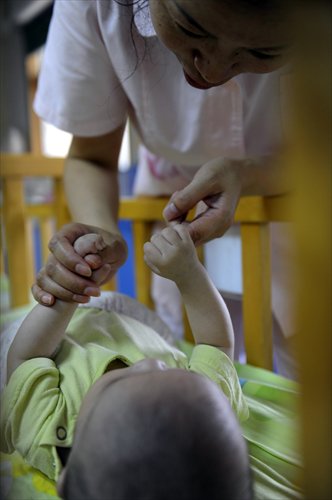
A worker cares an abandoned child at Nanjing Social Children's Welfare House in Jiangsu Province on May 29, 2013. Photo: CFP
When the starving 2-year-old girl fled her mother's apartment in Nanjing, Jiangsu Province, after being trapped inside for three days, authorities were well aware of the awful conditions facing the girl and her 1-year-old sister.
But police sent her back to the drug-addicted mother, who was their only legal guardian. The sub district office also refused to send the two girls to an orphanage, because they had a mother.
It wasn't the first time the girls had shown signs of desperation. After being locked in the apartment without food on a number of occasions, the girls had cried out for help, but each time, they just received some food.
Once, their great-grandmother had tried to intervene, and begged the authorities to put the girls in a welfare house, but the request was rejected.
It was only when the two girls starved to death that people really started paying attention.
In September 2013, the mother, Le Yan, was found guilty of intentional homicide after she left the girls alone for several months. The father was out of the picture, but had been released from prison in August, after doing time for drug offences.
But the sad truth is that this case is not unique. All over the country children face horrific conditions caused by neglect and abuse, but authorities are loath to intervene unless the children are orphans.
"Children who have parents but are often neglected or abused are not protected by the welfare system since they have not been abandoned. This is not subject to any regulation or laws in China," said Yao Jianlong, a professor at the East China University of Political Science and Law, and director of the Protection of Minor's Law advocacy group under the Shanghai Law Society.
"Legislators' concepts of guardianship are outdated, they believe children are parents' personal property, and that it's always best for children to stay with their parents.
They think that even if they die, it's better for children to die at home," Yao said.
But Yao is among those pushing for change, and new laws are being mulled in an attempt to reduce the frequency of such tragedies.
Free to be irresponsible
According to the Law of People's Republic of China on the Protection of Minors, guardianship can be revoked by a court if a guardian fails to fulfill his or her duties or infringes on his ward's legitimate rights and interests.
However, the regulations are quite vague and there has yet to be a single case of a parent being deprived guardianship since it was implemented in 1991, according to Fang Ming, a lawyer specializing in family and criminal law at the Wanfang Law Firm in Shanghai.
"It is a pity that there are no detailed regulations to deprive irresponsible parents of guardianship, we can only condemn them morally," Fang told the Global Times.
Under Chinese law, parents will be charged with abandonment only if they leave their child in a life-threatening situation. The crime of abandonment can receive a penalty of up to five years' imprisonment.
Over the past five years, there have been around 30 cases of abandonment in Shanghai, in which children suffered serious injuries or even death, but most of the guardians receive suspended sentences, according to Yao.
In March last year, Liu Baoguo, a vegetable vendor in Shanghai, was given a year in prison, suspended for a year, for the crime of abandonment. In June 2012 he had left his prematurely born baby girl in a green belt because he feared high medical fees. The girl later died of organ failure.
In October of last year, a couple from Shanghai left their son to a nanny surnamed Mao and paid her 7,000 yuan to care for the baby for two months at Mao's home.
However, two months later they disappeared.
Police discovered that the baby's father was a drug addict. The only relative that could be found was the boy's 85-year-old grandfather, who also refused to take the baby, saying his daughter didn't want the baby and that he had since cut off all contact with her.
"Even though the couple neglected the baby and failed to fulfill guardianship, as long as the baby was not injured, they would be given only up to five days administrative detention," Yao told the Global Times.
"But if it was in a foreign country like the US it would be different," he stated.
In the US, the child welfare system is designed to protect children from getting hurt mentally or physically, and to ensure their basic needs are met. According to US law, American states can intervene in the family in emergencies and protect children's rights. Anyone, including children or neighbors, can contact local social services agencies to report suspected child abuse or neglect, and social workers will move the child to a safe place for temporary care.
"If the case happened in the US, the court would decide whether to return the baby to his original guardian or send him to a foster family according to evidence uncovered by investigators and the guardian's statements," Yao added.
Children in the cracks
China's current children welfare system only protects orphans. When an abandoned baby is discovered, he or she is sent to a temporary care center, and the local public security bureau publicizes a notice to look for the baby's parents.
If the parents don't appear within three months, the security bureau will issue a document to prove the baby was abandoned and send him or her to an orphanage.
According to Chen Lan, founder of the Home of Little Hope, a Shanghai-based non-profit child abuse prevention organization, the country should become these children's final guardian.
In China's Criminal Law, the maximum sentence for the crime of abuse is only seven years, which has made the crime a protective umbrella for irresponsible parents.
A mother in Hangzhou, Zhejiang Province, violently knocked her daughter's head against a wall just because the girl knocked over a bottle of milk on a bed. But the mother was sentenced to only two and a half years.
China's current law only emphasizes family members' guardianship over minors, but does not regulate the guardian's ability, and is quite vague on when government power can intervene if the guardian does not carry out his or her duties.
There are no regulations to evaluate whether to revoke guardianship and no detailed rules on how to punish them.
To define these, Yao suggested the government should consider the child's best interests when evaluating guardianship. "Normally, irresponsible guardianship includes maltreatment, sexual abuse and neglect," Yao said. "When taking children away is better than leaving them with parents, we can say the parents are incompetent," he added.
According to an online survey jointly conducted by the China Philanthropy Times and news websites ifeng.com and sina.com.cn this January, among 7,912 survey respondents, 73.4 percent agreed that irresponsible parents should have their guardianship revoked, and only 20 percent opposed it, saying that kinship is the most important relationship for children and a perfect orphanage cannot offer family affection to children.
"We have no organization to accept these children, even if we built one, it would require lots of resources to train qualified social workers to help and rehabilitate children psychologically," Zhang Zhenyu, a professor from the Shanghai Psychological Society, told the Global Times.
Though the public is well aware that children abused or neglected by parents live miserable lives, there are fears of the ramifications of intervention. "Because we don't have such a system, no one knows how to evaluate parents and which organization could take care of the minors," said Yao.
Holding parents accountable
The Shanghai Women's Federation raised a proposal with the Shanghai Municipal People's Congress this March which suggested that parents who abandon their babies should be investigated and be held legally accountable for failing in their duties as guardians and forcing orphanages to take their children.
"Especially in regard to the babies left in hospitals. They have parents and thus cannot be admitted into orphanages. So the hospitals where the babies were born have to take responsibility and raise them at the hospital," Zhou Miao, vice director of the publicity department of the Shanghai Women's Federation, told the Global Times.
In the past five years, more than 1,000 babies have been abandoned in hospitals in Shanghai, but only around 50 of them have detailed information about birth parents. "In the Children's Hospital of Fudan University, seven or eight babies have been living in the hospital for at least two years. It's also a headache for the hospital," said Yao.
China has pledged to implement stricter nationwide supervision over the protection and guardianship of minors within this year.
Signs of action
The Supreme People's Court, the Ministry of Civil Affairs and the Ministry of Public Security announced this January that they would jointly make a guardianship intervention system, which would be released by the end of this year. The system will deprive guardians of guardianship if they seriously violate the rights of their charges.
"To those who refuse to fulfill guardianship obligations or injure minors, our intervention system will transfer guardianship and set a legal bottom line for protecting minors," said Zhang Shifeng, deputy director of the Ministry of Civil Affairs' social welfare office, the Xinhua News Agency reported.
Cheng Fucai, the deputy director of the Shanghai Academy of Social Sciences, suggested that the Ministry of Civil Affairs should accommodate the minors in rescue centers.
"The orphanage only receives orphans, but rescue centers for homeless children could help. The number of homeless children who live in the rescue centers is not excessive, and many centers still have room available," Cheng said in an interview with the Xinmin Weekly.
"Secondly, subdistrict level governments should set up community service centers for children, so that district officials can have follow-up visits and conduct guardianship evaluations of the families," Cheng said, pointing out that this would mean that if the guardians become qualified, children could potentially be returned to their families.