HOME >> CHINA
Hook, line and stinker
By Xinhua – Global Times Source:Xinhua - Global Times Published: 2014-4-2 21:03:01
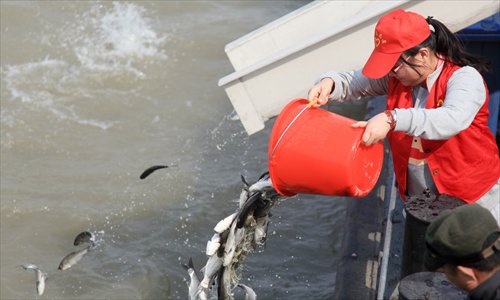
A worker releases fish fry into the Yangtze River in Zhangjiagang, Jiangsu Province on March 18. The activity has been held for the past few years to preserve the fishery resources. Photo: CFP
Shao Guoqing hauled his boat and fishing equipment onshore as the Yangtze River, dubbed China's Mother River, entered its three-month fishing moratorium on Tuesday.
The annual moratorium, which extends for the entire length of the river and began in 2002, hopes to restore fish resources in the Yangtze River, whose aquatic ecosystem is on the verge of collapse. The ban also applies to the river's tributaries.
"My wife and I will seek jobs elsewhere during the three months," said Shao, a 42-year-old fisherman from Wuhan, capital of Central China's Hubei Province. "We might come back at the end of June, or move on. Fishing in the Yangtze has become increasingly difficult, with fewer and smaller fish."
The fishing moratorium applies to 10 provinces and municipalities, but government subsidies are being offered to fishermen to minimize their losses. Authorities in Hubei, which has the longest moratorium period, have provided a 240 yuan ($39) monthly subsidy to each fisherman household this year. In Nanjing, Jiangsu Province, the monthly subsidy per fisherman household is 500 yuan.
As experts debate whether lengthening the fishing moratorium will save the Yangtze, the river is also suffering effects from excessive waterway development, growing pollution and other problems that pose serious ecological and social challenges.
Lost paradise
The ban not only affects Shao's family but some 150,000 people who work in the fishing business along the Yangtze River.
Though the ban means less income, families are generally supportive of it.
What was once a river of abundance is now a barren one because of years of over-exploitation, pollution and busy waterway traffic.
"When I was a child, I remember half a day of fishing was enough to fill the whole boat," said Shao. "These days you spend a couple of days on the river and get nothing. A fish weighing over a kilogram is a rarity."
There are only about 1,040 finless porpoises in the 6,300-kilometer-long Yangtze River and two lakes linked to the waterway, according to a survey in 2012 by the Ministry of Agriculture, the Chinese Academy of Sciences (CAS) and the World Wildlife Fund.
Scientists warned that finless porpoises, a barometer of the river's ecological conditions, may die out within 10 to 15 years if tough measures are not taken.
In 2006, a survey found no white-flag dolphins in the Yangtze River, suggesting they were "functionally extinct," which means the population is too small for the species to reproduce.
Losing battle
The three-month-long fishing ban can give fish some breathing space, but it cannot reverse a declining trend.
"What follows the ban every year is fishing activity with a vengeance," said Wang Ding, a research fellow at the Institute of Hydrobiology under the CAS.
The Yangtze River has more than 160 fish species that are unique to the river, but more than half of them haven't been spotted in recent times, according to the research conducted by Zhao Yimin, director of the Yangtze River fishery resources management committee under the Ministry of Agriculture.
A fish can grow to 1.5 kilograms into November, but fishermen cannot wait and catch them in July when they only weigh 50 to 100 grams, said Cao Wenxuan, another CAS academician.
"Even boats without fishing permits sneak out in the dark to fish, a situation difficult to manage as we are understaffed," said Zeng Jiqing, head of the fishing administration in Xinzhou district of Wuhan.
Under such circumstances, Cao proposed a 10-year fishing ban. Three to four reproductive cycles could happen during the 10-year period. It would significantly boost fish numbers and improve the ecosystem, he said.
The ban would not affect consumption as fewer than 100,000 tons of fish are caught in the Yangtze River each year. This number is minimal compared to some 25 million tons of annual freshwater fish caught across the country, Wang said.
Despite his lobbying, Cao's proposal has gained little traction and slight progress, even though the Ministry of Agriculture has considered it.
Troubling dilemma
To restore the Mother River to its former glory, much has to be done, with the balance of economic growth and environmental preservation being the keys.
"The two appear to be in perpetual conflict," said Wang Ding.
The government plans to make China's longest river a "golden waterway" that bolsters growth of the Yangtze River Economic Belt.
However, an economic push could aggravate the ecosystem of the Yangtze River.
When more boats enter the river the waterway will become busier. Fish will have less room. To make the situation worse, the Yangtze River is likely to become more polluted as more houses and factories get built along the banks when the economy picks up.
Li Jiale, a professor with Shanghai Ocean University, told the Global Times that construction of dams is also harming fishery resources.
While there are dozens of hydropower stations, including the Three Gorges Dam, along the Yangtze River water system, experts have long warned they have decimated the habitats of river life and blocked spawning paths for fish.
Zhang Boting, a senior engineer from the China Society for Hydropower Engineering, told a hydropower convention in November 2013 that hydropower development is not the major reason for the ecological collapse in the Yangtze River.
Zhang claimed hydropower projects could actually benefit the ecosystem, noting that artificial breeding has helped save some endangered species. However, he conceded that construction of dams can also negatively impact the spawning migration of fish and admitted the Yangtze River's ecosystem has deteriorated significantly.
"In the end it all boils down to the simple question: What do we want, a Yangtze River full of life or a 'golden' yet lifeless river?" Wang said.
The answer to such a question could be optimistic if both the government and the public work toward developing better environmental protection awareness. However, problems outside the fishery industry, including illegal industrial discharge and water transportation, are major hurdles an integrated taskforce must overcome to save China's Mother River.
Xinhua - Global Times
Posted in: Society