HOME >> CHINA
Betting on smog
By Fang Yang Source:Global Times Published: 2014-4-9 18:13:01
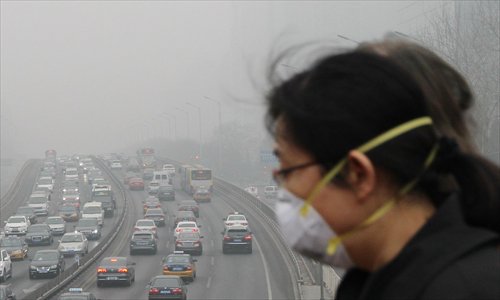
A woman walks on an overpass in Beijing wearing a mask in heavily polluted weather on March 27. Photo: CFP
Jia Cheng, a 19-year-old college student in Chengdu, Sichuan Province, bought some rather unusual insurance just before the recent Tomb-Sweeping Day.
"I thought it was very likely it would be smoggy during the holidays, because Chinese people traditionally burn incense at that time to remember and honor their ancestors," Jia told the Global Times.
Jia had bought a 10 yuan ($1.6) "smog insurance" policy which covered the period from April 1 to 7, with the three day holiday falling on the last of those days.
In exchange for premiums of 10 to 15 yuan, insurance company Ping An had promised to cough up as much as 50 yuan a day if the Air Quality Index (AQI), which measures particulate smog matter of 2.5 microns or less, hit more than 300 for seven consecutive days.
"I saw the insurance policy ads online, and I decided to take a shot," Jia said. However, the weather in Chengdu was quite good during the holidays, with rain and fresh air.
The heavy smog has raised significant concerns over health effects, particularly for children, the elderly and people with weak respiratory systems.
"The insurance is a publicity stunt, but it also encourages the public to care more about their health," Shanghai resident Li Kui, who also signed up for the policy, told the Xinhua News Agency.
Ping An predicted that the policies would be sold out from March 19 to 26, although it did not specify the number of policies it issued, Xinhua reported earlier.
However, the smog insurance policy, along with other smog insurance products launched by Ping An and another insurance firm, the People's Insurance Company (Group) of China Ltd (PICC), were shut down by regulators on March 24.
It was only about one week after the policies were launched. Both companies confirmed that the sold policies will still be honored.
Hazy cancellation
China's insurance watchdog China Insurance Regulatory Commission (CIRC) didn't specify the reasons why the policies were canceled. However, insiders from the CIRC told media that the insurance runs counter to the nature of insurance policies and it appeared more like a lottery than an insurance product.
In another canceled smog insurance policy that Ping An offered for residents in seven cities including Shijiazhuang, Beijing and Shanghai, customers could pay a premium of 100 yuan and receive medical examinations to check their lung functions when the AQI exceeded 300 for five consecutive days.
Under China's assessment system, an AQI value over 100 is unhealthy and one over 300 is considered hazardous.
Ping An also partnered with online travel agency ctrip.com to sell smog insurance for tourists. The short-lived policy covered six popular tourist destinations that are prone to smog. Tourists who purchased a domestic travel itinerary ranging from three to seven days through ctrip.com had the option of purchasing "smog insurance" at premiums of 10 to 15 yuan.
Ctrip and Ping An promised to give a daily compensation of 50 yuan to travelers when the AQI of their destination reached a fixed level. The policy required the insured traveler to stay in the city for at least two days.
Jia said he checked the specific compensation standard of the smog insurance and previous data afterward.
"Even during severe bouts of smog, readings of 300 or above don't usually last more than a couple of days," Jia said, adding that the insurance was all about probability.
"I feel that the insurance company just took the chance to make money while people don't have sufficient knowledge about smog and insurance policies," Jia said. "People were more likely to give it a try because it didn't cost much."
The PICC's smog insurance targeted Beijing residents and cost 78 yuan to 154 yuan per policy for a one-year contract. It promised to pay up to 1,500 yuan to customers that went to the hospital for smog-related conditions. It also said it would pay 300 yuan if the city's official smog index reached the hazardous level for five consecutive days.
Medical experts said that without definite data showing the direct connection between smog and certain diseases, it would be very hard to determine whether someone had been hospitalized for smog-related conditions.
"Insurance policies need to be formulated based on hard data and it should follow the law of large numbers," said Hao Yansu, dean of the School of Insurance at the Central University of Finance and Economics in Beijing.
The law of large numbers means that the more accidents occur for a particular risk and the more data collected, the more accurately the company can determine the probability of those accidents.
Hao said he believes the smog insurance doesn't follow these rules and should be abolished. "It's impossible to define smog-related damages without sufficient supporting data and there are no grounds for the premiums they collect," Hao added.
Debate rages on
Hao said the cancellation of the smog insurance policies sent out a clear signal that insurance products will be controlled according to specific scientific rules.
"It's not necessary to introduce smog insurance when we can just improve the existing health insurance and major illnesses insurance to cover more fields," Hao suggested.
However, supporters of the smog policies say that they are valid because smog has become an issue of public concern.
Tuo Guozhu, a professor of insurance at the Capital University of Economics and Business, argued that smog insurance products could be improved and upgraded to better serve policy holders.
"Whether they should have been canceled remains up for discussion," Tuo told the Nandu Daily on March 26.
Net users have been discussing the cancellation of the insurance policies and some even questioned whether the authorities only halted the practice because the insurance exposed pollution problems and put more pressure on them.
"Why don't they just let the products be tested by the market rather than the authorities?" one Net user asked on Sina Weibo.
A previous report showed that only three out of 74 Chinese cities monitored by environmental authorities met air quality standards in 2013. Beijing only met the standards in 175 days, or 48 percent of the days in 2013. Among the top 10 heavily polluted cities, seven were located in Hebei Province, which encircles the capital.
However, even if the policies were permitted, they would be unlikely to ease smog concerns.
"If I get ill because of smog, insurance compensation can't really buy my health back," Beijing resident Zhang Yunfei told the Global Times.
Hao also pointed out that if enough scientific data on smog weather and smog-related diseases is collected and smog insurance could be properly introduced, it would be a sign that the battle to reduce smog has been lost.
Posted in: Society