Found in translation
In act one of Shakespeare's Macbeth, the titular Scottish general hurries back to his castle to tell his wife that the king, Duncan, will soon visit their castle. Lady Macbeth asks, "and when goes hence?" To which Macbeth replies, "Tomorrow, as he purposes."
The late Chinese translator, Fang Ping (1921-2008), pondered for a great time over how best to render this four-word response into Chinese. Working in the 1990s, he already had another Chinese version to refer to. This was translated by Zhu Shenghao (1912-1944), one of the first, and to date very few, Chinese translators of Shakespeare's works. Zhu had translated the line as "Ta dasuan mingtian zou," which would be the most natural word order to use in modern Putonghua.
However, wishing to preserve as much of the effect of the original blank verse as possible, Fang opted for "Mingtian - Ta dasuan."
Fang said he chose this method "to keep the original form of Shakespeare's blank verse, and also, to reveal the general's implied ulterior motive, of seizing a chance to kill the king."
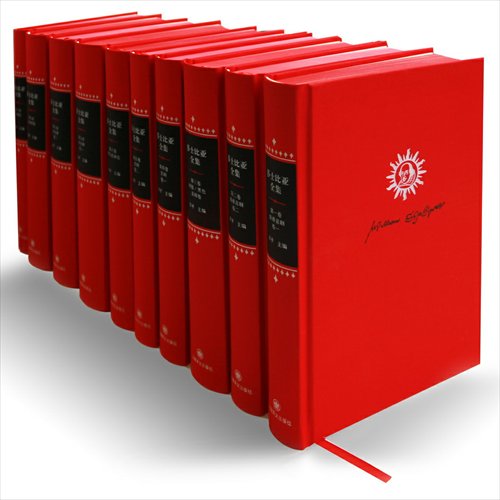
Ten volumes covering 39 works have been published to celebrate the 450th anniversary of the birth of Shakespeare. Photos: Courtesy of Shanghai Translation Publishing House
He explained further that giving an exact reply first - mingtian (tomorrow) - and then dragging a long tail behind - ta dasuan (as he purposes) - convey's Macbeth's implication that while the king plans to leave tomorrow, whether he can or not depends on whether Macbeth and his wife go through with their plan of regicide.
This is an example of the pains Fang took to preserve in his translations what he saw as the unique beauty of the blank verse of Shakespeare's works. From 1993 until his death in 2008, Fang, along with eight others, translated all of Shakespeare's works, with maintaining the blank verse a priority.
Now these translations have been collected together in 10 volumes covering 39 works to celebrate the 450th anniversary of the birth of Shakespeare on April 23.
"This collection is the first Chinese blank verse version of the complete works of Shakespeare in China," said Feng Tao, the editor in charge of the volumes at publisher Shanghai Translation Publishing House (STPH).
According to Feng, there are four other collections of Shakespeare in Chinese by other publishing companies, produced between 1957 and 1998.
"However, most of them were based on the translations by Zhu Shenghao, and all were modern Chinese prose rather than blank verse," Feng said.
Tan Zheng, head of the Institution of Foreign Literature Research of Fudan University, said that 70 percent of Shakespeare's work is in blank verse, 25 percent prose, and the remaining 5 percent is verse in rhyme.
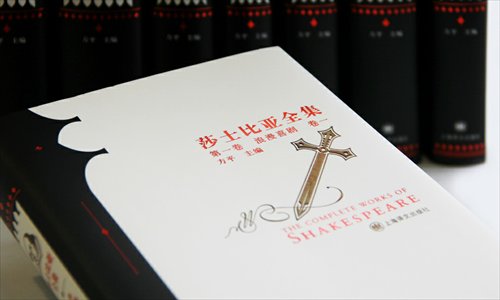
Ten volumes covering 39 works have been published to celebrate the 450th anniversary of the birth of Shakespeare. Photos: Courtesy of Shanghai Translation Publishing House
"In the time of Shakespeare, blank verse was the most popular literary language. Most plays at that time were written in blank verse. Therefore, for Shakespeare's works, maintaining blank verse in translation will help preserve the cultural essence of those original works."
Tan's opinion is also echoed by Wu Hong, deputy editor-in-chief of STPH. He said that Shakespeare was more concerned about the performance of his plays than the publishing.
Tan and Wu also agree over the huge difficulty of the task that Fang and his team accomplished.
"In most of Shakespeare's works, the meter most commonly used with blank verse is unrhymed iambic pentameter," said Tan. "This meter consists of individual lines that are each made up of five feet and each foot is made up of two syllables, through the use of stress, one unstressed and the other stressed. However, most traditional Chinese poems contain Chinese characters with odd numbers in each line. And through the use of tonal pattern, those characters alternate with each other between a level tone and an oblique tone. It is almost impossible to reach an exact equal effect in structure."
In an article he wrote about his blank verse translation, Fang said that in order to be as close to the original form as possible, he had to break the traditional structure of Chinese poetry and be flexible.
Wang Yiqun, another Chinese translator who was part of Fang's translation project, admits there are things that simply cannot be translated into Chinese from the original.
He took The Merchant of Venice as an example. Wang said that, in that work, Shakespeare alternates between two places, Venice and Belmont.
"Shakespeare uses different language in each of the two places to highlight their differences," Wang said. "The language used in Venice is very aggressive. However, in Belmont, Shakespeare used many words with long syllables to show the gentle and peaceful speaking manner of the characters. It is really difficult to do this in translation. All I can say is we did our best."