Troubled water
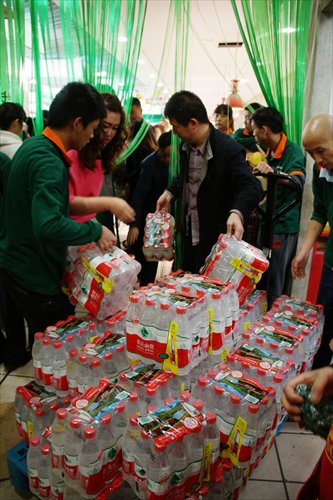
Customers buy bottled water in Lanzhou, capital of Northwest China's Gansu Province on April 11. Photo: CFP
When Li Xia, a Lanzhou resident, took her 5-year-old son to his kindergarten on April 14, she was surprised to find that less than half of the children had showed up.
"The kids all had a bottle of mineral water in their hands," Li told the Global Times. "Most of the parents decided not to take their children to school, fearing that they might drink tap water."
On April 11, the city government of Lanzhou, capital of Northwest China's Gansu Province, warned residents not to drink tap water for the next 24 hours, after an excessive amount of a carcinogenic chemical was found in the city's water supply.
The water in urban Lanzhou is processed and supplied by Lanzhou Veolia Water Co, a seven-year-old joint venture between the local government and France-based multinational Veolia Environnement SA.
Veolia has been under fire ever since, and Li said "the company is no longer trustworthy."
Residents and media outlets have questioned the wisdom of allowing foreign companies such as Veolia to invest in utilities in China. Some even argued that these firms have forced up water prices and pressured local governments to purchase expensive overseas-made facilities.
Coming to China
Foreign companies first entered China's water supply market in the 1990s, with Veolia, Thames Water Utilities Ltd and Compagnie Générale des Eaux among the first movers.
Dai Xingyi, an environmental science and engineering professor at Fudan University, told the Global Times on April 27 that foreign utility firms purchased entire waterworks in the early stages of their time in China.
But they later started forming joint ventures with local governments and companies in the early 2000s, as they found it highly difficult to adapt to the local business environment on their own, Dai said.
Veolia made its first investment in China in 1997, when it signed a 20-year contract with Tianjin Water Works (Group) Co to process waste water. A year later, Veolia and Japan's Marubeni Corp signed a contract with the government of Chengdu, capital of Southwest China's Sichuan Province, to process and supply tap water in the city.
China's State Council in 2012 released a circular supporting the injection of private and foreign investment in the municipal utilities sector. That motivated more overseas water supply firms to enter China.
Foreign companies have invested in around 10 percent of China's water supply and processing plants, Fu Tao, a professor at the School of Environment at Tsinghua University, was quoted as saying in an article posted on April 14 by Shenzhen-based China Market Report Center on its website.
Currently, Veolia's joint venture plants supply tap water in eight cities, including Shenzhen and Shanghai.
High premiums
Foreign companies have been seen to be paying high premiums when buying stakes in local waterworks.
In 2002, Veolia bought a 50 percent stake in Shanghai Pudong district's water supplier for 1.52 billion yuan ($242.88 million), which was 50 percent higher than the supplier's estimated value, according to a report published by Oriental Outlook Weekly magazine on April 24. And in 2007, the company bought a 45 percent stake in the government-owned tap water provider in Lanzhou for 1.71 billion yuan, while two rival bidders had offered 450 million yuan and 280 million yuan.
The high premiums raised suspicions about how the companies go about getting their money back.
Some market watchers and consumers have claimed that the firms recover the costs by raising water prices and forcing local governments to purchase expensive facilities from overseas companies.
A source from Veolia told the Global Times on condition of anonymity that the price in Lanzhou was raised only once after the deal was sealed.
"The high premium was not directly linked with the water price hike in Lanzhou," the source said. "Veolia does not have the right to push up water prices. They were raised by the government, as the cost of supplying tap water has soared and consumers demand water of higher quality."
National Business Daily newspaper on April 22 cited a former official at Lanzhou's price bureau, who said the city's water price was raised only once from 2.25 yuan a ton to 2.55 yuan a ton in 2009.
However, Sanlian Life Weekly magazine said in a report in its May 1 issue that Lanzhou's water price has been raised three times since Veolia's investment, without mentioning the time or the amount of the price hikes.
Dai said foreign companies are not likely to force the government to raise water prices, but they might use more subtle ways such as renegotiating the contracts and pushing the authorities to buy extra facilities.
"The companies could require an expansion of the waterworks and sell processing equipment to local governments at unfairly high prices," Dai said. "And they could renegotiate with the authorities to get more beneficial terms."
According to the report by Oriental Outlook Weekly, Veolia asked a company to design an expanded plant in Pudong for a price of 42 million yuan, much higher than the price charged by other companies. Also, the firm bought 17 million euros ($23.58 million) of facilities from various companies, despite the Shanghai government's suggestion of holding an auction, the magazine reported.
However, the Veolia source told the Global Times that the company never forced the local government to buy imported facilities at unusually high prices.
Foreign firms welcome
Despite the potential risks, foreign capital should be welcomed in developing China's utilities market, the China Environment Chamber of Commerce said in a statement sent to the Global Times on April 27.
"The foreign companies brought capital, technology, management expertise and new business models to China, and have facilitated the development of the country's water supply market," the statement said. "There is no link between Lanzhou's contamination case and the fact that the water is supplied by a company partly owned by a foreign firm."
Dai agreed, adding that local governments should learn to be more sophisticated when negotiating deals with foreign companies.
"Now, the Chinese negotiators are not well-trained. So when they are negotiating with seasoned foreign counterparts, the Chinese side may be at a disadvantage," he said.
Fu from Tsinghua said foreign companies' investments have slowed in recent years.
"The Lanzhou case will not hurt the prospects for foreign investment in utilities in China," Dai said.
"Foreign companies should be allowed into China to push for the marketization of the water supply industry, as long as the contract terms are fair."