HOME >> ARTS
60 years of New China
By Lu Qianwen Source:Global Times Published: 2014-5-6 20:48:01
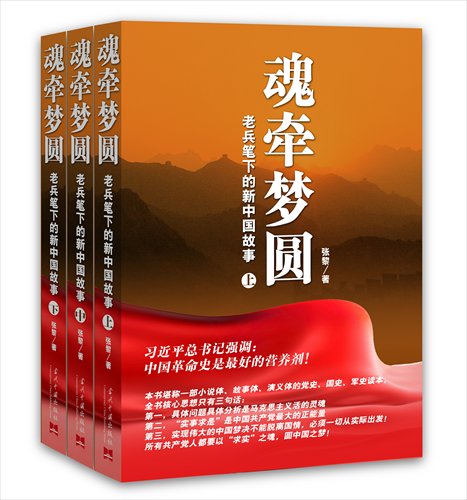
Following the Soul to Realize the Chinese Dream: A Story of New China from the Pen of an Old Soldier Photo: Courtesy of Contemporary China Publishing House
Over the past 60 years quite a few books, both positive and negative, have been written about modern China. However, when a fictional novel spanning this period written by a retired Chinese general comes along, that's a rare thing. This may be the reason that despite being published several months ago, Following the Soul to Realize the Chinese Dream: A Story of New China from the Pen of an Old Soldier is still highly talked about by readers interested in China's modern history and current social climate.
Through the eyes of a soldier
Written by retired People's Liberation Army General Zhang Li, the three-volume work took the 71-year-old soldier a whole year to sketch out a story line connecting the nation's 60 years of history and another year to complete writing it.
Born in 1943 in a poor village in Shandong Province, Zhang lived through many of the profound changes the country experienced since its founding in 1949. After working at machinery and paper-making factories in Shandong during the Great Leap Forward between 1958 and 1961, he joined the army in 1964. From that point on he was transferred to different military areas across the country up until his retirement in 2009, after which he became a member of the Chinese People's Political Consultative Conference. During this period he conducted extensive research into social and economic development in different parts of the country.
Zhang's rich life experience enabled him to produce this massive work, which offers his observations on the country's achievements, mistakes, problems and prospects over the past 60 years from a balanced perspective.
"When I visited foreign countries, there were always people whose impression of people's lives in China were very negative; always talking about famines, the drawbacks of a one-party system, corruption and the predicament of migrant workers," said Zhang in an interview with Global Times. "They made it seem like we're still living in a backward age."
"When asked where their impressions had come from, they told me that it was mainly from TV and works of literature," he added. "In fact, it isn't just foreigners, some of our own people are also unclear about our history and current social progress," said Zhang.
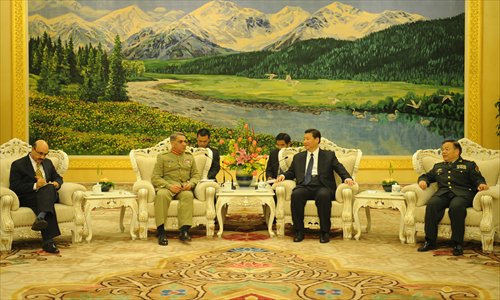
Zhang Li (R) and then Vice-president Xi Jinping (2nd from right) sit down with then Pakistan Chairman of the Joint Chiefs of Staff Committee General Tariq Majid (third from right) in 2008. Photo: Courtesy of Zhang Li
A controversial 30 years
Spanning an over 60-year period, the novel follows the lives of three boys from the fictional village of Guzhou from their time at school through their military careers, and then on to joining the Communist Party of China, getting married and starting a new career as civilians. By following the boys through their lives, significant events including the Anti-Rightist Movement of 1957, the Great Leap Forward, the later decade-long Cultural Revolution that began in 1966 and finally the opening-up of the late 1970s are depicted in great detail.
As one of the three boys, Jiezhou, is based on Zhang himself, many of the stories in the book are actually derived from his personal experiences.
The nearly 30 years between 1949-78 is a relatively sensitive period to approach for literary works since it involved numerous political movements that are still controversial even today. Works that do touch upon this time period, such as works belonging to the Scar Literature movement, usually only reflect one side of the story.
Scar Literature, which prevailed during the late 1970s and early 1980s in the Chinese mainland, mainly focuses on the harm inflicted on people by the Cultural Revolution.
It's difficult and rare for any author who has personally lived through these times of upheaval to take a step back and examine the causes and effects of these political movements from an objective standpoint. However, this is where Zhang feels he has succeeded, "I gave the book to those who had been labeled as rightists and also those who labeled others as rightists during the Anti-Rightist Movement, they both felt it was real and objective," said Zhang, adding that "Scar Literature is much too extreme."
In the book, the author compares the Anti-Rightist Movement in China with the McCarthyism prevalent in the US in the 1950s. He feels it unfair that although both occurred during the same period and involved the labeling and purging of innocent people, the former has long been the focus of global discussion while the latter has been neglected by many, be it in academic studies or literature.
In the novel, this comparison is delicately made through the chance encounter of victims of both movements. Liu Hanqing, a local government official in the novel, is labeled as a rightist during the Anti-Rightist Movement. After he is sent to a village to herd sheep as punishment, he meets his old schoolmate Yao Zifang, a victim of McCarthyism that had been forced out of the US.
Looking back on this political movement that affected the fate of an entire group of people in China, the writer affirms the original intentions behind the movement while also pointing out how the movement went overboard. According to the book, inertia inherited from the earlier period of class conflict, during which time leaders were highly sensitive to hostile forces, was one of the main causes that led to things getting out of hand.
"The 30 years prior to 1978 was an arduous process of exploration for the country; we achieved much, but also made mistakes," said Zhang.
Realizing the 'Chinese Dream'
After delving into the country's weighty first 30 years, the book continues its intensive study into the nation's most recent 30 years by placing direct focus on the most controversial and urgent issues facing China today, including corruption, air pollution and an aging population.
Different from many books that merely reflect social problems, the author attempts to offer solutions to the many issues it touches upon. For example, to cope with an aging society, the author suggests a multi-pronged strategy that establishes pension funds on one hand, while building and promoting residential communities for the elderly on the other.
Since Chinese President Xi Jinping proposed the concept of the "Chinese Dream" in late 2012, it has become a cohesive social glue strongly influencing Chinese from all walks of life. While individuals may have their own various interpretations of this concept, ensuring the welfare of each individual is a broader dream shared by all.
To realize this dream, the book also proposes a solution: staying true to the "soul" of China. This "soul" refers to a famous remark by Chairman Mao: Seeking truth from the facts, and concretely analyzing concrete problems are the living soul of Marxism. "That's also where the book's name comes from," explained Zhang.
"We need to adopt a matter-of-fact attitude when reviewing our achievements and problems. Despite shortcomings and defects, China as a whole has flourished," Zhang stressed.
Posted in: Books