Surround the world
If you fancy an exotic break between now and May 29, but can't get the time off work, then an ongoing exhibition at Chronus Art Center (CAC) on 50 Moganshan Road may be just the ticket.
Without needing to worry about visas or flight bookings, you can find yourself exploring Hampi in India, home to the World Heritage Site Vijayanagara, or the German city Ruhr, a former significant industrial area that has become a cultural hub.
These flights of fancy are achieved by donning a pair of 3D glasses and walking into the immersive space created by artist Sarah Kenderdine and Jeffrey Shaw, which consists of a 360 degree screen wrapped around a floorspace of 9 meters in diameter.
On the screen appear a number of cylinders, with different scenes from either Hampi or Ruhr on their surfaces. Using an iPad to control their movement, visitors choose the cylinder that most interests them. On reaching it, the scene on its surface will expand to surround them. They can then use the iPad to explore this 3D world.
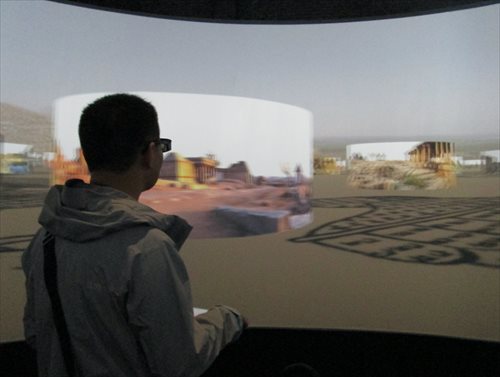
A visitor wearing 3D glasses explores the immersive Place-Hampi with an iPad at Chronus Art Center (CAC). Photo: Sun Shuangjie/GT
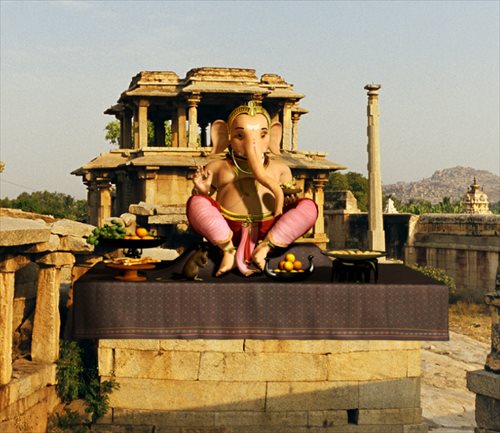
An animated holy elephant inserted in a panoramic photograph of Place-Hampi;
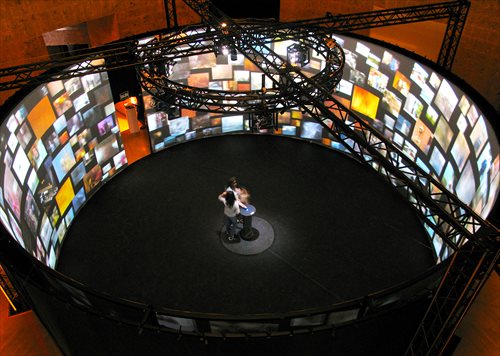
a bird's-eye view of the AVIE work T_Visionarium Photos: Courtesy of CAC
If you choose to look around at Hampi, you may encounter an animated Indian dancer performing a traditional dance amid relics of historical architecture; a stone statue of a seated elephant among majestic temples, who will wink at you with a kindly smile; locals of all ages bathed in the sun; and laborers busy working on a construction while cheering to raise their morale. All the scenes were captured in panoramic photographs by a high-resolution 360 degree stereoscopic camera in 2004, while the sound of each spot was recorded at the same time as shooting. The images were then manipulated to produce the animated effects.
Meanwhile, the Ruhr scenes employ similar techniques, although these were created using short panoramic films, rather than photos, made in 2000.
Artistically conceived AVIE
The two works, Kenderdine's Place-Hampi and Shaw's Place-Ruhr, would not be possible without Shaw's Advanced Visualisation and Interaction Environment (AVIE), which began life in the mid-1990s and finally achieved maturity in 2004.
Born in Australia in 1944, Shaw has been a pioneering figure in the field of new media art since the 1960s, when he diverted his focus from painting to film, theater and art installations, and experimented in audience interaction.
The AVIE system's basic configuration is a cylindrical silver projection screen 4 meters high and 10 meters in diameter, over which a set of 12 high-resolution digital video projectors together project two 1,000 x 8,000 pixel polarized stereoscopic images.
In the following six months, CAC will showcase projects produced using AVIE by a number of other artists. For instance, in T_Visionarium, which will be showcased in June, visitors will see on the screen 30,000 different video clips from broadcast TV, which will be played in accordance to the request of each visitor, and which can be combined with each other to make new stories.
Shaw told the Global Times after a seminar at CAC Saturday that he would like to compare the AVIE system to a medium like cinema, through which people can tell different stories and make new kinds of experiences for audience.
The seminar was hosted by Hans-Georg Knoop, senior strategic adviser at Shanghai Theatre Academy and former president of European Union National Institutes for Culture (EUNIC).
The seminar featured Shaw and Kenderdine as key speakers addressing the topic of how media art practices help conserve cultural heritage and make them accessible to the public.
Cultural continuity
Kenderdine, professor of the College of Fine Arts at the University of New South Wales, summarized the function of AVIE into four aspects: embodiment of space, augmenting the object, cultural data sculpting and transforming the intangible.
With AVIE, audiences in Washington DC were able to "visit" the Mogao Grottoes in Gansu Province in 2012. Last August, Hong Kong Maritime Museum presented the Qing Dynasty (1644-1911) scroll painting Pacifying the South China Sea as a 360 degree interactive image. Museum Victoria in Melbourne transformed archives of millions of artworks into visualized data in AVIE. There are also plans to use AVIE to record some of China's intangible cultural heritage, such as the South China Kung Fu Archive and traditional Chinese operas.
Shaw said that the AVIE system can sometimes provide more knowledge to audiences than visiting the real-life version of the thing it's depicting. For instance, artists can add interviews and background data.
Kate Hennessy, an assistant professor at Simon Fraser University's School of Interactive Arts and Technology who has worked on visual and media anthropology projects in Canada and Thailand, argued in her paper The Intangible and the Digital in 2013 that "digital heritage initiatives can support decision-making about the circulation - or restriction - of heritage while drawing attention to the complexities of safeguarding in the digital age."
"There is no way we are going to stop this rush to digital, because simply it's just so enjoyable and also meaningful," said Shaw. "Of course, the museums of great collections will always survive, but all the new museums will have to imagine a digital strategy for the future."
So far, AVIE has been installed in a number of museums and educational institutes around the world, among which are Museum Victoria in Melbourne, ZKM Center for Art and Media Karlsruhe in Germany, City University of Hong Kong and Rensselaer Polytechnic University in New York.
Newspaper headline: Art installation takes visitors on immersive 3D journey